
Sharaa’s Doha speech unveiled a comprehensive blueprint for a new, institutionalized, socially reconciled, economically recovering Syria that seeks balanced regional relations, redefined ties with Israel, inclusive national identity—including Kurds and women—and a confident transition into global diplomacy.
Ahmed Sharaa’s Doha speech serves as a manifesto for the New Syria, outlining a transition toward institutional governance, social normalization, economic recovery, and an inclusive national identity. He presented data-driven achievements, firmly addressed Israeli aggression, reframed women’s rights through pragmatic governance rather than ideology, and interpreted the revolution as the culmination of 14 years of social buildup. His remarks signaled new diplomatic equilibria involving the United States, Gulf states, Europe, and Türkiye, while emphasizing national unity with Kurds and the psychological shift from a nation of fear to one of confidence and return. Altogether, the speech positions Sharaa as a quiet but determined architect of Syria’s next era.
Syrian Interim President Ahmed Sharaa, who entered the Doha Forum through the audience door and received a standing ovation for minutes, did not just give a speech; he transformed Syria’s post-revolutionary course into a “new era manifesto” that the international community is watching with interest. The key point of the speech was that Syria will hold elections in four years. But this wasn’t simply a timeline announcement; it was a strategic message at the heart of Sharaa’s vision of a “new state model based on institutions, not individuals.” The following lines are the full framework of this big picture explained by Shara, analyzed in journalistic style.
Sharaa, in his speech, presented a three-dimensional state architecture: institutionalization, social normalization, and state capacity reconstruction. This framework positions him as a “technocrat redesigning the state” rather than a classic transitional leader. Institutionalization is Shara’s clearest emphasis: temporary constitutional arrangement, five-year limited and auditable transition authority, merit-based representation, and People’s Assembly elections. This new model, opposed to the old regime’s cadre dynamics, heralds an era in which Syrian politics will be organized not based on “belonging” but on “competence.” Social normalization involves repairing the deep fault lines opened by the war. Shara’s agenda includes security and property guarantees that enable the return of millions, dialogue committees to reduce sectarian polarization, and legal regulations that will ensure the empowerment of women in public life. Rebuilding state capacity was reinforced with figures. The increase in electricity supply from 1.5 hours per day to 12–14 hours was presented as an indication that infrastructure teams were able to organize quickly. Within the scope of economic recovery, topics such as the fight against inflation, normalization of money transfers, and the resumption of production came to the fore. Yet above all this stands one truth: economic recovery is impossible without the lifting of the Caesar sanctions. Shara openly stated that an “active diplomatic process” is underway with the US and regional countries.
The harshest part of the speech was directed at Israel. Shara outlined Israel’s new security threat to Syria by sharing data on “over a thousand airstrikes and hundreds of land violations” since December 8, 2024. Israel’s question regarding the “weapon-free zone” it demands is critical: “If there is no army and security forces, who will protect this area?” This sentence summarizes why negotiations stalled. While Sharaa emphasized adherence to the 1974 Agreement, he also hardened his tone by describing Israel as a “crisis exporter.” During the Assad era, Israel had the “comfort of a predictable enemy.” Now it faces an uncertain actor whose legitimacy increased after the revolution, rapidly recovering infrastructure, and accelerating returns. Therefore, the increase in Israeli aggression is not surprising.
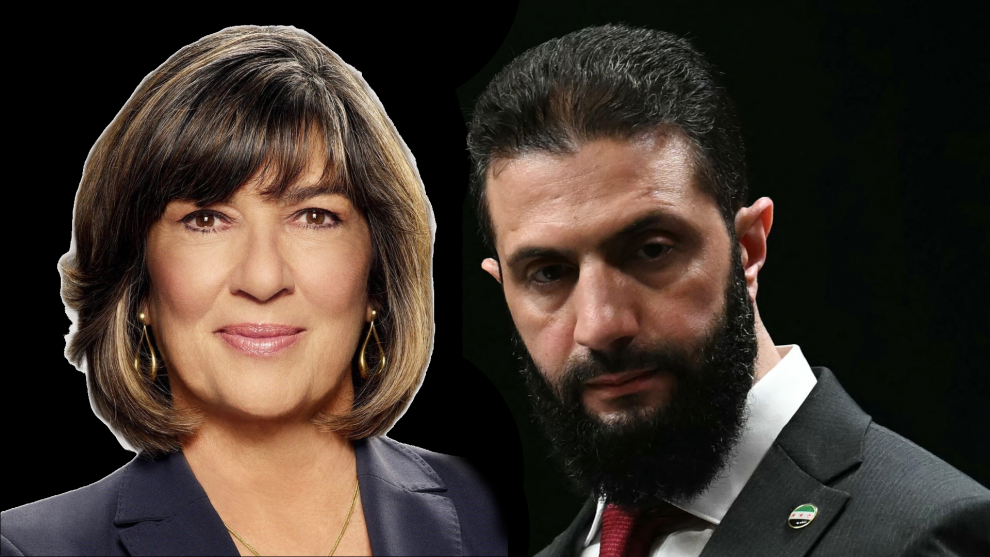
Christian Amanpour’s question — “Does Islamism restrict women’s rights?” — was perhaps Shara’s most subtle test. His answer relied on numbers and humor. Two-thirds of the 26,000 university students in Idlib are women. Women are active in both the public and private sectors. And the sentence that drew laughter: “Don’t worry about the women in Syria. We’re worried about the Syrian men.” This answer showed Shara’s confidence and his grasp of social realities. It challenged the long-held Western assumption that “Islamism = anti-women.”
Shara rejects the view that the revolution was an “11-day operation.” Those 11 days are only the final act of 14 years of social accumulation — not a sudden uprising but an inevitable transformation after prolonged deterioration. The roots of the revolution lie in 14 years of economic collapse, systematic corruption, erosion of state capacity, and insecurity. Shara therefore defines the revolution as a “social necessity.” Years of clashes between HTS and other groups were replaced by institutional dialogue, power sharing, unified command, and awareness of common goals — an invisible engineering that made the revolution “low-cost and high-speed.” Shara presents himself not as a coup leader or war commander, but as the “designer of internal peace.”
The most striking sentence of the Doha speech was: “Within a year, an armed revolution took place, but not a single Syrian citizen was forced to leave their homes.” This message targeted international concerns over a “new migration wave.” Shara also announced that one million Syrians had returned, primarily from Türkiye, describing Syria’s emergence as a “center of attraction” after the revolution. This return influences Türkiye–Damascus relations, offers hope to Europe, and reshapes demographics in Kurdish regions.
On sanctions, Shara stated that lifting the Caesar sanctions is essential for recovery. Trump’s expression of support signals the US reopening diplomatic space for Syria. Once sanctions lift, European funds, Gulf capital, and trade routes with Türkiye will connect, potentially making Syria the largest investment zone in the post-war Middle East. Shara is now a figure on global diplomatic agendas.
Regarding Kurds, Shara’s message was: “The Kurds have a special place in our hearts. We will unite as soon as possible.” This is not a federation signal, but a national-unity model based on equal citizenship. Shara separates the PKK/YPG file (to be handled with Türkiye) from the rights of Syrian Kurds (to be addressed internally), forming a balanced approach that reassures both sides.
At the Doha Forum — with 6,000 participants and 471 speakers — Shara was the standout figure. His minute-long ovation reflected international curiosity and recognition of the new Syria. His presence, alongside Türkiye’s diplomatic representation, demonstrated a new political architecture emerging among Türkiye, Qatar, and Syria.
Decoding Sharaa’s Doha speech means reading the political DNA of the new Syria: an institutionalized state model, social peace, the strong role of women, economic recovery, inclusive national identity, independent foreign policy, controlled but principled negotiations with Israel, and leadership that centers on the state, not the revolution. Ahmed Sharaa is not just a transitional president; he is a low-profile but highly influential leader attempting to rewrite Syria’s fate.
The Israeli file was the sharpest section of his speech: over a thousand airstrikes and hundreds of violations since December 2024. Militarily, these strikes constitute a strategy of attrition targeting Syria’s air defense; politically, they aim to portray the new administration as weak; symbolically, they challenge the independence of the new era. Shara interprets them as a regional intervention attempt. Israel’s “demilitarized zone” demand triggered his critical question: “If there is no army, who will protect this area?” For Shara, the demand challenges sovereignty, applicability, and negotiation logic. Referencing the 1974 Agreement signals compliance with international law while pointing to Israel as the destabilizer.
Calling Israel a “crisis exporting actor” was one of the harshest lines. During the Assad era, Israel was a manageable “credible enemy.” Now, Syria is becoming unpredictable, institutionally stronger, and internationally legitimate — a regional power center rather than a controllable vacuum. Shara implies that Israel’s increasing aggression is driven by its desire to halt Syria’s rise.
On women and Islamism, Shara used Idlib — widely seen as an Islamist laboratory — to demonstrate that two-thirds of university students are women and that women are indispensable in public and private sectors. His humor revealed confidence, dismantled Western stereotypes, and reframed the issue as one of state capacity, not ideology. New Syria is neither Islamist nor ideological; it is community-based, rational, and confident. Women’s education and employment are treated as economic and institutional necessities.
On the revolution’s “14 years + 11 days,” Shara emphasized that the real engine was long-term social collapse and that the revolution’s speed came from deliberate efforts to prevent internal conflict. He positions himself as the architect of peace. On fear vs. confidence, he noted the absence of forced displacement, revenge attacks, or security vacuums, making Syria a country people return to rather than flee. One million returns reshape regional politics.
On Trump, sanctions, and balance, Shara points to US pragmatism and new movement across Gulf-Europe-Türkiye. On the Kurdish issue, he emphasizes unity, equal citizenship, and a two-track policy. On the Doha Forum, he asserts that Syria has returned as a central file in global diplomacy.
Ultimately, Shara’s speech outlines a new Syria built on institutions, social peace, economic revitalization, inclusive national identity, balanced foreign policy, and leadership centered on state-building. He emerges as a capable leader guiding Syria away from what could have become a century-long rupture.
Syria’s Transition Algorithm
Ahmet Shara’s Points
What follows is the full analytical framework of Sharaa’s major messages.
1. A Transitional Leader and a Reconstructed State
In Doha, Sharaa outlined a three-layered model for state redesign:
institutionalization, social normalization, and rebuilding state capacity.
Rather than acting like a typical transitional leader, he positioned himself as a technocrat reconstructing the state.
Institutionalization — Sharaa’s strongest emphasis:
- a temporary constitutional order
- a five-year audited transition authority
- merit-based representation
- elections for the People’s Assembly
This framework, in contrast to the old regime’s cadre politics, heralds a phase in which competence—not identity—structures Syrian governance.
Social normalization aims to repair the deep fractures left by war:
- security and property guarantees for returnees
- dialogue committees to reduce sectarian polarization
- legal reforms empowering women in public life
Rebuilding state capacity was demonstrated with data:
Electricity supply increased from 1.5 hours to 12–14 hours daily, signaling rapid administrative recovery.
Economic normalization drew focus:
- fighting inflation
- stabilizing money transfers
- restarting production
Yet Sharaa noted one overriding reality:
economic recovery is impossible without lifting the Caesar sanctions.
He added that an “active diplomatic process” with the US and regional actors is underway.
2. Israel: A Crisis-Importing, Crisis-Exporting Actor
The sharpest section of the speech targeted Israel. Sharaa revealed data showing over a thousand airstrikes and hundreds of ground violations since December 8, 2024.
The core of the dispute centers on Israel’s demand for a “weapon-free zone.”
Sharaa’s critical question:
“If there is no army or security force, who will protect this area?”
This single sentence explains why negotiations are frozen.
He maintained balance by affirming adherence to the 1974 Agreement, yet hardened his tone by labeling Israel a “crisis-exporting power.”
During the Assad era, Israel enjoyed the “comfort of a predictable enemy.”
Now it faces a Syria that is:
- uncertain
- increasingly legitimate
- rapidly rebuilding
- accelerating the return of its population
Thus, Sharaa argues, rising Israeli aggression is no surprise.
3. Women, Islamism, and the Confidence of the New Syria
Christian Amanpour’s question—“Does Islamism restrict women’s rights?”—was Sharaa’s most sensitive test.
His answer rested on both statistics and wit:
- Two-thirds of Idlib’s 26,000 university students are women.
- Women are active in the public and private sectors.
His humorous remark drew laughter:
“Don’t worry about the women of Syria. We’re worried about the Syrian men.”
Sharaa dismantled the Western assumption that
“Islamism = anti-women”
by grounding his response in sociological realities—not ideology.
He framed the new Syria as:
- community-based,
- data-driven,
- pragmatic,
not an ideological project.
Women’s participation is treated as:
- an economic necessity,
- a stability requirement,
- and a central component of state-building.
4. Anatomy of the Revolution: 14 Years + 11 Days
Sharaa rejects the idea that the revolution lasted only “11 days.”
Those 11 days were the final expression of 14 years of accumulated tension—a long-brewing transformation, not a spontaneous revolt.
Why this matters:
- Deep structural roots
For 14 years, Syrians endured:
- economic collapse
- systemic corruption
- declining state capacity
- insecurity
Thus the revolution was, in Sharaa’s framing, a “social necessity.”
- Conflict-prevention engineering
Years of HTS–other faction clashes were replaced by:
- institutionalized dialogue
- power-sharing
- unified command mechanisms
- shared objectives
This internal engineering ensured a “low-cost, high-speed” revolution.
- Sharaa as the architect of peace
He presents himself:
- not as a coup leader
- not as a war commander
but as the “designer of internal peace.”
5. From Fear to Confidence: The Psychology of the New Syria
Most striking sentence:
“In one year, an armed revolution occurred, yet not a single Syrian citizen was forced to leave their home.”
This targeted regional fears of a new migration wave.
Key outcomes:
- No revenge attacks
- No mass displacement
- No security vacuum
One million Syrians—mostly from Türkiye—have already returned, reshaping the regional landscape, including Kurdish areas.
Syria, Sharaa argues, is now a country of return, not departure.
6. Trump, Sanctions, and the New Global Balance
Sharaa confirmed he received explicit Trump support for lifting Caesar sanctions.
This signals:
- A pragmatic US–Syria engagement
- Reopening the Gulf–Europe–Türkiye corridor
Once sanctions lift:- European funds
- Gulf capital
- Turkish trade arteries
will connect.
Syria could become the largest post-war investment zone in the Middle East.
Sharaa is now part of global dossiers, not merely regional ones.
7. Kurds: “They Have a High Place in Our Minds”
His short but powerful reply to Rudaw:
“Kurds have a special place in our hearts.”
This signals:
- a national—not ethnic—approach
- not federation, but equal citizenship
- a dual-track policy:
- PKK/YPG → Security coordination with Türkiye
- Kurdish social rights → Domestic Syrian mechanism
8. The Big Picture in the Shadow of Doha
The Doha Forum showed one thing clearly:
the Syrian file is back—this time in a leading role.
Sharaa’s standing ovation reflected:
- curiosity
- surprise
- recognition of new legitimacy
A new architecture is forming across the Türkiye–Qatar–Syria triangle.
Conclusion: The Codes of the New Syria
Sharaa’s speech outlined the political DNA of the New Syria:
- an institutional state
- social peace
- economic reconstruction
- an inclusive national identity
- balanced foreign policy
- controlled but principled negotiations with Israel
- leadership centered on state-building, not revolutionary mythology
Sharaa emerges as a quiet but capable leader—one attempting to redirect Syria from a century-long rupture toward a new beginning.