
The International Crisis Group—a think tank comprising former prime ministers, ministers, ambassadors, and business leaders from 23 countries (and one that, as far as I have observed, has managed to remain impartial)—states the following in its report titled “EU and Turkey: Uniting on Defense?”:
“Russia’s full-scale invasion of Ukraine and growing uncertainty regarding U.S. support have significantly influenced Turkey’s perspective on the European Union’s defense.”
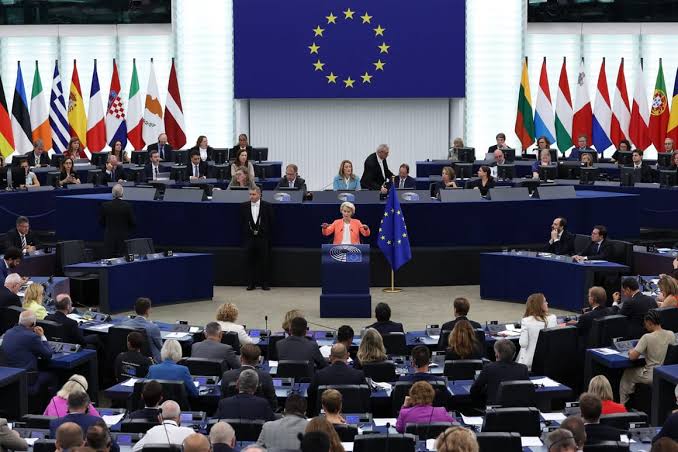
On the cover of the report is a photograph—taken three years ago at a summit in Lithuania—showing European Commission President Ursula von der Leyen shaking hands with President Recep Tayyip Erdoğan, both of them smiling. This stands in stark contrast to the fact that, just three days earlier, von der Leyen had expressed intense indignation over a memorandum of understanding between Turkey and Libya concerning maritime jurisdiction and territorial waters.The report focuses primarily on the perspectives of EU member states that are not part of NATO, specifically regarding “the necessity of countering Russian influence and supporting Ukraine.” Judging by the sources and statements cited in the report, many Europeans are consumed by the fear that, once its invasion of Ukraine is complete (!), Russia will proceed to invade the rest of Europe—passing through Poland and Germany. Russian leader Vladimir Putin is, of course, aware of these concerns; yet, perhaps adopting the attitude that “the wicked deserve their torment,” he offers no reassurances to quell these fears. Kremlin spokespersons—Dmitry Peskov included—have even suggested that Europeans might as well add “playing cards” to the lists of items they request when calling for urgent food and humanitarian aid!
The primary factor fueling the fear among Europeans—whom the Russian media mockingly portrays as “fragile people easily gripped by panic”—is the stance taken by their own governments, which frame Russia as an existential threat to Europe. Indeed, this perspective is also noted in the report by the International Crisis Group. The report points out that Turkey views the situation involving Russia—including matters concerning its own national interests and, for instance, the preservation of Ukraine’s territorial integrity—as an “international issue that must be managed.” With this point noted, let us turn to the second report.This is a report by the European Commission assessing the progress made by Turkey—which has applied for full membership in the European Union—in its accession negotiations. Evaluating Turkey’s progress or regression over the past year across more than 20 policy chapters, the team concludes that “the gap between Turkey’s goal of EU membership and the regression in political criteria is widening.” The report notes that accession negotiations, which have been at a standstill since 2018, remain deadlocked due to the failure to resolve underlying structural and political issues.
The report urges Turkey to take immediate action, including “abandoning contested maritime claims in the Aegean and the Eastern Mediterranean, ceasing to obstruct the Greece-Cyprus electricity interconnection project, and accepting a two-state solution for Cyprus.” Furthermore, the Commission states that it considers the maritime boundary delimitation agreement between Turkey and Libya to be invalid.
You may have seen reports indicating that the Turkish Ministry of Foreign Affairs has rejected the document, characterizing the Commission’s stance as “biased and unfair” and accusing it of applying double standards regarding fundamental rights and regional disputes.Does the European Commission—which effectively accuses Turkey of piracy in the Mediterranean—not realize the dangers it might face if it fails to find a way to work with Turkey in the face of the dire threat posed by Russian aggression? I am not suggesting that the “recommendations for improvement” outlined in the Commission’s report—comprising some twenty-odd points—should be ignored; indeed, the report contains significant observations. With November 15—PEN International’s Day of the Imprisoned Writer—approaching, we can expect another statement highlighting that Turkey holds the highest number of imprisoned writers and journalists, with references made back to this report—leaving us, once again, to hang our heads in shame.
What I wish to point out is the hypocritical approach the EU takes toward Turkey’s interests in the international arena—a contradiction that brings to mind the Turkish expression: “Crunching away happily while eating the cabbage, but bleating like a sheep the moment you reach the stalk!”
Source: https://www.milliyet.com.tr/yazarlar/hakki-ocal/avrupanin-kuyrugu-tam-sikismamis-gibi-7697033