
By Dr. Sibel Bülbül Pehlivan
Today, states’ strategic goals of sustainable development, economic diversification, and positioning themselves in global competition are being realized through “mega projects” that go beyond traditional urbanization and infrastructure investments. Mega projects are not limited to large-scale construction and infrastructure investments; they have also become an important vehicle for social and economic transformation, international investment and technological integration, and geopolitical moves related to both regional and global power balances. While these projects offer host countries the opportunity to break free from their current resource dependency, create jobs, transfer technology, and build new economic ecosystems, they also bring financial, social, and environmental risks. In this context, mega projects that aim to build a “new future,” especially for economies dependent on fossil fuels, are of critical importance.
What is NEOM for Saudi Arabia? Why is it important?
In recent years, Saudi Arabia has demonstrated a clear stance toward transforming its political, economic, and social positioning at both the regional and global levels. The Kingdom no longer wishes to be defined by its traditional image as a country that relies solely on oil revenues, directing these revenues toward security and defense spending, and characterized by strict social regulations, prohibitions, and conservative domestic policies. Instead, it aims to position itself as a more innovative and multifaceted actor in the global system through its extensive investments in artificial intelligence, advanced technology, the digital economy, and the entertainment sector. The development and transformation policies shaped within the framework of Vision 2030 form the institutional basis for these efforts.
The Riyadh administration, aiming to retain its young population, strengthen social dynamism, and attract international capital flows, is lifting many restrictions that were once deemed “impossible,” signing international partnerships, and increasing its capacity to resolve issues through diplomatic means. This diversified strategic approach demonstrates that Saudi Arabia is no longer merely an energy exporter; it has become a power seeking to be at the center of regional stability, economic transformation, and technological innovation. Therefore, mega projects such as NEOM are seen as critical initiatives that reflect the Kingdom’s new identity on the world stage and direct global investment flows to the country.
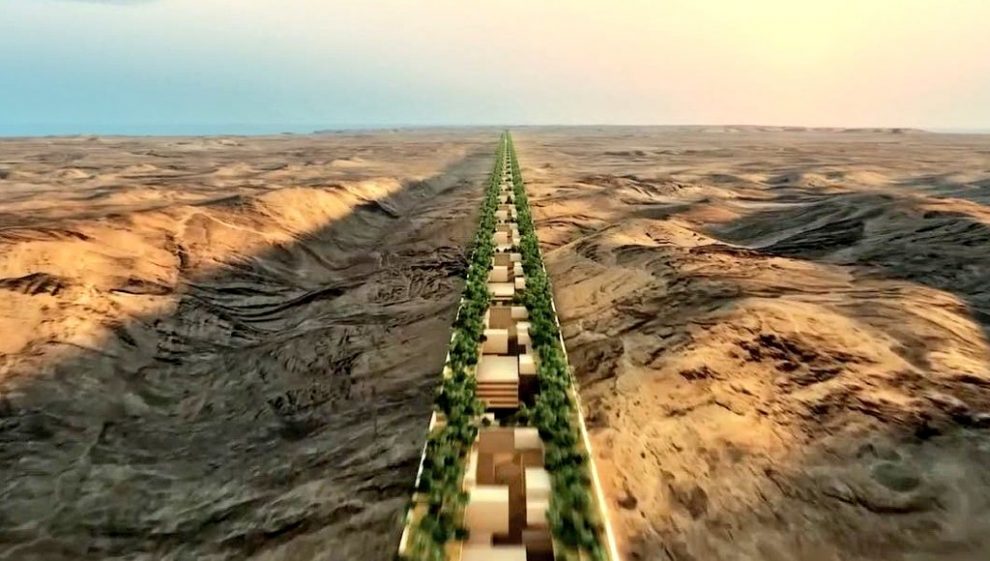
NEOM: Saudi Arabia’s Future City
Source: Middle East Institute (MEI)
NEOM was announced in 2017 by Mohammed bin Salman; its name comes from the combination of the Greek word “neo,” meaning “new,” and the Arabic word “mustaqbal,” meaning “future.” The project is conceived as a “mega city/mega region” initiative that transcends the traditional understanding of a city, planned to spread over an area of approximately 26,500 km² in the province of Tabuk in western Saudi Arabia, including the Red Sea coast. NEOM is not just a single city; it includes a series of sub-centers (regions) with different purposes and functions: for example;
• The Line: A linear city focused on urbanization, living, and urban planning.
• Oxagon: A region focused on industry and logistics.
• Trojena: A region planned for mountain and nature tourism, mountain sports, and winter tourism.
• Sindalah: A concept for marine tourism/island/yacht support island.
NEOM was initially announced as a $1.6 trillion investment, but recent sources indicate that the project’s cost could be much higher, potentially reaching $8.8 trillion. In this regard, NEOM is one of the mega projects at the heart of Saudi Arabia’s long-term development and transformation plan, Vision 2030.
NEOM’s Potential Benefits for Saudi Arabia
One of NEOM’s most significant contributions in terms of economic and structural transformation is its support for Saudi Arabia’s goal of moving away from the rentier state model traditionally based on oil dependency. The project aims to create new investment areas in sectors such as renewable energy, advanced technology, tourism, logistics, and high value-added production in order to diversify the country’s economy. According to economic estimates made in this direction, NEOM is expected to contribute approximately $48 billion to Saudi Arabia’s Gross Domestic Product and provide more than 380,000 new job opportunities. Oxagon, one of NEOM’s sub-regions, is designed to be an attractive production and logistics hub for international capital thanks to its proximity to global trade routes on the Red Sea and Gulf of Aqaba, favorable legal regulations granting foreign investors 100% ownership rights, and a low-tax environment. All these elements support Saudi Arabia’s goals of transforming its economic structure and reducing its dependence on energy. Indeed, NEOM’s renewable energy-based, sustainable, and high-tech urban model plays a critical role in strengthening non-oil sectors in the country’s long-term development strategy.
Projects like The Line are concrete manifestations of Saudi Arabia’s “smart city” vision, aiming to implement contemporary urban planning principles such as car-free transportation, carbon-neutral infrastructure, carbon-neutral living spaces supported by renewable energy, and urban planning in harmony with nature. This approach is not limited to improving the quality of urban life; it is also central to Saudi Arabia’s strategy to reposition itself globally as a modern, sustainable, and technology-focused country. NEOM’s technology and design-focused vision is a strategic move that aims to accelerate internal social transformation while attracting the interest of international investors and global players.
NEOM is not only a tool for internal economic and social transformation; it is also a geopolitical move aimed at strengthening Saudi Arabia’s position on the global stage and potentially influencing regional power balances. New investments, advanced logistics infrastructure, ties with international investors, and attracting global capital flows to the country aim to transform the Kingdom from being seen solely as an oil exporter into a multifaceted economic actor. In particular, its proximity to strategic trade routes such as the Red Sea and the Gulf of Aqaba increases NEOM’s potential to serve as a bridge for international trade, logistics networks, and the transportation of global goods. In this regard, NEOM is a concrete manifestation of Saudi Arabia’s intention to be competitive in the “global arena” not only in the energy sector but also in areas such as technology, tourism, logistics, and sustainable development, thereby expanding its regional/international sphere of influence.
Key Risks and Criticisms Facing NEOM
Financial and Economic Risks
The project’s cost has risen from the initial estimate of $1.6 trillion to astronomical figures of $8.8 trillion in some recent assessments. This represents an investment more than 25 times Saudi Arabia’s annual budget. The sustainability of such a large investment—especially during the transition from a petroleum-based economy—is fraught with uncertainties in areas such as financing structure, liquidity capacity, investment return rate, and international investor interest. Indeed, academic studies assess NEOM’s financial, liquidity, and market risks as “very high.” Furthermore, plans for some sub-projects (particularly The Line) have not been approved in the 2024 budget; consequently, claims of downsizing/postponement at the project level have emerged.
Criticisms from a Social and Human Rights Perspective
The displacement of local communities—particularly tribes such as the Huveytat—forced evictions, land expropriations, and dispossession claims have been raised as serious human rights violations in the implementation of NEOM. Furthermore, the working conditions, working hours, remuneration, and safety of foreign investors and migrant workers have raised serious concerns when compared to international standards. This situation reveals a serious contradiction between the project’s vision, which emphasizes the slogan of a “sustainable/human-centered city,” and the social side effects that have emerged in practice.
NEOM’s Current Status and Discussions on Achieving Success
In 2024, media reports emerged about the budget for The Line, the most notable part of the project, not being approved and the possibility of downsizing the project. Some critics describe NEOM as a “utopia” or “dystopia candidate,” emphasizing that it poses serious problems in terms of human rights, environmental sustainability, and financial feasibility. In contrast, project advocates view NEOM as a strategic and long-term transformation initiative aimed at freeing Saudi Arabia from its energy and economic dependence, modernizing the country, and gaining an advantage in global competition. For this reason, the project remains central to the Saudi state’s long-term vision. However, current economic difficulties, fluctuations in global energy prices, the volatility of international investor confidence, and concerns about project costs and sustainability cast uncertainty over NEOM’s chances of success.
Geopolitical Dimension
The NEOM Project is not merely an initiative aimed at economic and urban transformation; it is also a strategic foreign policy tool that reshapes Saudi Arabia’s relations with regional and global actors. The scale of the project, its financing requirements, technological infrastructure, and geographical location enable Riyadh to develop new partnerships with both regional countries and global powers, while also having the potential to create areas of competition-based tension with certain actors. In this context, NEOM is designed as a tool that influences Saudi Arabia’s foreign policy in a multifaceted way across the dimensions of economy, technology, investment, logistics, and security.
Due to their geographical proximity, the relationships to be developed with Jordan and Egypt are a key element in the process of implementing and ensuring the continuity of the NEOM project. As countries bordering the Red Sea, they share a natural basis for cooperation through energy infrastructure, tourism corridors, and logistics networks. While the new economic opportunities that NEOM will create in terms of production, trade, and port activities could offer strategic benefits to Jordan and Egypt, the project’s potential to alter the balance of power in the Red Sea may occasionally create areas of competition and diplomatic tension. Similarly, relations with the United Arab Emirates in the Gulf region are shaped by both cooperation and competition. Dubai and Abu Dhabi’s current claims to be global financial and logistics hubs could be seriously challenged by the implementation of NEOM. In this case, the strategic competition between Riyadh and Abu Dhabi is likely to deepen. Qatar and Bahrain are other regional actors that could play both complementary and competitive roles in areas such as tourism, sports technology, finance, and labor markets in NEOM.
At the global level, NEOM adds a new dimension to Saudi Arabia’s relations with major powers. The project’s components, particularly advanced technology, artificial intelligence, renewable energy, and defense infrastructure, offer new opportunities to strengthen high-tech partnerships with the US. The involvement of American technology companies in the project could diversify the areas of economic dependence between the two countries; however, Saudi Arabia’s simultaneous deepening of cooperation with China will prompt Washington to bring pressure or sanctions threats to the agenda. On the other hand, China’s view of NEOM as a strategic partner in terms of logistics and investment within the scope of the Belt and Road Initiative is deepening Riyadh-Beijing relations. The construction and infrastructure capacity of Chinese companies can contribute to the rapid progress of NEOM; however, the project’s excessive openness to Chinese influence creates diplomatic risks with the West and may lead to criticism on data security issues. The European Union is interested in the project due to NEOM’s sustainability and renewable energy vision and holds potential for cooperation, particularly in financing and environmental technology. However, the EU’s high sensitivity to human rights, environmental impact, and transparency issues carries the risk of limiting project financing or political support if NEOM is criticized in these areas.
The NEOM Project is seen as a strategic initiative that could provide Saudi Arabia with significant advantages at the international level. First and foremost, the project increases the country’s capacity to attract large-scale foreign investment and contributes to Saudi Arabia’s creation of a modern, innovative, and technology-based brand value on a global scale. Creating a competitive advantage in sectors such as technology, tourism, and logistics, NEOM strengthens Riyadh’s claim to regional leadership and positions the country as a strategic hub in the Red Sea–Mediterranean trade corridor. Furthermore, the project plays a critical role in supporting the diversification of the Saudi economy into non-oil sectors, which is essential for achieving long-term economic independence. However, NEOM also carries significant risks. The project’s high cost and long-term financial burden could potentially undermine investor confidence. International reports on human rights violations and environmental impacts are also known to carry the potential to cause diplomatic tensions with Western countries. NEOM’s reliance on technical and economic cooperation with both the US and China places Riyadh at the center of competition between the two major powers and forces it to make difficult choices. The project’s potential to increase logistical and energy competition with neighboring countries could also create new diplomatic challenges. Furthermore, NEOM’s large scale, ambitious goals, and as-yet-unproven sustainability capacity mean that failure of the project would represent a significant loss of prestige for Saudi Arabia.
NEOM is a visionary, ambitious initiative that pushes the boundaries of the “mega project” definition in terms of scope. It is a strategically logical and understandable direction in terms of Saudi Arabia’s desire to move away from an oil-based economy and transition to a diversified, sustainable, high-tech structure. It also offers potential benefits in areas such as economic diversification, employment, international investment, technology transfer, global competition, and geopolitical position.
However, in such massive projects, the vision may not always align with reality, the ideal with practice, or the rhetoric with implementation. As in the case of NEOM, factors such as high costs, financing issues, uncertainties regarding investor confidence, social resistance, environmental concerns, and human rights issues threaten the project’s legitimacy and sustainability. In this context, NEOM—perhaps historically—is a test that must balance the “potential for realization, sustainability, and social legitimacy” before it can be deemed ‘successful’ or “unsuccessful.”
When examining the NEOM project, while its idealistic vision and strategic objectives are acknowledged, it is evident that if economic, social, and environmental risks are not successfully managed, the project could lead to sustainability issues, social discontent, and resource waste instead of delivering its promised benefits. It should be emphasized that the financial dimension of the project, as well as its human rights and environmental responsibility dimensions, must be managed transparently in accordance with international standards.
In conclusion, mega projects such as NEOM carry both enormous opportunities and significant risks. Such projects are strategic tools that aim not only at physical infrastructure construction but also at economic restructuring, social transformation, and international positioning. NEOM may be the embodiment of Saudi Arabia’s “new future” vision; however, whether this vision will transform into a sustainable, fair, transparent, and socially accepted model depends on its implementation, governance capacity, investor confidence, and social/environmental sensitivities. In this context, NEOM is an important “case study” not only for Saudi Arabia but also for other countries planning or evaluating similar mega projects.
Source:stratejiturkiye.com