
Pope Leo XIV’s Türkiye–Lebanon visit marks a historic and strategic moment that reconnects Christianity’s 1,700-year legacy to Anatolia while elevating Türkiye’s diplomatic, cultural, and regional influence.
The visit of Pope Leo XIV to Türkiye and Lebanon represents a major geopolitical and historical milestone, centered on the 1,700th anniversary of the First Council of Nicaea in İznik. By commemorating this anniversary on Anatolian soil, the Vatican signals a return to Christianity’s geographical origins while reshaping Catholic–Orthodox dynamics and relations with Middle Eastern Christian communities. The visit underscores Türkiye’s renewed central role amid the Gaza crisis, rising Islamophobia, and shifting regional alliances. It is also poised to significantly boost Türkiye’s faith and cultural tourism. Politically, the Türkiye–Lebanon route reflects the Vatican’s eastward reorientation and its interest in stabilizing the region, while shared opposition to Europe’s far right hints at a developing moral partnership. Overall, the tour opens new diplomatic, cultural, and humanitarian channels that elevate Türkiye’s position in both regional and global arenas.
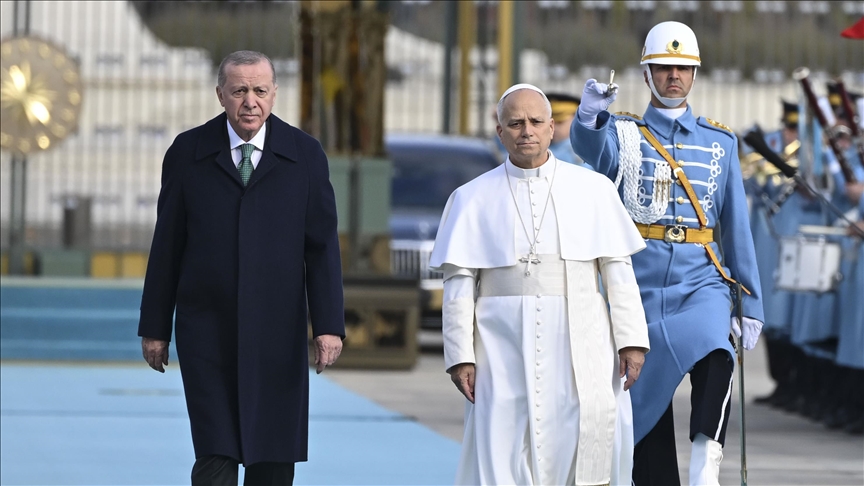
President Erdoğan’s full-protocol reception of Pope Leo XIV at the Presidential Complex is more than a diplomatic ceremony. The visit marks a multilayered turning point that touches the 1,700-year memory of Christianity and redefines Türkiye’s role in today’s geopolitics.
At the center of the visit lies İznik. The 1,700th anniversary of the First Council of Nicaea—held in 325 and forming the dogmatic backbone of Christianity—is the symbolic spine of the Pope’s Türkiye itinerary. For the first time, such a critical anniversary is being commemorated personally by a Pope on Anatolian soil, signaling a return of Christianity’s institutional memory to its geographical roots.
For the Vatican, İznik is not just a historical stop; it is the artery of Catholic–Orthodox relations, regional Christian demographics, and global church debates. The messages the Pope delivers here will spark a new balance-seeking process for Rome, the Ecumenical Patriarchate, and Christian communities throughout the Middle East.
The visit also demonstrates Türkiye’s restored central role in regional diplomacy. The moral and humanitarian crisis triggered by the Gaza war, rising Islamophobia in Europe, and the deepening sectarian fault lines in the Middle East all make the Pope’s choice of Türkiye more meaningful. The Vatican clearly seeks cooperation with an actor trusted in the Islamic world and possessing real diplomatic weight.
Ankara, in turn, gains an opportunity to strengthen its moral leadership and expand humanitarian diplomacy channels. A dimension not to be overlooked is tourism. Through his symbolic emphasis on İznik, the Pope is repositioning Türkiye as a global focal point of Christian heritage tourism. İznik, Ephesus, Antioch, the House of the Virgin Mary, Cappadocia, and Mardin are expected to regain prominence as pilgrimage and faith-tourism destinations. A softened European climate and a positive perception of Türkiye across the Catholic world will boost not only religious tourism but also cultural, historical, and gastronomic travel. The visit will elevate Türkiye’s profile and attract a larger, higher-value tourist audience.
The political dimension is even more strategic. Pope Leo XIV selected the Türkiye–Lebanon corridor for his first comprehensive Middle East tour after taking office. This choice signals that the Vatican’s geopolitical compass is turning back toward the East. The inclusion of eight cities and districts in Lebanon—many of them Christian-majority areas—indicates not only moral support but also an attempt to stabilize Lebanon’s collapsing political order.
This cooperation with Türkiye could lay the foundation for a broader humanitarian and diplomatic partnership in the Eastern Mediterranean. Gaza forms the other pillar of this framework. The Pope is one of the most vocal critics of Israel’s actions and insists on the protection of children. Türkiye’s efforts on ceasefire, prisoner exchanges, and humanitarian corridors have resonated strongly in the Vatican. The joint messages expected from the visit will likely influence debates on international law and public opinion in the West.
Another key theme is Europe’s far right. The Pope has long criticized the far-right wave, and Türkiye has positioned itself firmly against it. This creates a shared normative ground. The visit may be the first step toward a “moral partnership” between Türkiye and the Vatican against rising discrimination in European politics.
In conclusion, Pope Leo XIV’s Türkiye–Lebanon tour represents a rare diplomatic beginning that touches history, politics, and economics simultaneously. By making Christianity’s 1,700-year memory visible again in Anatolia, the visit opens a new diplomatic space for Türkiye both in the Middle East and in Europe. At the intersection of symbolism and politics, a new equation emerges: Türkiye is returning to the center—not only geographically but also culturally, religiously, and diplomatically. This visit is the first concrete sign of that return.