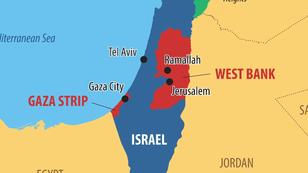

Let’s not go back too far; let’s remember how, step by step, since 2008, Israel has been eviscerating the “two-state solution” hype. When Israel, or rather Theodor Herzl, began to look for a “homeland” to realize the idea of a Jewish state that had been agreed upon at the International Zionist Congresses, the model they had in mind was not to share that land with another religion or ethnic group. As soon as they overthrew the Ottoman Empire, took Palestine from it and started encouraging (you can call it coercion after the motivation provided by Hitler) European Jews to migrate there, “ethnic cleansing” began. The 1948 Nakba (Great Catastrophe) was the first example.
But such old examples are not very memorable; let us begin to trace Zionism’s step-by-step cyclical strategy to cleanse Palestine of Palestinians from more recent history:
December 2008: Israel invaded Gaza, Rafah and Khan Younis under the name of “Operation Cast Lead” in response to Hamas terrorist acts, martyred 1600 Palestinians, demolished and destroyed 46,000 homes. A 6-month ceasefire was declared with Egyptian mediation. The UN and South Africa filed a case against Israel at the International Criminal Court (ICC). 13 days later, the Kassam Brigades fired rockets at Israel, reporting that Israel violated the ceasefire; Israel closed crossing points and food shortages began in Gaza.
July 2014: With “Operation Protective Edge”, Israel responded to Hamas’ terrorist activities….
I won’t go on, but we can repeat the above paragraph by changing the place names, dates, numbers and mediating countries. In 2011, Hamas and Israel signed the first comprehensive reconciliation text and accepted UN observers. When the first shots were fired, the UN observers left Gaza and never returned. Another ceasefire agreement, another violation.
May 2021: “Operation Protector of the Walls”; different names, same cycle. The spark was Israel’s incursion of troops into the Haram al-Sharif in Jerusalem; when Hamas protested, Israel bombed Gaza. Long clashes, thousands of martyrs, destruction of thousands of buildings… First a 30-day ceasefire, then Netanyahu, now prime minister, refusing to agree to a longer agreement, then extensions for Ramadan… But now Al-Aqsa Mosque and East Jerusalem are under permanent occupation.
And October 2023: the events of today, beginning with the Hamas raid on the Torah reading holiday, the deaths of 1200 Israelis and the taking of 200 hostages.
All these plans are based on the same elements: a spark that leads to escalation; a confrontation triggered by Hamas rocket fire and the Israeli army’s response; a call by the US and the international community for an end to hostilities; a ceasefire, usually mediated by Egypt or Qatar. Then a temporary silence, aid entering Gaza, so-called Israeli concessions.
Then another spark, another conflict, another ceasefire and another Israeli attack. This time the third step was accompanied by warnings from some European countries to force Israel into a ceasefire: “Look, if you don’t stop your attacks, we will recognize the Palestinian state.”
Following the 1993 Oslo Accords and the establishment of the Palestinian Authority, the rhetoric of a “Palestinian State” and a “Two-State Solution” emerged. The Palestinian Authority is not a real state, and today, with Mahmoud Abbas at its head, it is merely an informal organization funded by donors (i.e. the US and the EU).
Abbas and his team are neoliberal, pro-Israel, pro-conciliation, and opposed to organizing in the occupied territories, preferring individual initiatives to collective action. Abbas and his friends, who were content with protesting against Israel’s occupy-occupy-settle practice, now seem to be re-energized by these promises (or threats) of recognition. But this “move to recognize Palestine”, as the British and Canadian prime ministers put it, is not a reward for Hamas and Gaza, which has been resisting Zionist bullets for 667 days. It is just a continuation of the Zionist cycle.