
The war in Yemen has reignited with a ferocity not seen since the 2022 truce, and the picture emerging from the front lines is unflattering for Saudi Arabia and the forces it backs. Houthi fighters have seized the port of Mokha, taken an island commanding the approach to the Bab al-Mandeb strait, and struck Saudi oil infrastructure in Abha, Jazan, and Khamis Mushait with enough regularity that Riyadh’s air defenses now look porous rather than deterrent. Pro-Saudi factions on the ground have been pushed onto the back foot in Hodeidah and along the Red Sea coast, and only in Taiz have they managed a genuine counteradvance. For a kingdom that has spent a decade and hundreds of billions of dollars trying to project itself as the Arab world’s dominant military power, being harassed by an Iranian-armed militia operating out of one of the poorest countries on earth is not just a tactical setback. It is a humiliation, and humiliations of this kind travel fast through a region that watches for weakness.
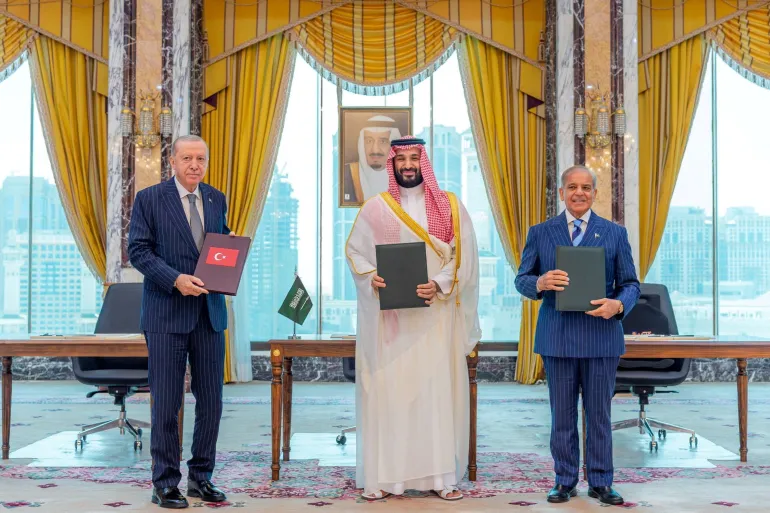
This is precisely the scenario the Makkah Joint Defence Agreement was supposed to answer. Signed by Saudi Arabia, Türkiye, and Pakistan in August, the pact was framed as a mutual security arrangement with unmistakable echoes of NATO’s Article 5, an assurance that an attack on one signatory would be treated as an attack on all three. Pakistan has already invoked the agreement rhetorically, warning that continued Houthi strikes could trigger it. But a defense pact that exists only on paper while its principal beneficiary absorbs missile and drone strikes week after week is worse than no pact at all. It signals to Tehran, to the Houthis, and to every other actor watching that the agreement’s guarantees are conditional and slow, which defeats the entire purpose of signing it. If Ankara and Islamabad want the Makkah framework to mean anything, and if they want to be treated as serious security guarantors rather than ceremonial partners, Yemen is the test case they cannot dodge.
There is also a harder strategic argument, one that has nothing to do with treaty obligations and everything to do with who fills the vacuum. Israel has its own escalating interest in the Houthi file, given the group’s continued missile and drone fire toward Israeli territory, and Jerusalem has both the capability and the appetite to offer Riyadh direct military cooperation against the Houthis if Ankara and Islamabad hesitate. Saudi Arabia’s calculus is not sentimental. If Türkiye and Pakistan sit out while Israel steps in with intelligence sharing, air defense support, or strike capability, Riyadh will take the help it is offered, and a security relationship forged in a moment of acute vulnerability tends to outlast the crisis that created it. That is exactly the kind of quiet realignment that Ankara has spent years trying to prevent, and it would hand Israel a foothold in the Saudi security establishment that no amount of Turkish diplomatic messaging could easily reverse afterward.
None of this requires a wholesale Turkish or Pakistani ground deployment, nor should it. What it requires is visible, immediate contribution: air defense batteries and radar integration to blunt the drone and missile barrages hitting Saudi cities, naval assets to help secure the Bab al-Mandeb approaches the Houthis have just demonstrated they can threaten, and training or advisory support for the pro-Saudi factions currently being outmaneuvered on the ground. Türkiye has battle-tested air defense and drone-warfare experience from Syria, Libya, and Nagorno-Karabakh that translates directly to this fight. Pakistan brings a professional military with decades of counterinsurgency experience and an existing informal defense relationship with Riyadh that predates the Makkah pact by generations. Neither country needs to invent capability from scratch. They need to decide to use what they already have before someone else does.
The cost of inaction is not neutrality, it is forfeiture. Every week that Ankara and Islamabad delay a visible response, the Houthis gain more territory and more leverage, pro-Saudi forces lose more credibility, and the door stays open for Israel to become Riyadh’s partner of first resort in a crisis that the Makkah Joint Defence Agreement was explicitly designed to prevent. Türkiye and Pakistan built a security architecture with Saudi Arabia on the premise that they would show up when it mattered. Yemen is where that premise gets tested, and so far, the two guarantors are failing the test by default.