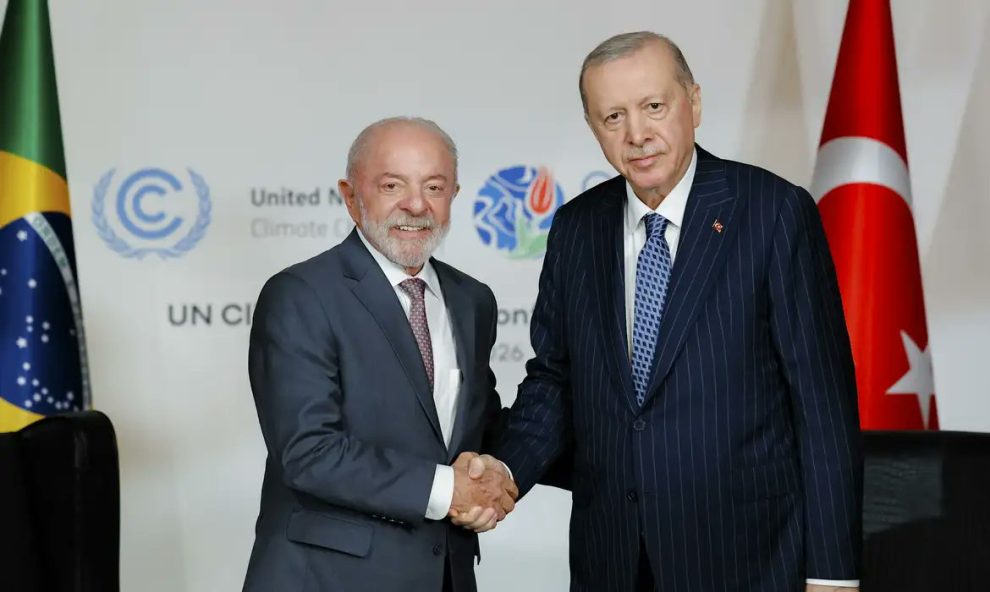

The meeting between Lula and Erdoğan during COP31 opens new perspectives for technological and industrial cooperation, with emphasis on the Brazilian Army’s New Family of Tracked Armored Vehicles program and unmanned aerial systems.
The rapprochement between Brazil and Turkey in the defense area gained a new political dimension with the meeting of Presidents Luiz Inácio Lula da Silva and Recep Tayyip Erdoğan, held on November 10, 2026, in Antalya, during the 31st United Nations Climate Change Conference (COP31).
On that occasion, the two leaders discussed the deepening of bilateral relations, and Lula expressly stated Brazil’s interest in establishing a more robust partnership with Turkey in the defense sector. The statement, released by the Brazilian president himself, comes at a particularly opportune moment, when the Brazilian Armed Forces are facing important modernization programs and the Turkish defense industry presents itself as one of the most dynamic and technologically developed among emerging countries.
Official photo of the meeting of the presidents of Brazil and Turkey (Source: Agência Brasil)
The initiative should not be interpreted merely as a possibility of expanding Brazilian imports of military equipment. There is a much broader opportunity: to establish a relationship of complementarity between two industrial bases that possess experiences, capabilities, and strategic interests that can be combined in projects for the development, production, and commercialization of military systems.
Over the past two decades, Turkey has developed a diversified defense industry, with the capacity to design and produce armored vehicles, aircraft, helicopters, unmanned aerial systems, missiles, radars, sensors, weapons, and electronic equipment. Brazil, for its part, has established companies in aeronautical, land, naval, and defense systems segments, as well as an industrial and engineering structure that can be expanded through international partnerships.
The moment is also favorable because the two countries already have diplomatic and legal instruments to support this rapprochement, especially the Agreement on Cooperation in the Defense Industry, signed in 2022 and approved by the respective legislative processes in 2025.
More importantly, however, there are ongoing Brazilian programs in which Turkish companies already appear as potential suppliers or industrial partners. Among them, the Brazilian Army’s (EB) New Family of Tracked Armored Vehicles and the acquisition of Remotely Piloted Aircraft Systems (SARPs) stand out. These are precisely the projects that can turn the political rapprochement between Brasília and Ankara into concrete results for the Brazilian Defense Industrial Base (BID).
The challenge now is to transform the political will that has been expressed into effective contracts, investments, and industrial projects. And this is already happening behind the scenes, as sources linked to Brazilian diplomacy confirmed that, at the same time as the heads of state were meeting, a delegation from Avibras Aeroco was meeting with representatives of major Turkish companies, including Otokar and Baykar, indicating that the first steps are already underway.
Avibras is already moving ahead and has started talks for partnerships in the defense area (Photo: Avibras Aeroco/Divulgação)
A RELATIONSHIP BUILT OVER TIME
Although the meeting at COP31 represents an important political advance, military cooperation between Brazil and Turkey has a prior trajectory.
Diplomatic relations between the two countries date back to 1858, when the Treaty of Friendship and Commerce was signed between the Empire of Brazil and the Ottoman Empire. In 1927, after the formation of the Republic of Turkey, a new friendship agreement was signed. Embassies in Ankara and Rio de Janeiro were established in 1930, and the relationship gained greater intensity in the 21st century.
On August 14, 2003, during the visit of Turkish Defense Minister Vecdi Gönül to Brazil, the first bilateral agreement specifically aimed at defense cooperation was signed. The document established the bases for the exchange of experiences, knowledge, and information between the military structures of the two countries, creating conditions for the development of activities of common interest. It was approved by the Brazilian National Congress through Legislative Decree No. 277 of October 4, 2007, and promulgated by Decree No. 6.411 of March 24, 2008.
In 2009, President Luiz Inácio Lula da Silva made the first visit by a Brazilian head of state to Turkey. The following year, during the visit of then-Prime Minister Recep Tayyip Erdoğan to Brazil, an Action Plan for the Strategic Partnership was signed, expanding the bilateral relationship agenda.
In 2011, during President Dilma Rousseff’s visit to Turkey, the two countries reinforced this strategic condition through a joint declaration called Türkiye-Brazil: A Strategic Perspective for Dynamic Partnership.
These instruments expanded the relationship beyond diplomatic exchange, creating opportunities for closer ties in the areas of science, technology, trade, investments, and defense.
But the main institutional advance occurred on March 25, 2022, when the Brazilian and Turkish governments signed the Agreement on Cooperation in the Defense Industry, in Brasília and Ankara.
Unlike the 2003 instrument, which established the general bases for the military relationship, the new agreement began to directly address cooperation between the respective industries.
Among the fields envisaged are research, development, production, modernization, and joint acquisition of military equipment, exchange of technical and scientific information, logistical support, maintenance, and development of armaments. The document also establishes conditions for the implementation of joint projects in the territories of the two countries and opens possibilities for the commercialization of the products developed in third markets.
In May 2024, the Foreign Relations and National Defense Committee of the Chamber of Deputies approved the text of the industry cooperation agreement, and in October and November of that year, the Brazilian Ministry of Defense promoted initiatives to bring companies from the two countries closer, including the Brazil-Turkey Defense Industries Dialogue, with the participation of representatives from 27 companies. The Federal Senate approved it on September 3, 2025, resulting in Legislative Decree No. 195 of September 9, 2025, establishing a more comprehensive legal basis for industrial cooperation.
In 2019 Turkey brought its T-129 attack helicopter to Brazil
WHAT CAN HAPPEN CONCRETELY?
Among the possibilities for cooperation, one of the most important for the EB is related to the New Family of Tracked Armored Vehicles program, aimed at replacing the current Leopard 1A5BR and M113 in different roles. This is one of the most relevant projects of the Strategic Armored Forces Program, as it involves the renewal of a significant portion of the combat means of mechanized and armored troops, with direct impacts on the operational capacity of the Land Force in the coming decades.
The market consultation process, initiated by the Army Projects Office (EPEx) in August 2024 through RFI/RFQ 02/2024, received proposals from 11 companies from ten countries and, after preliminary analysis, a list of four candidates considered most suitable was established. Among these candidates, the TULPAR from Otokar deserves special attention, not only for its technical characteristics but also for the industrial integration possibilities that may arise with the deepening of Brazil-Turkey cooperation.
Another segment in which cooperation with Turkey could produce important results is that of Remotely Piloted Aircraft Systems (SARP).
As the company Baykar has become one of the world’s leading manufacturers of this type of equipment, especially after the commercial and operational success of the Bayraktar TB2 and the consolidation of the TB3. For Brazil, the two models present distinct possibilities, meeting needs that may involve both the Army and the Navy, with the TB3 being the most interesting option for the latter, as it already has a naval embarked version.
In addition to the Bayraktars, there is the option of the FPV (First Person View) Skydagger drones as an option for the Attack Drones Initiative, coordinated by the Directorate of Manufacturing and the Army Technological Center (CTEx). A partnership between Brazilian companies and the Turkish one could eliminate some stages, saving time and resources.
Besides these, the portfolio of the Turkish defense industry is quite broad, and solutions such as towed 105mm howitzers and self-propelled 155mm howitzers, among others, can also be viable alternatives.
OPPORTUNITIES FOR BRAZILIAN COMPANIES
The realization of these initiatives could represent an important opportunity for Brazilian companies operating in the segments of military vehicles, electronic systems, armaments, aeronautics, and systems integration.
Closer ties with the Turkish industry would allow greater access to technologies that Brazil does not yet fully master, while also opening possibilities for national companies to participate in international programs. And these opportunities would not only be in absorbing Turkish technology, but also in supplying their products to Turkey, as in the case of the partnership between Embraer and Turkish Aerospace, announced last year.
In addition, Turkey will find in Brazil a partner with a significant domestic market, companies with experience in complex projects, and the capacity to act as an industrial and commercial platform in Latin America.
The Brazil-Turkey rapprochement could represent much more than a new alternative for the supply of military equipment. It could constitute the beginning of a strategic partnership capable of expanding Brazilian technological autonomy, strengthening its defense industry, and increasing its presence in the international market.
Source: Tecnodefesa (published ~November 13, 2026).