
By Dr. İdris Kardaş
On the morning of March 20, 2003, the US army entered Iraq.
Baghdad was bombed. Later, Fallujah was burned and Mosul was torn apart.
A 2006 study by The Lancet estimated that the death toll caused by the occupation exceeded 600,000. Millions of people were displaced. Decades later, Iraq has still not recovered. Iraq turned into an area where the US could demonstrate its military power and showcase its weapons.
That morning, the phrase “freedom is coming to Iraq” said by US Vice President Dick Cheney on television best exemplifies how a duplicitous system was built.
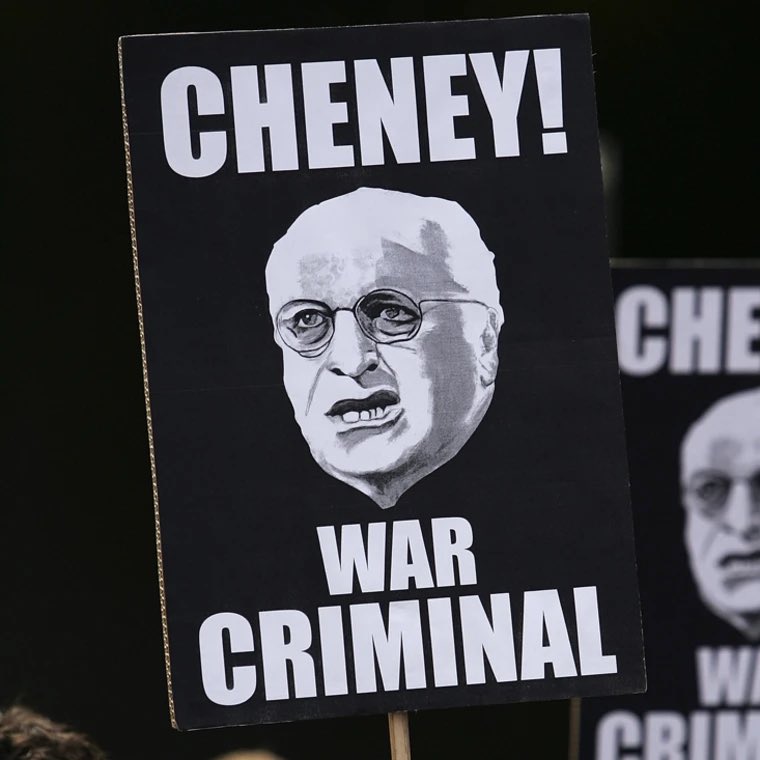
Yesterday, news sites and social media reported Cheney’s death.
Axios described Cheney in his obituary as “the most powerful vice president who expanded the boundaries of modern American executive power.”
We usually write and talk about good people when they die.
And rightly so. Goodness spreads as it is spoken.
But when it comes to people like Cheney who harmed humanity globally, it also requires a few words.
Cheney’s career, an actor in many decisions from the Guantánamo prison—an indelible stain in US history after 9/11—to the Iraq invasion, goes back a long way.
He started his career during Nixon’s era and continued as Chief of Staff in Ford’s White House.
His ideological framework was already clear when he entered Congress during Reagan’s years: strong American interventionism.
When “Daddy” Bush made him Secretary of Defense in 1989, it was the time when a new world was born after the Cold War ended.
In the 2000 elections, when he sided with George W. Bush, the press called him a figure who completed everything Bush lacked. Experience, seriousness, deep state connections.
The September 11, 2001 attacks marked a turning point when Cheney’s time had come.
The darkest years of the White House were shaped by his hand. Under the slogan of the “war on terror,” Guantanamo camps were established, torture became routine, and illegal eavesdropping became common.
The Iraq War became the peak—and also the shame—of Cheney’s political career. He personally defended the claim that Saddam Hussein had weapons of mass destruction, initiated the distortion of intelligence reports, and dragged the US into war disregarding international law.
It later turned out that all of it was lies.
Cheney and his team led the public and the US Congress to prepare for war with the perception of “We are under very great threat.”
On June 5, 2008, the US Senate’s “Select Committee on Intelligence Prewar Iraq Intelligence” report documented these lies.
The report clearly showed that Cheney and Bush’s administration acted “as if there was solid evidence that Iraq had chemical and biological weapons,” while intelligence reports were full of uncertainties and contradictions.
A remarkable sentence in the report states:
“The public statements of the President and Vice President (Cheney) were more definitive and certain than the level of doubt expressed by the available intelligence.”
In the report’s annexes, it was found that Cheney, through the “Office of Special Plans” established within the Department of Defense, created an intelligence line independent of CIA and State Department analyses. This part is truly alarming.
This parallel structure, created by Cheney, produced analyses overstating the connection between Iraq and Al Qaeda and conveyed this through Cheney’s office to the White House.
The committee defines this process as “the politicization of intelligence.” It notes that Cheney became not just a bureaucrat but an executive actor who directly interfered with institutional mechanisms.
The manipulation of public opinion is another element clearly assessed in the report.
It was documented that in over a hundred media interviews in 2002 and 2003, Cheney described Iraq as a direct threat to the US. The impression that Saddam Hussein had nuclear capability was particularly emphasized in the report.
Continuing from the report:
“These statements did not fully align with the intelligence data. The committee characterized this communication strategy as ‘presenting unverified information as certain fact.’ Therefore, Cheney intensely used his executive power not only in decision-making processes but also in shaping the public narrative.”
Audits conducted after the war confirmed this picture.
Let’s briefly look at the 2005 “Commission on the Intelligence Capabilities of the United States Regarding Weapons of Mass Destruction” report.
The report showed that no weapons of mass destruction were found in Iraq, intelligence was systematically misinterpreted, and decisions were made under political pressure.
Thus, Cheney held fears, not facts.
Therefore, calling Cheney a liar who built one of the 20th century’s greatest destructions on systematic lies wouldn’t be wrong.
Energy giants like Halliburton earned billions in post-war reconstruction contracts in Iraq. It should be noted here that Cheney was CEO of Halliburton before the war.
Dick Cheney, who made decisions costing millions of lives in Afghanistan and Iraq, who did not hesitate to resort to manipulations, produced false intelligence documents, and was unfortunately in one of the most influential positions in a militarily powerful country like the US at the time, will undoubtedly be remembered for these along with the Guantánamo prison.
Source: https://www.haberturk.com/ozel-icerikler/idris-kardas/3836409-dick-cheney-ve-yalanlari