

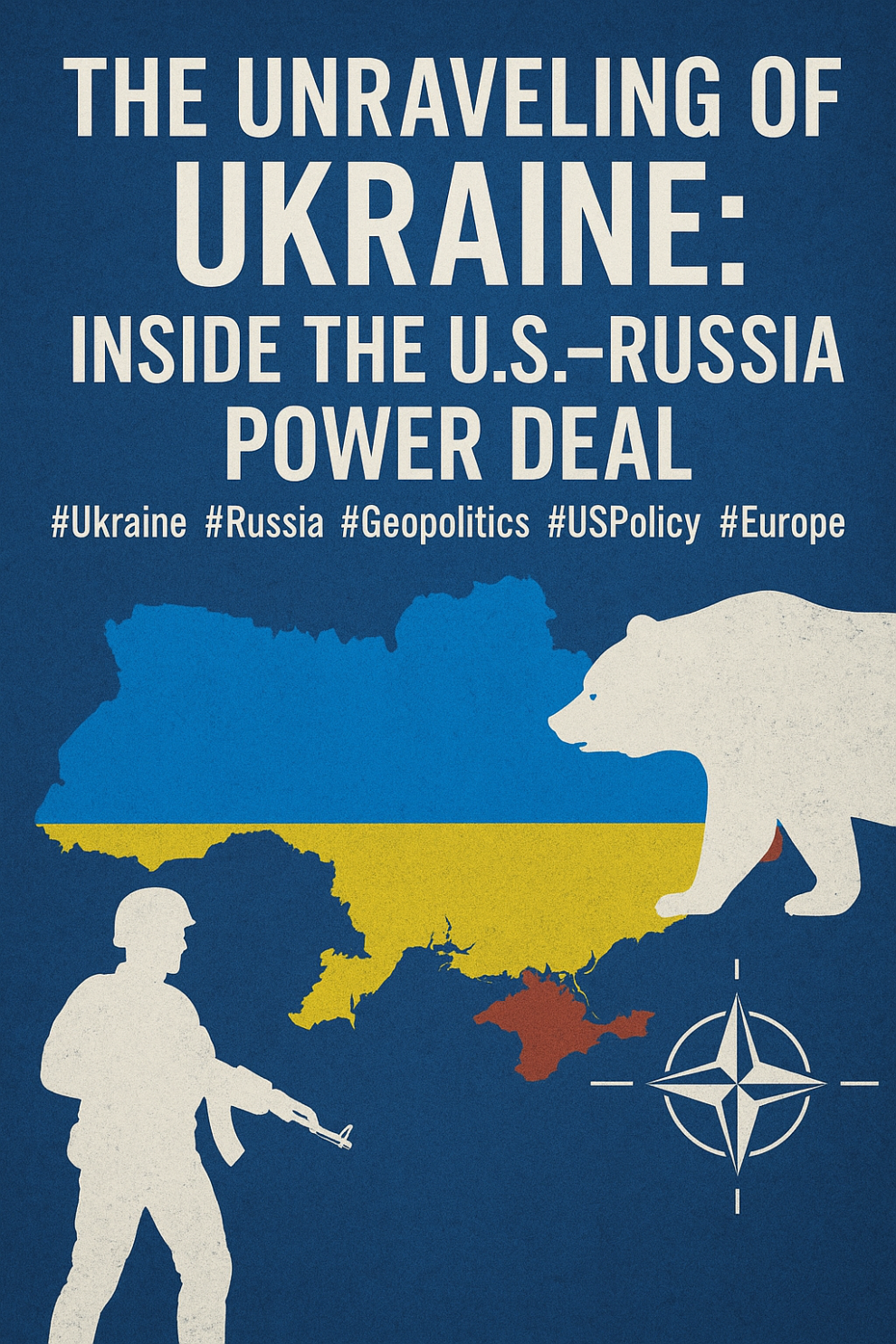

The article argues that Ukraine is being forced into a U.S.–Russia–designed settlement that dismantles its territory and sovereignty, while Europe and Kyiv—stripped of leverage—are reluctantly accepting a new geopolitical order shaped by American and Russian power.
The text contends that Ukraine is disintegrating under a geopolitical arrangement crafted by the U.S. and Russia, disguised as a peace process but effectively dividing the country’s territory and resources. With Russia controlling major regions and the U.S. exposing alleged corruption within Zelenskyy’s circle, Kyiv and European states have lost all bargaining power and are being pushed into accepting a comprehensive peace plan that includes territorial concessions, military limitations, and the renunciation of NATO membership. The article concludes that Europe never truly prioritized Ukraine’s survival, fearing instead a broader Russian advance, and now faces the collapse of the post–Cold War order.
The European continent—spanning 10.186 million square kilometers—has begun witnessing the disintegration of its second-largest country after Russia: Ukraine. What is publicly framed as a “peace” or “cease-fire” process is, in reality, a continent-wide geopolitical reallocation that extends far beyond Ukraine. Today, roughly 35% of Ukraine’s 603,000 square kilometers—its eastern and southern regions—remain under Russia’s de facto control.
Beyond Crimea, the oblasts of Donetsk, Luhansk, Zaporizhzhia, and Kherson have already been annexed by Russia. Consequently, nine of Ukraine’s twenty largest cities, along with its most fertile agricultural territories and richest natural resources, appear set to remain under Russian control. The geopolitical confrontation waged by the United States against Russia has ended in another strategic failure. Yet European governments, blind to reality, initially resisted the emerging U.S.–Russia settlement over Ukraine. Washington, recognizing this, bided its time. After ensuring that European countries agreed to increase NATO defense spending and grant Western access to Ukraine’s mineral wealth, the U.S. initiated the final stage.
Now, by showing “death,” Washington is making both Europe and Kyiv settle for “malaria.” Ukraine and its allies—once adamant about rejecting permanent peace—find themselves unable to oppose President Donald Trump’s leaked 28-point “permanent peace” framework.
The turning point was the U.S. exposure of a multi-billion-dollar corruption network involving President Volodymyr Zelenskyy and his inner circle, stripping Kyiv of all leverage. Zelenskyy—who once rejected even temporary cease-fires—has now acquiesced, fearful that more of his secrets will be revealed.
Following his meeting with President Erdoğan in Ankara, Zelenskyy posted on Telegram: “What matters is stopping the bloodshed, working in coordination with all our partners to achieve lasting peace, and maintaining strong, effective American leadership.” It is evident that Pentagon officials confronted him after the scandal and delivered a series of firm ultimatums.
The U.S. has intensified pressure further, insisting that Kyiv accept a peace plan—drafted jointly by Washington and Moscow and excluding both Ukraine and Europe—by the November 27 U.S. Thanksgiving deadline. The terms include Ukraine’s withdrawal from Donbas, recognition of Crimea’s annexation, acceptance of Russian control in Kherson and Zaporizhzhia, a downsized military, the abandonment of long-range missiles, official recognition of Russian as a second state language, formal status for the Moscow-aligned Orthodox Church, and a binding pledge never to join NATO.
A battlefield tribunal bears no resemblance to a civic courtroom. War is not a realm of justice; it is governed solely by power. Europe is only now awakening to this harsh truth. Beyond all this, Russia is reportedly preparing to seize additional territories in Eastern Ukraine. In exchange, the U.S. plans to offer Ukraine and Europe “security guarantees” against further Russian expansion.
This reveals that Europe’s true concern was never Ukraine. They had written the country off long ago. Their singular fear is that Russia might continue westward after Ukraine. Ultimately, in the geopolitical gamble over Europe’s future, the “table”—the power structure—has once again prevailed. The losers are Ukraine and Europe, both misled by American strategy.
European leaders have already begun voicing despair. After reviewing the new plan, German Chancellor Fredrick Mertz exclaimed: “The 100-year order in the West and the 35-year order in the East have collapsed. A new world order is emerging.”



