


By Dr. Ramazan Aydın
Indonesia is one of the most important actors shaping the political and economic balances in Southeast Asia. As the country with the largest Muslim population in the world, it occupies a prominent position both within the Muslim world and on a global scale. Thanks to its strategic location at the center of the Indian and Pacific regions, Indonesia has become an actor that cannot be ignored in the competition between the US and China. With its economic size, it also plays an indispensable role in the stability of ASEAN.
This country, consisting of more than 17,000 islands, is divided into seven main regions: Sumatra, Java, Kalimantan, Sulawesi, Nusa Tenggara, Maluku, and Papua. Each region has its own distinct historical background, ethnic structure, cultural practices, and economic activities. The fact that the vast majority of the population lives in the Java Region has led to the concentration of state capacity and resources on this island, creating a historical center-periphery imbalance by increasing the development gap between this region and the rest of the country. Indonesia’s multi-layered and unique structure offers significant opportunities for the country on the one hand, but on the other hand, it also brings certain vulnerabilities in terms of political integrity. It was at this point that former President Joko Widodo announced in 2019 that the capital Jakarta would be moved to the new capital Nusantara, to be built on the island of Kalimantan, located near the geographical center of Indonesia. This decision can be seen not only as an administrative relocation but also as a strategic step shaping the country’s future development and national vision.
Reasons for Relocating the Capital Jakarta
Historical examples show that many countries have relocated their capitals for various reasons. Turkey’s move from Istanbul to Ankara, Brazil’s transition from Rio de Janeiro to Brasília, and Nigeria’s shift from Lagos to Abuja are clear indicators that states can use space as a tool for political, economic, and administrative transformation processes. These examples reveal that the decision to relocate a capital is often a strategic choice reflecting the state’s long-term perspective and search for national identity, rather than a physical necessity. Indonesia’s decision to move from Jakarta to Nusantara should also be understood within this historical framework.
Jakarta has become one of the world’s most problematic megacities due to its long-standing population density, unplanned urbanization, and inadequate infrastructure. Due to excessive groundwater use, some parts of the city collapse every year, posing a serious security risk. Chronic problems such as flooding, traffic, and air pollution have progressively weakened the capital’s manageability, rendering the state’s long-term planning processes unsustainable. Therefore, Jakarta’s current conditions constitute the fundamental justification for the technical necessity of relocating the capital. At this point, the Nusantara project is primarily a state-level response to Jakarta’s structural problems.
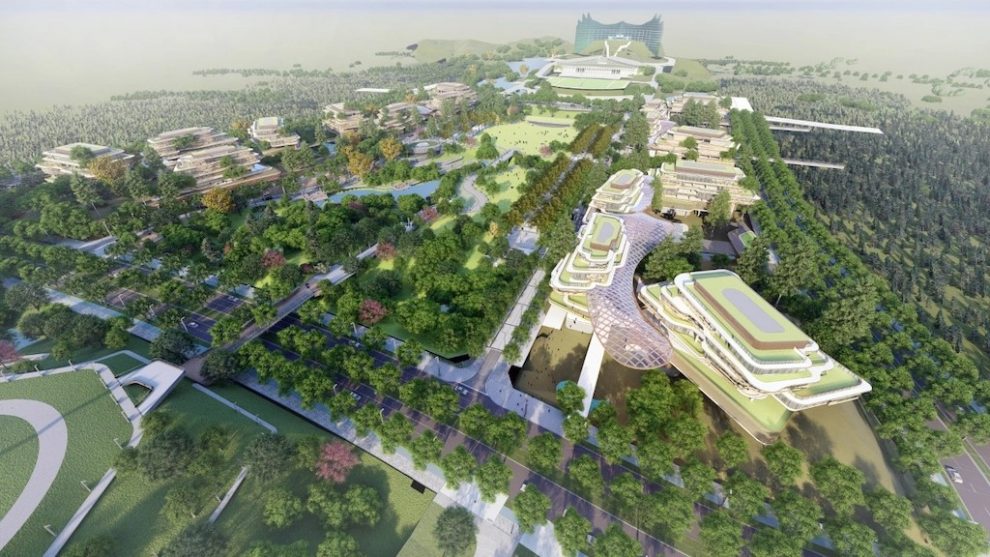
The Nusantara project, estimated to cost approximately $35 billion, has opted for a hybrid financing model. While the state budget will cover the financing of public institutions such as the presidential palace, parliament, and ministry buildings, a significant portion of the transportation infrastructure, residential areas, energy systems, and smart city components will be implemented through public-private partnerships and private sector investments. The first phase of the construction process, officially launched in 2022, focuses on the presidential complex, ministry buildings, and basic infrastructure. The project is planned to become operational on a limited scale by 2024 and to be completed in phases by 2045. The new capital is designed as a sustainable urban environment with low carbon emissions, based on renewable energy, supported by a digital management infrastructure, and in harmony with nature.
Viewing the relocation of the capital to Nusantara solely as a solution to Jakarta’s physical problems will prevent a comprehensive understanding of the issue. As is well known, the majority of Indonesia’s population and economic activity is concentrated on the island of Java. Consequently, the political center has become excessively concentrated in a single region, causing structural imbalance across the country. The choice of Kalimantan is a conscious decision aimed at spreading state capacity more evenly across the country. The region’s geographical proximity to the center of the country has the potential to strengthen the integration of the eastern regions into the political center. In this respect, the Nusantara project represents a transformation in which the center is redefined rather than simply expanded to the periphery.
Alongside all these internal transformations, the Nusantara project also reflects Indonesia’s desire to reposition itself in the global competitive environment. Faced with increasing great power competition in the Indo-Pacific, Indonesia prefers neither full alignment with China nor integration into Western-centered security blocs. Instead, it is striving to pursue a multifaceted and flexible foreign policy that preserves its strategic autonomy. The interest shown in the project by many actors, notably China, Japan, South Korea, and the Gulf countries, has turned Nusantara into a multi-actor geo-economic space where competition and cooperation are intertwined. The Jakarta administration is taking care to diversify project financing in order to balance the risks of dependency that could arise from Chinese investments, particularly those under the Belt and Road Initiative. From this perspective, Nusantara is a symbolic and strategic project that reinforces Indonesia’s capacity to define its own axis in the global power struggle at the spatial level, much like Kazakhstan’s move from Almaty to Astana.
Turkey’s Place in Nusantara: A Quiet But Strategic Opportunity
Relations between Turkey and Indonesia have been developing in recent years on the basis of a strategic partnership encompassing political, economic, and security dimensions. The institutional framework for these relations was established with the High-Level Strategic Cooperation Council, founded in 2022, and the Council has become the main coordination mechanism for bilateral cooperation. The Council’s first meeting was held during President Recep Tayyip Erdoğan’s official visit to Indonesia in 2025. During this visit, a comprehensive joint declaration consisting of 64 articles under 13 headings covering areas such as defense industry, trade, energy, infrastructure, digital transformation, and education was published. On the economic front, the parties agreed on the goal of increasing bilateral trade volume to $10 billion; they announced that steps would be taken toward this goal, including the facilitation of customs procedures, the improvement of the investment environment, the widespread adoption of public-private partnership models, and the completion of the Comprehensive Economic Partnership Agreement (CEPA). In this context, the 2025 visit represents a stage where the institutional structure has become operational and the strategic partnership has materialized.
One of the most notable aspects of this partnership is the growing cooperation in the defense industry. Defense relations between the two countries have moved beyond the traditional supplier-buyer model toward a long-term security partnership based on technology sharing, joint production, and capacity building. The agreement covering 48 KAAN fighter jets stands out as one of the most concrete indicators of this transformation. Furthermore, the international experience gained by the Turkish defense industry in the fields of unmanned aerial vehicles, aviation systems, armored land vehicles, and defense electronics provides a basis for cooperation that is in line with Indonesia’s strategic autonomy goals. In this respect, the defense industry has become a structural element in bilateral relations that not only strengthens military ties but also mutual trust.
Upon examining the content of the joint statement, it is understood that the Nusantara project is one of the most important areas in the implementation of the Turkey-Indonesia strategic partnership. Indonesia aims to build Nusantara with a balancing and diversifying approach in terms of foreign investment and does not want the project to become an area of excessive influence for certain countries. However, the current investment composition, in which countries such as China, Japan, and South Korea stand out as strong actors, does not fully align with the Jakarta administration’s long-term goals. For this reason, Indonesia prioritizes flexible and multidimensional partners that do not create unilateral dependency. In this context, Turkey stands out as a strategic alternative partner with its international experience gained in different regions, its approach sensitive to political conditions, and its balancing foreign policy profile.
Nusantara’s infrastructure and urban planning policies at the implementation level hold a special place. Turkish companies have gained significant experience in the financing and implementation of large-scale infrastructure investments through the airport, highway, tunnel, and bridge projects they have undertaken in the Middle East, Africa, the Balkans, and Central Asia. This accumulated expertise in public-private partnerships and project financing carries both technical and institutional value for a capital city like Nusantara, which is being built from scratch. In addition, Turkey’s experience in urban transformation and social housing production takes on strategic importance when considered alongside Indonesia’s annual target of producing 3 million homes. The Turkey-Indonesia Infrastructure Forum, established in this context, provides an institutional framework for technical coordination and project development processes in infrastructure and housing projects.
In addition to all this, it would be incorrect to limit the Nusantara project solely to infrastructure and urban development activities. On the contrary, the project also offers a strategic framework that enables the repositioning of Turkey-Indonesia relations on a regional and global scale. From Turkey’s perspective, Nusantara stands out as an important field of application that embodies the “Return to Asia” initiative in Southeast Asia. Indonesia’s central position and regional weight within ASEAN elevates Nusantara beyond a national development project, transforming it into a platform for regional interaction and cooperation. In this context, Turkey’s involvement in the project aligns with Ankara’s goal of deepening its relations with the ASEAN region and becoming a more visible actor in multilateral structures.
Ultimately, the Nusantara project is not merely an investment area offering economic opportunities for Turkey, but also represents a long-term strategic test. In mega-scale projects, lasting impact is achievable not only through physical outputs but also through institutional alignment, sustainable planning, and trust-based partnership models. Turkey’s success in the Nusantara process depends on its ability to reflect its technical capacity in the field, maintain balance in a multi-actor competitive environment, and approach the project with a long-term perspective. In this respect, Nusantara constitutes an important reference area showing how Turkey wants to be a partner in the Asia-Pacific region.
How Should We Interpret Nusantara?
Three fundamental elements make the Nusantara project significant. First, beyond being a technical response to Jakarta’s environmental and infrastructure problems, the project is a structural transformation initiative aimed at addressing Indonesia’s historical center-periphery imbalance. Second, Nusantara is a spatial reflection of Indonesia’s determination to maintain its strategic autonomy and pursue a multifaceted foreign policy in the face of deepening great power competition in the Indo-Pacific. Thirdly, the project embodies Indonesia’s long-term modernization vision by elevating the principles of sustainable urbanism, digital governance, and environmentally compatible development to the level of state policy.
From Turkey’s perspective, Nusantara is not merely an infrastructure project offering economic or technical cooperation opportunities; it establishes a long-term and strategic partnership platform through defense industry, urbanization, technology, and public-private partnership models. Turkey’s multidimensional project experience, its capacity for implementation gained during crises and transformation processes, and its understanding of cooperation that does not create unilateral dependency are in line with Indonesia’s search for partnership. In this sense, Nusantara represents not only an opportunity for Turkey to become visible in Southeast Asia, but also a concrete possibility to position itself as a permanent, reliable, and balancing actor.
Source: stratejiturkiye.com



