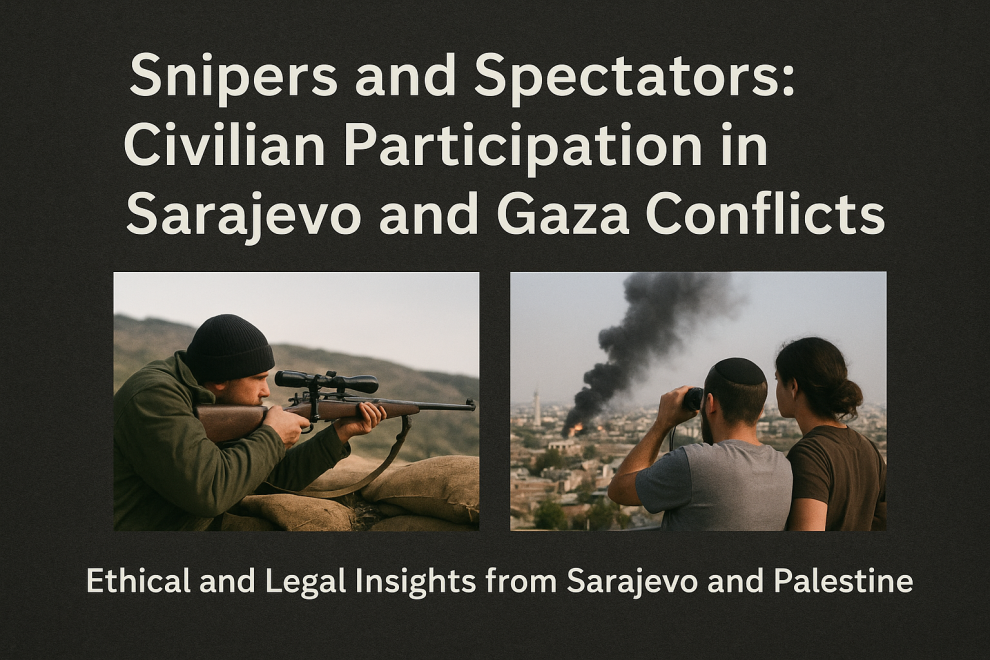

The article analyzes foreign civilian involvement in the Sarajevo Siege and Israeli civilians’ observation and reserve participation in Gaza, highlighting the legal, ethical, and societal consequences of war tourism and normalized violence.
This study examines two distinct forms of civilian engagement in conflict zones: Italian citizens allegedly participating in “sniper safaris” during the Sarajevo Siege, and Israeli civilians both observing military operations and serving as reserve forces in Gaza. It explores the historical, legal, and ethical dimensions of these activities, emphasizing how direct or indirect civilian involvement can affect civilian populations, shape collective memory, and influence post-conflict justice. By comparing these cases, the article underscores the urgent need to address war tourism, spectatorship, and the broader societal impacts of civilian participation in armed conflicts.
1. Introduction
Wars are not limited to conflicts between armed forces and local populations; the direct or indirect participation of international actors can profoundly shape the dynamics of conflicts. Two recent phenomena highlight the darker aspects of such participation:
- During the Bosnian War (1992–1995), certain Western civilians allegedly participated in “sniper safaris,” positioning themselves on the hills around Sarajevo and shooting at civilians for money,
- In the ongoing Israel–Palestine conflicts, some Israeli civilians have been reported to observe military operations in the field, potentially normalizing or indirectly supporting violence.
This article analyzes both cases within historical, legal, and ethical frameworks, arguing that what appears to be “new” evidence is, in fact, part of long-standing but insufficiently examined structural issues.
2. The Sarajevo Case: “Sniper Safaris”
2.1 Historical Context
The Siege of Sarajevo (1992–1996) is one of the longest sieges in modern European history. Serbian militia forces positioned snipers on elevated terrain surrounding the city, targeting civilians over extended periods. This created a highly dangerous environment for everyday life in the city.
2.2 The Re-emergence of Allegations
In November 2025, the Milan Public Prosecutor’s Office initiated an investigation into Italian citizens allegedly participating in “weekend sniper safaris” in Sarajevo during the war. These civilians reportedly paid to shoot at Bosnian civilians while being guided and positioned by Serbian forces.12
According to reports, a “price list” existed, with higher fees for shooting children and lower fees for adult men, women, and the elderly.3 The investigation includes charges of aggravated premeditated murder.4
2.3 Legal and Ethical Analysis
- Under international humanitarian law, these allegations constitute potential war crimes. Deliberate attacks on civilians violate the Geneva Conventions and related protocols.
- From an ethical standpoint, the notion of “killing for pleasure” represents the extreme devaluation of human life and the systematic objectification of violence.
- Historical memory and justice are critical: investigating these allegations offers symbolic accountability for civilians affected by the war.
2.4 Criticisms and Limitations
- Evidence is still debated: financial records, witness statements, and documentary material exist, but identifying individual participants may prove difficult.
- The passage of time, deceased witnesses, or memory limitations could complicate the investigation.
- Some former Serbian militiamen deny the allegations.5
3. The Palestine Case: Observation, Normalization, and the Spectacle of War
3.1 Observation Practices
In contemporary Palestine, some Israelis reportedly gather on hills overlooking Gaza to watch Israeli military bombardments. These vantage points have become a form of “war spectacle,” where visitors observe operations through binoculars and document them on social media.6
This phenomenon may contribute to the normalization of violence and the perception of civilian harm as legitimate.
3.2 Legal and Ethical Implications
- International humanitarian law may not consider passive observation as a war crime, but legitimizing or endorsing military operations in this way risks indirect accountability.
- Ethically, such practices may contribute to desensitization to violence and reinforce harmful psychological and societal norms.
- From the perspective of collective memory, these observation practices shape public perceptions of the conflict and influence post-conflict societal healing.
3.3 Critiques and Debates
- Advocates may argue that observers are merely curious and not active participants in violence.
- Critics highlight the significant psychological impact of “war spectatorship” and the potential societal costs.
- Human rights organizations emphasize the complexities, noting instances where the Israeli army reportedly uses Palestinian civilians as human shields.78
3.4 Israeli Civilians as Reserve Forces and Direct Participation
Beyond passive observation, reports indicate that certain Israeli civilians are mobilized as reserve forces during military operations in Gaza. These individuals participate directly in combat or support operations, which may include actions causing civilian casualties. This involvement raises both legal and ethical concerns:
-
Legal implications: When civilians in reserve roles partake in operations that result in unlawful killings or collective punishment, international humanitarian law may classify these acts as violations, potentially amounting to war crimes.
-
Ethical considerations: Participation blurs the line between civilian and combatant roles, complicating accountability and reinforcing normalized attitudes toward violence.
-
Societal impact: Direct involvement of civilians in operations affecting Palestinians shapes collective memory, potentially desensitizing both participants and observers to the human cost of conflict.
4. Comparative Analysis, War Tourism
| Dimension | Sarajevo | Palestine |
|---|---|---|
| Type of Participation | Foreign civilians directly engaged in violence (as snipers) | Civilians observe military operations |
| Targets | Bosnian civilians | Palestinians in targeted areas |
| Motives | Thrill, fascination with weapons, extreme ideology | Curiosity, social pressure, normalization, nationalism |
| Legal Status | War crimes allegations, murder, crimes against humanity | Primarily ethical considerations; indirect liability in some cases |
| Ethical Impact | Devaluation of human life for entertainment | Normalization of violence, psychological desensitization, spectator psychology |
| Societal Outcome | Historical accountability, justice debates | Memory shaping, collective trauma, normalized perception of violence |
5. Conclusion and Recommendations
The allegations concerning Italian civilians’ “sniper safaris” in Sarajevo and Israeli civilians’ observation practices in Gaza demonstrate, in different contexts, the same underlying phenomenon: the profound impact of foreign or non-combatant involvement on civilian life and the ethical complexities it generates.
Key takeaways include:
- War Tourism and Participation: Foreign presence in conflict zones is not only a historical concern but raises contemporary legal and ethical questions.
- Observation and Normalization: Turning war into a spectacle may deepen social trauma and normalize violence.
- International Law and Civil Responsibility: These cases suggest that accountability should extend beyond state actors to civilians who actively or indirectly facilitate violence.
- Historical Memory and Justice: The Sarajevo investigation allows for confronting past trauma, while critical analysis of Palestinian observation practices informs post-conflict societal recovery and peacebuilding.
References
Footnotes
- Al Jazeera, “Italy probes Sarajevo ‘sniper safaris’: What were they, who was involved?” link ↩
- Anadolu Agency, “Investigation into ‘weekend sniper safaris’ during Bosnian war.” link ↩
- ANSA, “Probe into weekend snipers in Sarajevo during Bosnian war.” link ↩
- CNBCe, “Italy investigates alleged sniper tourism in Sarajevo.” link ↩
- The Guardian, “Milan prosecutors investigate alleged sniper tourism during Bosnian war.” link ↩
- Le Monde, “From a hilltop in Israel, observers have a sinister view of Gaza bombings.” link ↩
- Anadolu Agency, “Israeli army systematically uses Palestinian civilians as human shields.” link ↩
- Machsom Watch – Wikipedia, link ↩