
by Yusuf Alabarda
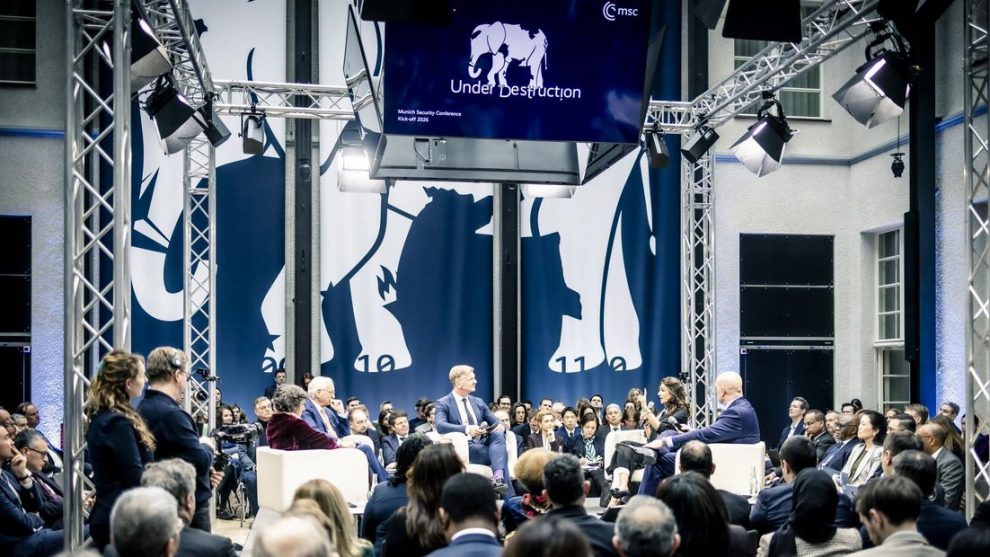
The 62nd Munich Security Conference (MSC 2026), which took place last week in the heart of Bavaria, went down in the history of diplomacy not as an effort to repair, but as a declaration of liquidation.
The question of “How do we reform the international order that has been ongoing for years?” was replaced this year by a much more worrying acceptance: The current order is collapsing; the main issue is how we can manage this destruction with as little damage as possible.
Of course, the destruction management I wrote about is not an idea I came up with. If it were, you could pass it off as the author’s own view, but it turns out that the official report of the Munich Security Conference used the title “Under Destruction” this year, which is the main theme used by global elites.
The liberal world order based on rules, established after 1945, is no longer even a patchwork. Today, the existing order is described as a building that is shaking from its foundations and whose collapse is inevitable. The prevailing atmosphere in the corridors of the conference is: the reform train has already left, now it’s time for controlled demolition.
So far, changes in order have been quite bloody, so a security conference with the theme of “destruction” should make all of us shiver.
Why can’t the status quo be repaired?
For years, the G7 countries and the transatlantic alliance have tried to patch up the cracks in the world with diplomacy, economic sanctions, or regional alliances. However, the 2026 Munich Summit showed that Washington’s bulldozer politics, Europe’s internal vacuum, and especially Southeast Asia’s wholesale objection to the West-centered order have disrupted the working rhythm of the old system.
Now, the gears in the system no longer turn smoothly, but instead grind against each other.
Is a successful destruction possible?
The most debated thesis of the conference was that destruction is not an end, but a process. If this destruction process can be managed without escalating into a nuclear confrontation, a total trade war, or uncontrolled migration waves, humanity can transition to a “new order” at a lower cost.
When I say “lower cost,” I emphasize that a cost will inevitably be paid. From the moment world history began to be written, the cost of such order transitions has been extremely bloody.
Considering where we are now, and the deadliness of countries’ war machines, I leave it to you, dear readers, to imagine the picture that will emerge.
Türkiye and the region
It is a fact that Türkiye has been undergoing a heavy preparation process to protect its own geography in the face of the impending chaos, from the Caucasus to Syria and Iraq, and from Libya to Somalia with the concept of Blue Homeland.
Türkiye will continue to use the next critical five years to prepare for this destruction process in all areas, and if this time is not used well, I think several centuries will be lost.
On the threshold of a new world
Munich 2026 is a frantic effort to prepare a shelter against the coming storm.
The world has now abandoned its dream of becoming a better place and has instead sat down at the table to negotiate a less bad transition.
If the destruction is successfully managed, history will record it as an exceptional transition period; if it is not managed, the controlled demolition discussed in Munich will give way to a global debris removal effort.
Source: https://www.aksam.com.tr/yazarlar/yusuf-alabarda/batan-geminin-mallari/haber-1644178