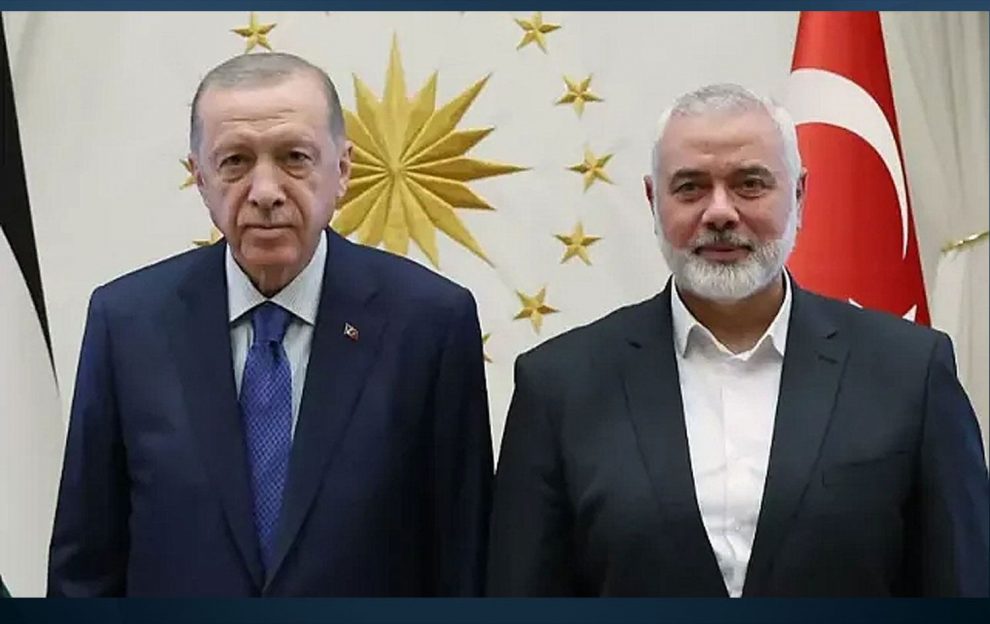

Today, on the anniversary of the martyrdom of Palestinian Prime Minister Ismail Heniyye, I would like to share the story of a letter he entrusted to me.
Today, on the anniversary of the martyrdom of Palestinian Prime Minister Ismail Heniyye, I would like to share the story of a letter he entrusted to me.
I have visited Gaza three times. My first visit was in 2008, followed by a second visit to establish Anadolu Agency’s Gaza office, and finally a third visit in November 2012 at the height of the Israeli offensive.
I first set foot in Gaza in 2008 with a group of volunteers from IHH. Gaza, which had been blockaded by land, air and sea since 2006, was entering the second year of the embargo. In those dark days, Gazans rebelled against the steel wall built between them and Egypt and shouted by breaking that huge barrier: “We want to live!”
Two thirds of the steel wall had fallen to the ground. The next morning, as tens of thousands of people poured over the wall and crossed into Rafah, we reached Gaza with them. Freedom was beating in the hearts of Gazans at that moment; they were running to find bread, to get medicine, to cling to a crumb of hope.
That moment of Armageddon at the border was a stark reminder of the siege the people of Gaza were under. Children, women, old people… Each one of them was running somewhere, and those who passed through al-Arish were buying whatever they could find and filling their bags with hope. Tongues were silent, eyes were speaking…
During the four days we stayed in Gaza, we met with orphans and families of martyrs. We delivered aid and shared prayers. On the last day of our visit, we met a leader who welcomed us with great humility: Palestinian Prime Minister Ismail Heniyye. He was a leader who lived in a modest refugee house in Gaza, at a table on the floor, intertwined with his people.
With his speech, his posture, the twinkle in his eyes, he made us feel that he was a true leader of the people. He greeted us with the ancient name of Istanbul:
“Hello my brothers from Asitane!”
Asitane, meaning the capital. This address was not just a greeting, but a sign of a heart connection. Even in the midst of the embargo, occupation and bombardment, he was spreading hope around him. “We have not given up, we will not give up,” he was saying. “Even the destruction of the Rafah border crossing is a sign that we will overcome this blockade.”
He spoke with great gratitude of the Turkish people’s support for Gaza. “From the land of Gaza, from the blessed land of Palestine, from Jerusalem al-Sharif, I convey my warmest greetings on behalf of myself, my government and my people to the brotherly people of Turkey,” he said.
When we said goodbye hours later, he handed us a sealed envelope. The following sentence was written on the envelope:
“From Palestinian Prime Minister Ismail Heniyye to Turkish Prime Minister Recep Tayyip Erdoğan.” He entrusted that letter to me. I shook his hand and hugged him. Just before we parted, we talked about President Erdoğan. His eyes shone when he mentioned his name. “My dear friend Erdoğan,” he said in a sincere tone. So much loyalty, hope and brotherhood was packed into those two words. I remember the sparkle in Heniyye’s eyes, the love in his heart, the warmth of that moment as if it were today…
After receiving the letter, I placed it in my backpack with great care. Then my friends and I crossed the Gaza border and reached the Egyptian side. On the other side of the border crossing, tired and impatient taxi drivers were waiting. The negotiations dragged on, some demanding too much, some not trusting the vehicle. Finally, we made a deal with an old Egyptian uncle. “Come on, guys,” he said with his curly beard and tired but smiling eyes. He had an old model BMW, but it looked like it had long since given up being a car. The wind blew through the doorways, the air conditioning didn’t work, the interior smelled like junk. But what we were promised was not luxury, but reaching Cairo. At the time when the sun was setting softly in the desert, we set off on a long 5-hour journey in the cooling sands of Sinai.
Friends were worried that the old driver might fall asleep. So I sat in the front seat, sleepless but alert. “Whatever you do, keep uncle awake,” my friends, who were sleeping in the back seat wrapped in blankets, told me. So that long night, I both chatted with him and sang songs in my own way. Not professionally, of course… But whatever came to me: Folk songs, art music, sometimes arabesque. There was both homesickness and the pain of Gaza’s resistance. The old Egyptian sometimes accompanied me, sometimes shrugged, but always kept his eyes on the road.
As we approached Cairo, we fell asleep without realizing it. We were startled by a scream from behind as the car swerved left and right. The old uncle grabbed the steering wheel as if he had never slept, rubbed his eyes and said, “Don’t be afraid, children. “Even if I sleep, this car knows these roads by heart. It has been like this for years…” We both laughed at these words and talked about other ways to keep the driver fresh by changing places in a hurry.
When we arrived in Cairo, it was night, our eyes were bloodshot and our backs were tired from the days. We looked for a place to stay. Finally, we decided on a hotel that was both safe and comfortable. This hotel promised a night that would bring some peace to our bodies that had not slept for seven days. The next evening we had a flight to Istanbul. In the morning, I told my friends that I wanted to go to the famous Cairo Book Fair in Egypt. They wanted to join me. We made our plan and everyone retired to their rooms.
We got up early in the morning. Sleep was still in the corner of our eyes, but even these few hours of rest had revitalized our bodies. As I was packing my bag after breakfast, I thought of that relic. Ismail Heniyye’s letter to President Erdoğan… I asked my friends: “Should I carry this letter in my bag or leave it in the suitcase in the hotel room?” One of them immediately objected: “Keep it in your bag. You can’t put such an embassy in a suitcase. Just in case.”
His words were right. I carefully placed the letter in the most protected compartment of my backpack and then we took a taxi to the Cairo Book Fair. There was also a very valuable meeting in our plan that day. We were going to meet Prof. Dr. Abdel Wahhab al-Messiri, one of Egypt’s world-renowned thinkers, a man of struggle and ideas.
I had the opportunity to meet Messiri a few times before. He had published his writings on the websites Dünya Bülteni and Tümetürk, of which I am the founder, and later these writings were published as a book by Mana Publications under the title “Hamburger Civilization”. He was a great thinker who knew both the East and the West, who deeply understood both the structure of Israel and the spirit of the Palestinian cause.
When we arrived at the entrance to the Cairo Book Fair, we stood in a long queue for the security check amidst the hum of the crowd and the whirring of the iron detectors. The sun was high in the dusty Cairo sky, casting a misty light over the place. As the line moved forward, I caught the eye of a young woman standing just in front of the entrance gate with a Palestinian keffiyeh on her shoulders. That keffiyeh carried the honor, the patience, the tear-stained history of a people.
The security guards approached her. They asked:
“Where are you from?”
“Palestinian.”
“What are your views?”
“I am a leftist,” the young woman said, holding her head high.
As the interrogation continued, out of the blue, an Egyptian security guard rushed forward, pulled the young girl’s keffiyeh off her shoulders and threw it to the ground. Then, without hesitation, he began to step on it with his feet. At that moment something inside me snapped. My voice raised on its own: “What are you doing? Are you Israeli soldiers?”
Before the echo of my words was over, a crowd, I couldn’t tell how many, descended on me. As I was being tossed back and forth in the melee, I realized that they started to rummage through my bag. And at that moment… They saw the letter that Heniyye had entrusted to them. When they tried to open the envelope, I made one last move: “Stop! That letter is official, you can’t open it!”
But everything went black in an instant. I fell to the ground, got dizzy and lost consciousness in the chaos.
When I opened my eyes, I found myself in the basement of a security center near the book fair. Cold concrete walls, a blackened table, a yellow lamp shining on me. I was sitting on a chair. A few minutes later a large, angry Egyptian guard entered. He was throwing punches at the table, hurling insults, saying “letter” over and over. He was shouting unspeakable words against Turkey, Erdoğan and the Palestinian cause.
I tried to stay calm, but every time he said something, another knot tightened in my heart. I couldn’t take it anymore and shouted: “We are the descendants of Yavuz Sultan Selim! You have handed Egypt over to Israel and America. We are here to take it back!”
He became even more enraged by my words, hit the table once more and left the room. Then another official with a softer temperament and a face that bore traces of compassion entered the room.
“O my brother,” he said, “why did you shout with the officer before?”
“Because that person has declared himself a man of Israel and America. He insulted Turkey and Palestine. I couldn’t keep quiet,” I said.
He bowed his head and sighed. “Unfortunately, there are such people in this country,” he said.
After he left, the sounds of arguing started coming from the corridor. The soft-spoken official and the angry one were talking loudly at the door. Their every word echoed off the walls.
After a short while, the burly officer entered the room again. This time he was more aggressive. He pounded on the desk, again asking for the letter. He was followed by the other again. Hours passed between these two poles, between questioning and arguing…
At the end of four hours, a man in a suit walked in, introducing himself as someone from the Ministry of the Interior. He was serious but measured. First he took the letter in his hand, the envelope had been opened. He read it. Then he turned to me:
“Tell me what happened,” he said.
I started. I told him everything, from the incident at the gate of the fair, to the letter being taken out of my bag, to the insults and arguments.
He was silent for a while. Then he took out a notebook from his jacket pocket. “We have researched you,” he said. “We know you are a good journalist known in the Arab world. We also received a call from the Turkish Embassy in Cairo. You will therefore be released.”
“But,” he said, “we will keep the original letter. Here is a photocopy.”
I looked at the envelope. The photocopied page was in front of me. But the original letter was a few feet away, on the table.
As they prepared to release me, I had only one thing on my mind: the escrow. The letter I received from Heniyye’s hands could not be replaced with a photocopy. That envelope had been sealed by his hand and given to me with his blessing.
Suddenly I stood up, said something to distract the attention, caused a small commotion, and then, with quiet agility, replaced the photocopy with the original. I placed the letter inside my jacket. My eyes went to the door. An attendant gave way. The other hadn’t noticed. Only this sentence ran through my head: “The trust must find its place…”
I descended the stairs with heavy steps under the stern gaze of the security guards at the gate with guns slung over their shoulders. With each step, I carried the coldness of steel that I was trying to leave behind but that echoed inside me. Across the road, an old taxi was waiting, pulled over. I jumped in without hesitation. “To the hotel,” I said, my voice almost too tired to be heard, but with the weight of a decision.
As the taxi drove on, I took the letter out of my bag with trembling hands… Heniyye’s letter to Erdoğan… I opened it slowly and my eyes fell on the lines. Each word hit my heart like a bullet, and the tears flowed softly down my cheeks. In his letter, Heniyye addressed Erdogan with great affection, expressing his gratitude to the people of Turkey, the suffering of his brothers in Gaza, the suffocating weight of the embargo and the shortage of food and medicine.
The taxi driver glanced at me in the rearview mirror, but asked nothing. At that moment, there was only me and the secret of this relic on the streets of Cairo…
When we arrived at the hotel, I put the letter back in the envelope. When I entered the lobby, my friends were waiting for me. We hugged. It was a hug full of warmth and tranquility, a greeting of having survived a hardship, of having carried a burden together. Afterwards, we met the Turkish publishers who were at the fair. They were also packing up and getting ready to return.
We were in a hurry not to be late for the airport when the hotel manager approached us from behind.
“Excuse me, are you Turan Kışlakçı?”
“Yes,” I said hesitantly.
“Sir, the owner of our hotel likes you very much. He reserved the king room for you. Let’s move your things right away.”
For a moment we were stunned, my friends and I looked at each other, and then the man handed me a candy bar. I smiled, put the candy in my pocket, then pointed to the restroom and said, “I need to wash my face.” While the manager went to the reception phone, I pretended to go to the restroom, threw the candy in the trash, and headed out the side door. Outside, one of our publisher friends I knew from the fair was waiting in a taxi. I jumped in, my eyes on the clock. Time was tight. If we got stuck in traffic, we might miss the plane.
“Go fast,” I repeatedly told the taxi driver. Through the window of the car, the dusty buildings and monumental streets of Cairo were left behind. We were halfway there when my phone rang. It was the hotel manager.
“Mr. Turan, where are you? We are looking for you everywhere.”
“I’m on my way to the airport,” I said shortly.
Soon another phone call came. This time the voice on the other end was familiar. It was an Egyptian writer I had met at seminars in Turkey.
“Why did you leave?” he said. “Why did you refuse the hotel owner’s hospitality?”
The words came out of my mouth spontaneously:
“Are you also Egyptian intelligence, maestro?”
At that moment, the phone went off. And that voice never returned to my life.
When we arrived at the airport, my friends had already delivered my belongings to the baggage claim. I quickly passed through the security checks and reached the platform where the Turkish Airlines flight was to take off. When I sat in my seat, it was as if a mountain had been lifted from my shoulders. I took a deep breath. On the one hand I was looking at the relic in my hand and on the other hand I was thinking about what the Gazans were going through…
The hope shining in Heniyye’s eyes, the prayer of Gaza wrapped in resistance, the sincerity of the love for Erdoğan, all of them were no longer hidden in my bag, but in the depths of my heart…
The plane’s engines started. I closed my eyes. There was a whisper on my lips:
“Allahu akbar… Allahu akbar…”
Source: https://kritikbakis.com/heniyyenin-kaleminden-erdogana-bir-mektubun-hikayesi/