
By Mehmet Acet*
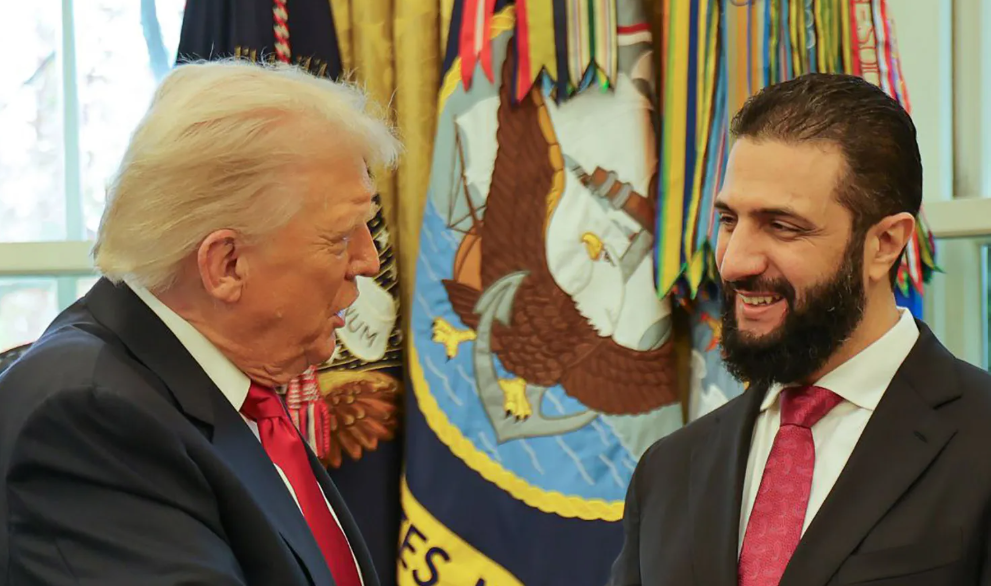
The previous evening, Syrian President Ahmed al-Shara met with US President Donald Trump at the White House for a meeting that lasted over an hour.
The images reflected were historic in nature.
The US had declared the individual a terrorist and put a bounty on his head, but he was now being hosted at the White House.
This situation was made possible by Trump’s personal insistence, as his surroundings and US institutions continued to express reservations, evident from Shara’s meeting being held through a back door.
GOOD NEWS FOR TURKEY…
In September, a new Syrian flag was sent to Washington, and Shara attended a UN General Assembly meeting, marking an important threshold in the recognition of the new Damascus administration.
This development was also significant and welcome news for Turkey, which views the new Damascus administration as a close ally and supporter.
The international legitimacy and strengthening of the Damascus administration, and the efforts to revive the idea of a unified Syria, were met with satisfaction in Ankara.
Notably, Turkish Foreign Minister Hakan Fidan was also at the White House at the same time, a clear indication that Turkey was involved in the discussions.
After Shara and Trump met for about an hour, a trilateral meeting was held between the foreign ministers of Syria, Turkey, and the US.
The goal was to follow up on the understanding reached between the two presidents and establish practical application mechanisms.
TRUMP GAVE HIS TEAM INSTRUCTIONS NOT TO PUT HIM AT ODDS WITH TURKEY
Trump is pursuing a policy of building Syria’s future in cooperation with Turkey.
This has become increasingly clear.
In a sense, he has written Syria off to Turkey.
He has also instructed his team to “not bring me any issues that will put me at odds with Turkey” in Syria.
After meeting with Shara, Trump made another statement praising Turkish President Tayyip Erdogan, saying, “Erdogan is a great leader and strongly supports what is happening in Syria.”
This is also good news for Ankara.
US Ambassador to Turkey and Special Representative to Syria Tom Barrack was present at the White House meeting and described it as “historic.”
He also made the following assessment:
“Syria, which was a significant problem for us, has become an important partner.
There are positive steps regarding the integration of the PYD.
You will see its impact in the coming days.”
ANXIOUS NEWS FROM ISRAEL AND THE SDG FRONT
Shara’s hosting at the White House was met with satisfaction in Ankara but caused unease among two groups:
Israel and the Syrian Democratic Forces (SDG) in northwestern Syria.
Israel’s anxiety was reflected in media reports.
For example, Kan News reported:
“Syrian Kurds are anxious about Shara’s US visit.
They fear that Syria’s participation in the coalition against ISIS may have negative consequences for the Kurds.”
The US, or rather Trump and his special representative, working with Ankara on Syria has caused significant discomfort in Israel.
On Sunday, Israeli Prime Minister Netanyahu held a meeting with senior officials to discuss developments in Gaza and Syria, focusing on Turkey.
However, considering the power of the Israeli lobby within US institutions, it would be incorrect to assume that the issue is now settled.
Shara’s security agreement with Israel may not be enough to alleviate Israel’s concerns.
A crucial issue is whether the SDG will adhere to the March 10 agreement and the understanding reached with the Damascus administration.
Turkey’s security concerns are closely tied to this.
Turkey’s cooperation with the US has created an opportunity for the process to move forward despite Israel’s opposition.
The new position of CENTCOM, the architect of the SDG formation in northwestern Syria, is also in Ankara’s favor.
They claim they will not stay there forever and are conveying this message to the SDG to reach an agreement with Damascus and Ankara.
However, there is also information that Israel is sending a message to the SDG, saying, “Even if the US leaves, we will support you.”
This poses a significant threat to the SDG’s integration into Damascus.
During such periods, provocations can occur.
Indeed, a new report emerged that ISIS had attempted to assassinate Shara and the new Syrian government not once but twice, and these attempts were foiled.
Those who have lost at the negotiating table may resort to provocations on the ground to poison the atmosphere, and it is essential to be aware of this.