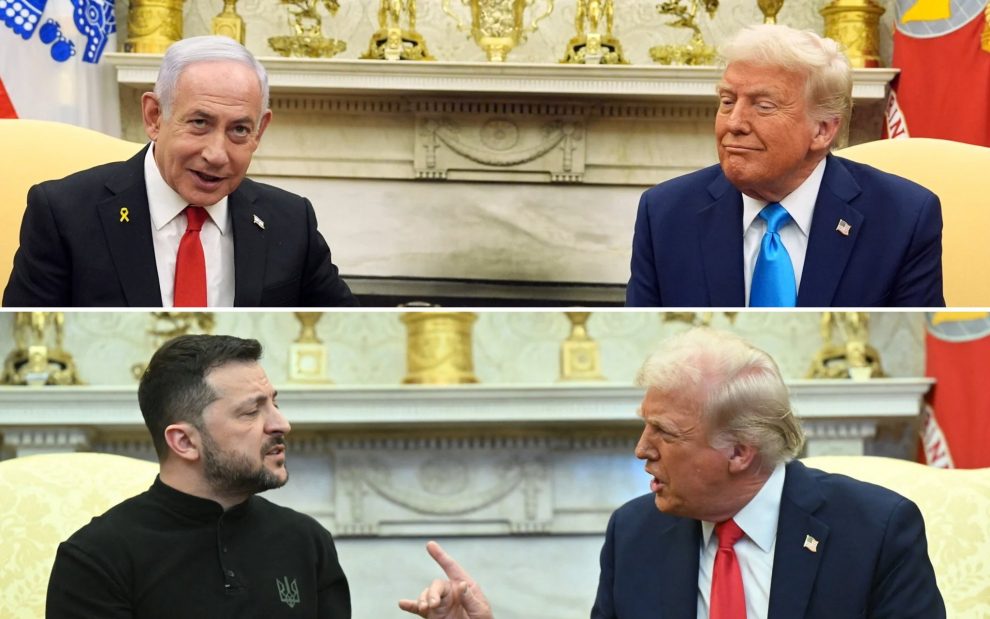

In the shadow of America’s ballooning $37 trillion national debt, President Donald Trump’s “America First” foreign policy has taken a sharply transactional edge. No longer content with open-ended commitments to allies, Trump has begun framing U.S. aid as investments that demand returns—whether in minerals, oil, or outright repayments. His recent push for Ukraine to hand over access to $500 billion in rare earth minerals as payback for American support has stunned diplomats and allies alike. But as a new report from Brown University lays bare the staggering cost of U.S. military aid to Israel—$21.7 billion since the Gaza war erupted in October 2023—the question looms: Will Trump turn the screws on Israel’s lifeline, too? The Brown University Costs of War Project’s latest analysis, released on the two-year anniversary of the October 7, 2023, Hamas attacks, paints a stark picture of Uncle Sam’s generosity. Over the past 24 months, the U.S. has funneled at least $21.7 billion in military assistance to Israel, dwarfing the usual annual $3.8 billion baseline. Of that surge, $17.9 billion flowed under President Joe Biden’s watch through September 2025, with an additional $3.8 billion approved under Trump’s second term.
This isn’t pocket change; it’s enough to fund major infrastructure projects or shore up domestic priorities like border security or veteran care. The report’s authors, including policy analyst William D. Hartung of the Quincy Institute, emphasize that this figure excludes tens of billions more in arms sales commitments stretching into the future.
Layer on another $9.65 billion to $12.07 billion for U.S. regional operations—think Navy strikes against Yemen’s Houthi rebels, who launched attacks in solidarity with Gaza—and the total tab climbs to $31.35 billion to $33.77 billion.
“This was substantially more than in any other year since the U.S. began granting military aid to Israel in 1959,” the report notes, underscoring how the Gaza conflict has supercharged an already historic alliance.
Israel, the top cumulative recipient of U.S. aid since World War II at $251.2 billion (inflation-adjusted), has relied on American hardware—from precision-guided bombs to Iron Dome interceptors—to sustain its operations against Hamas, Hezbollah, and other threats.
Trump’s approach to foreign aid, however, has always been about the bottom line. During his first term, he slashed aid to nations he deemed insufficiently grateful, like withholding Ukraine’s security assistance in 2019 to pressure Kyiv into investigating political rivals—a move that sparked his first impeachment. Fast-forward to 2025: With Russia grinding down Ukraine’s defenses, Trump has escalated that playbook into outright debt collection. In February, he demanded Ukraine cede rights to its vast rare earth deposits and oil reserves—valued at up to $500 billion by his administration—as collateral for the roughly $182 billion in total U.S. support since 2022.
fortune.com
“We’re asking for rare earth and oil, anything we can get,” Trump declared at the Conservative Political Action Conference, exaggerating U.S. contributions at $350 billion while insisting Europe treat its aid as loans.
This minerals-for-missiles deal, reportedly inked in March, includes a 10-year grace period and 35-year repayment terms, but critics like the Vienna Institute for International Economic Studies warn Ukraine’s debt burden is already unsustainable without broader relief.
Ukrainian President Volodymyr Zelenskyy, initially resistant, has warmed to the framework, viewing it as a pathway to “security guarantees” amid stalled peace talks.
Yet the optics are brutal: A war-ravaged nation bartering its natural wealth to keep American F-16s flying.So, why not Israel? The Jewish state boasts a robust economy—GDP per capita rivaling Western Europe’s—and a defense budget second only to the U.S. globally. Unlike Ukraine’s loans and grants, much of Israel’s aid is outright grants, deposited interest-free into a Federal Reserve account for weapons purchases.
Trump himself hinted at restructuring aid as loans during his 2024 campaign, vowing to demand repayment from any ally that “drops us like a dog.”
In a February 2025 Oval Office address, he exempted Israel from a broader foreign aid freeze via executive order, fast-tracking $4 billion in emergency munitions and reversing Biden-era holds on bomb shipments.
Since January, his administration has greenlit nearly $12 billion in Foreign Military Sales to Israel, bypassing congressional reviews.
Public sentiment on X (formerly Twitter) crackles with frustration over this disparity. “We’re $37 trillion in debt and still sending billions to Israel while our veterans sleep on streets,” one user vented, echoing a thread criticizing a House bill extending U.S. military benefits to Israeli Defense Forces personnel.
Another post questioned: “Trump stopped foreign aid—except to Israel. AIPAC controls nearly all politicians.”
Hashtags like #EndForeignAid and #AmericaFirst trend sporadically, blending isolationist MAGA voices with broader critiques of endless wars.Yet Trump’s calculus with Israel differs profoundly from Ukraine’s. The U.S.-Israel bond is woven into domestic politics—AIPAC’s lobbying muscle, evangelical support, and shared intelligence on Iran make it a third rail. Prime Minister Benjamin Netanyahu, a Trump ally, has publicly mused about “weaning” Israel off aid, but only after securing long-term commitments.
In September 2025, amid escalated strikes on Hezbollah, Trump deployed additional carrier groups to the region, signaling unwavering backing.
No whispers of minerals deals or repayment clauses have surfaced; instead, aid flows freely.Experts are split on whether this will change. “Trump’s Ukraine gambit is a template for fiscal hawks, but Israel is the exception that proves the rule,” says Hartung, whose report warns that such aid “fuels enmity toward the U.S.” in the Arab world.
A Council on Foreign Relations analysis notes the aid’s scrutiny has intensified post-Gaza, with polls showing 51% of Americans opposing more support.
If Trump’s tariffs and domestic spending hikes balloon the deficit further, pressure could mount—even from within his base.For now, Israel dodges the debt collector. But in Trump’s ledger-driven world, no ally is untouchable forever. As one X user quipped amid the Brown report’s fallout: “Ukraine pays with dirt; will Israel pay with tech?” The answer may define whether “America First” means friends first—or cash on the barrelhead.