

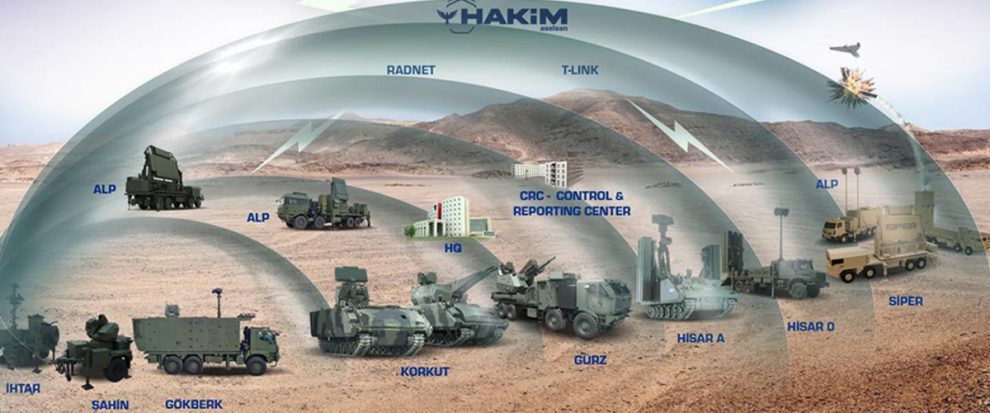

Turkey is strengthening its defenses. Through the Steel Dome project ( Çelik Kubbe ) , Erdogan’s country seeks to develop an integrated, multi-level air security system using domestic technology to protect its airspace from threats such as missiles and drones. The project was officially approved a year ago, in August 2024, by Turkey’s Defense Industry Executive Committee (SSIK).
Using sensors, radars, weapons, command stations, and communications under a common network, the system, supported by artificial intelligence for improved results, aims to detect and respond to threats entering the airspace of the transcontinental country (it belongs to both Europe and Asia, with most of its territory in the latter continent).
Drones (unmanned aerial vehicles) have become essential tools for modern militaries because they can carry out missions in dangerous environments without endangering the pilot, and are also ideal for reconnaissance, intelligence, and surveillance operations in combat zones. A few months ago, Ukraine surprised Russia with Operation Spider Web, an attack using more than 100 drones on various bases in Vladimir Putin’s country.
A system often compared to Israel’s Iron Dome , but more comprehensive and effective
Turkish defense company Aselsan recently delivered 47 vehicles to the Turkish Armed Forces as part of the Steel Dome system , a project that seeks to create a multi-layered “national shield” to combat aerial threats. The supply is valued at $460 million (€388 million) and consists of air defense, radar, and electronic warfare systems. Turkish President Erdogan, who described the system as the country’s “security umbrella” in the skies, said during an opening ceremony in Ankara:
Today we are equipping our heroic military with Sky Dome systems, comprised of 47 vehicles valued at $460 million, that will inspire confidence in friends and fear in enemies.
While the new system will integrate AI-refined data from multiple sources to provide commanders with a unified view of threats nationwide, it is also expected to take into account existing defenses around key regions, particularly in Ankara and along the Bosphorus and Dardanelles straits.
The Steel Dome is composed of three main layers : very short-range defense (anti-drone weapons, anti-aircraft weapons, and portable missile systems), short/medium-range defense (intercepting cruise missiles, light aircraft, and helicopters), and long-range (interceptors such as the SIPER system, capable of targeting higher and more distant targets).
Turkey’s project has drawn comparisons to Israel’s Iron Dome , although Erdogan’s proposal is broader in scope and more layered to address a wider range of threats. With Iron Dome , Turkey is declaring technological independence in air defense, reducing its dependence on foreign systems.



