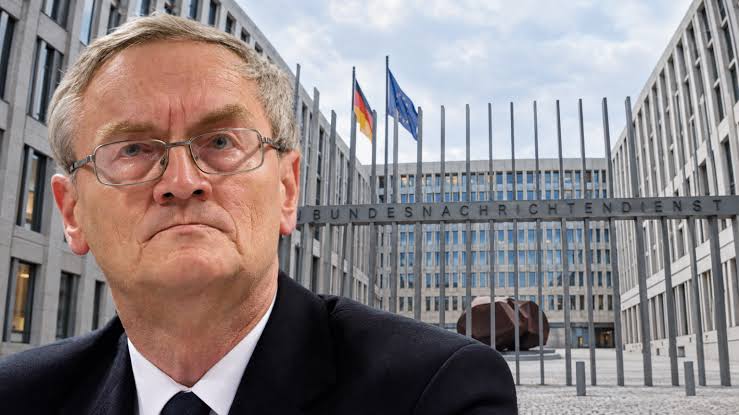

Germany’s former foreign intelligence chief, August Hanning, remains in custody after a federal court ordered him held on suspicion of espionage and attempted treason, in a case prosecutors describe as one of the largest leaks of classified material from the country’s spy service in decades.
Hanning, 80, who led the Federal Intelligence Service (BND) from 1998 to 2005 and later served as state secretary in the Interior Ministry until 2009, was arrested on October 6 at his home in Nordwalde, near Münster. A former aide, identified only as Manfred D., was detained the same day. On October 7 a judge of the Federal Court of Justice issued formal arrest warrants for both men.
The Federal Prosecutor’s Office says the two agreed in 2010 that Manfred D. would supply Hanning with confidential BND material in exchange for payment. Manfred D. later served as chief of staff to Hanning’s successors and remained at the agency until March 2026. Investigators say he passed on roughly 2,000 documents, many of them classified and intended only for internal briefings. German public broadcasters have reported that the cache included material on Iran’s nuclear program and the Russian military, as well as reports from foreign partner services.
Prosecutors allege Hanning used some of that material in his private consulting work, drafted an analysis for an officer of one foreign intelligence service, and maintained contact for years with a representative of another, passing on political information. They have not named either service, and it is not clear whether the analysis reached its intended recipient. Hanning’s lawyer has said he partially acknowledged elements of the case but denied selling information; he has also told Der Spiegel that his client is being wrongfully prosecuted.
German magazine Der Spiegel reported that investigators were examining a link to Azerbaijani intelligence and that Hanning had sat on the board of the German-Azerbaijani Forum. Azerbaijan’s Media and Broadcasting Council denied any connection and called the report a smear aimed at damaging ties with Berlin. The prosecutor’s office declined to comment on the Spiegel account. Separately, Agence France-Presse reported that Russia was not believed to be involved.
The Turkish outlet Straturka, in posts on October 8, framed the case differently, writing that Hanning was accused of passing classified documents to Israel and that his “Jewish background” had been questioned in connection with alleged cooperation with Israel. Those claims are not supported by the prosecutor’s public statements. German biographical sources list Hanning as Protestant. The Israel-related material in the public record concerns a separate investigation: Hamburg prosecutors have accused Hanning of putting steakhouse heiress Christina Block in contact with a private firm staffed by former Israeli intelligence officers, in connection with the alleged abduction of her children from Denmark during a custody dispute. Searches in that case are what first turned up classified BND material and led to the espionage probe.
Straturka also noted that Hanning serves as senior European adviser on the advisory board of United Against Nuclear Iran (UANI), a Washington-based advocacy group whose stated aim is to prevent Iran from acquiring nuclear weapons. That role is confirmed on UANI’s own leadership page. The group’s board includes former officials from the United States, Israel, Britain and elsewhere. Straturka described UANI as part of an “Israeli lobby” that, with other organizations, pressed for U.S. military action against Iran. UANI presents itself as a bipartisan sanctions and pressure campaign; it does not publicly describe itself as an arm of the Israeli government.
If convicted of treason, Hanning could face a life sentence under German law. He has not been convicted of any charge.