
A group of western geologists have announced that they have found remnants of Noah’s Ark on Durupinar region near Mount Ağrı (Ararat) in Eastern Türkiye. The Bible also writes that Noah’s Ark landed on Mount Ararat. If confirmed, the place of Noah’s Ark will be where the Bible pointed out.
However, Qur’an says it landed on Mount Cudi, located in Southeast Türkiye. Islamic Encyclopedia written by Turkish authors gives below information about landing of Noah’s Ark on Mount Cudi:
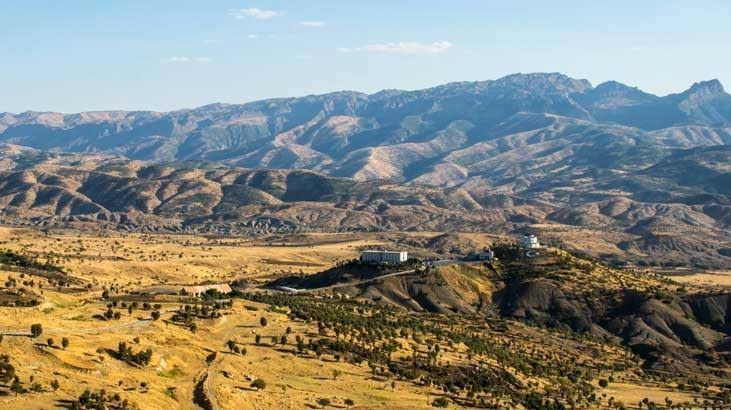
“Mount Cudi is located in the Southeastern Anatolia region, 17 km from the provincial center of Şırnak and 32 km northeast of Cizre—a town situated on the banks of the Tigris River, 15 km from the Turkey-Iraq border. Mount Cudi is elliptical in shape and features four peaks exceeding 2,000 meters in height; the highest of these stands at 2,114 meters. Among these peaks, the one rising to 2,017 meters is known as the “Prophet Noah Visitation Peak.”
The geological foundation of Mount Cudi consists of massive limestones dating back to the Jurassic and Cretaceous periods. Overlying this base is a series of younger formations (dating from the Late Cretaceous to the Paleocene), which include green-hued ophiolitic rocks in certain areas. Although some sections are steep and rugged, the mountain is generally very easy to ascend and descend. Streams and torrents flow from its southern slopes into the Tigris River. Despite its modest elevation, the mountain presents a majestic appearance when viewed from the south and west. Although situated in an arid region, it receives over 500 millimeters of rainfall; consequently, pine and oak forests thrive at altitudes between 1,500 and 2,000 meters. While the tree cover has suffered significant damage, forested areas still exist on the mountain’s northern slopes, whereas the southern slopes feature scattered oak trees.
Mount Cudi holds great significance in the history of religions, particularly within Islam, as the Quran states that Prophet Noah’s Ark came to rest on Mount Cudi following the Great Flood. The meaning of the relevant verse is as follows: “It was said: ‘O earth, swallow your water, and O sky, withhold [your water]!’ The water receded, and the matter was concluded. The Ark settled upon [Mount] Judi” (Hud 11/44). Although the word “Ararat” (Genesis 8:4)—which emerged from the mispronunciation of the term “Rrt” by Biblical authors—was misinterpreted (Dorme, p. 24) and Mount Ararat (Ağrı Dağı) was identified as the landing site of Noah’s Ark, it is evident that this does not align with the facts. Indeed, based on the works of numerous Armenian authors and others up to the 10th century, it is possible to establish with considerable certainty that Mount Ararat has no connection to the Flood. Ancient Armenian traditions contain no information suggesting that Noah’s Ark landed on a mountain. The accounts appearing in Armenian literature during the 11th and 12th centuries regarding the Ark landing on the summit of Mount Masik stem from the misinterpretation of the Biblical passage (Genesis 8:4) by Europeans (İA, III, 223). Moreover, Mount Ararat is extremely high and rugged, lacking the resources essential for human life, such as water, trees, and shelter; thus, it seems implausible for the Ark to have landed there. Conversely, the presence of numerous caves suitable for shelter on Mount Judi, the fact that its summit offers a surface appropriate for the Ark’s landing, and the availability of food sources provide strong indications that the Ark landed there. It is also noteworthy that the location where the ship came to rest acquired the name Yeşildağ.
Translating the word tradition—used in the original “Cûdî” entry written by M. Streck for the İslâm Ansiklopedisi—into Turkish as efsane (legend/myth) creates the erroneous impression that the historical event recounted in the Bible, the Quran, and ancient texts lacks any factual basis. Furthermore, the interpretation attributed to Nöldeke in the same entry does not reflect the truth. According to Nöldeke, the “Cûdî” mentioned in the Quran refers to a mountain in Arabia, which Prophet Muhammad regarded as the highest of all mountains (İA, III, 224). Islamic sources refer to two mountains bearing the name Cûdî. One is located on the Arabian Peninsula within the territory of the Tayy tribe; this is the mountain alluded to in the poetry of Abū Sa‘tara al-Bawlānī (Yāqūt, II, 180). The other is Mount Cûdî, the location and characteristics of which were described earlier. According to accounts recorded in all exegetical works and transmitted by Companions such as Ibn Abbās and Ka‘b b. Aḥbār, the mountain where the ship landed is the one known as Cûdî—situated “in the Jazīra region (between the Tigris and Euphrates rivers) near Mosul” (see, for example, Ṭabarī, VII, 48; Zamakhsharī, II, 271) and currently located within the borders of Turkey. If a mention in a poet’s verse is considered evidence, then the Judi (Cûdî) appearing in the poetry of Ibn Qays al-Ruqayyat and Umayya b. Abi’l-Salt refers not to a mountain in Arabia, but to the mountain in Southeastern Anatolia (Lisān al-ʿArab, entry “cvd”; İA, III, 224). Furthermore, the claim that the Prophet regarded Judi as being located in Arabia and as the highest of all mountains is baseless.
The narration stating that Adam built the Kaaba using stones brought from Mount Sinai, Mount Zayta, Mount Lebanon, and Mount Judi is also not authentic (Aydemir, p. 268).
Recent attempts by Jews, Christians, and Armenians to conduct research and investigations on Mount Ararat—claiming for political reasons that Noah’s Ark landed there—are entirely devoid of any religious or scholarly foundation (see AĞRI DAĞI; see also Tanyu, Nuh’un Gemisi, passim).
Both the geological structure of Mount Judi and the relevant historical information and narrations support the view that this is indeed the Mount Judi upon which the Quran states the Ark came to rest.”
Source: https://islamansiklopedisi.org.tr/cudi-dagi