
The world’s active military aircraft fleet has decreased to 52,231 units across 161 nations, reflecting a 1% net reduction of 411 aircraft from the prior year, primarily driven by the removal of Syria’s entire 414-aircraft inventory after a regime change in December 2024. This shift occurred amid Israeli and US airstrikes aimed at securing military assets, highlighting ongoing geopolitical tensions.
Throughout 2025, several high-profile conflicts contributed to fleet dynamics, including Israel’s operations against Hamas in Gaza, as well as strikes in Iran and Yemen. A short-lived India-Pakistan skirmish saw unverified reports of Indian Rafale fighter losses, while the US executed “Midnight Hammer” missions on Iranian nuclear facilities, deploying 125 aircraft—among them seven B-2 bombers—that delivered 75 precision-guided weapons in a 36-hour operation. Additionally, border clashes between Cambodia and Thailand involved F-16 and Gripen jets.
Dominating the global landscape, the United States maintains the largest fleet at 13,033 aircraft, accounting for 25% of the total, with 2,718 combat types and 610 tankers representing 75% of the world’s tanker capacity. Russia follows with 4,237 units (down 55 from last year), China with 3,529 (including an estimated 250 J-20 stealth fighters, up from 19), India with 2,183, and South Korea with 1,540. Regionally, the Middle East saw a 9% decline to 4,186 aircraft, while Africa and the Asia-Pacific experienced modest 1% increases to 4,257 and 14,681, respectively. Ukraine’s inventory grew to 347, bolstered by 25 donated F-16s and two Saab 340 airborne early warning and control (AEW&C) platforms.
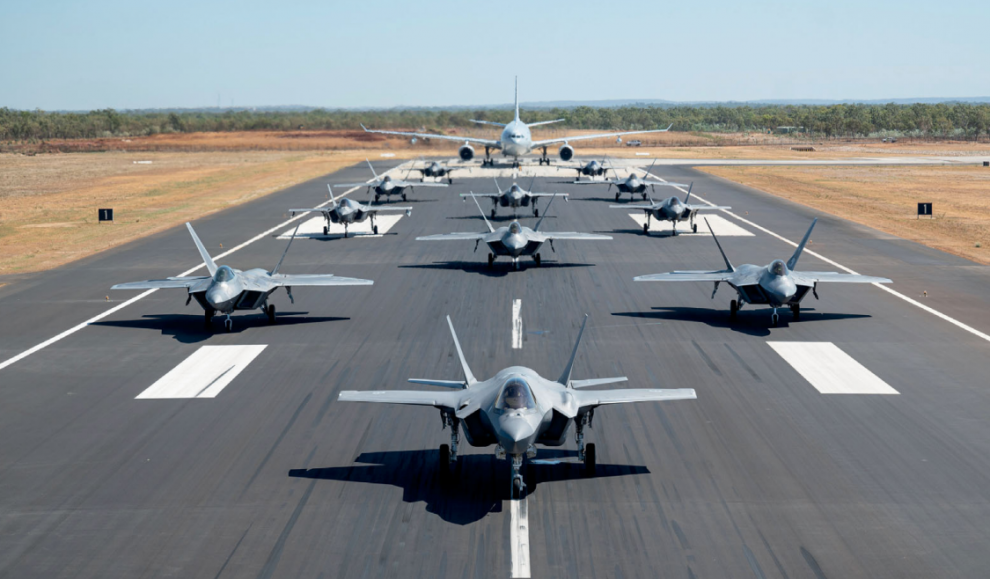
The year also featured key acquisitions and modernization efforts: Algeria secured 14 Su-57 fighters; Australia finalized its 72 F-35A procurement; India announced plans for 12 Su-30MKIs and 97 Tejas Mk1As; Japan opted for T-6 Texan II trainers; South Korea committed $2.6 billion to four Global 6500 AEW&C aircraft; Thailand ordered four Gripen E/Fs with intentions for eight more; Sweden acquired four C/KC-390s, joining Portugal, Lithuania, and Slovakia in expanding their fleets; Eurofighter deals went to Italy (24), Spain (25), Germany (20), and Turkey (20); the US advanced production of 185 sixth-generation F-47 fighters; and China’s J-20 count was revised upward.
Retirements included India’s MiG-21s, Japan’s C-1 transports, and a downward adjustment of Russia’s active L-39 trainers to 100. Notably, the KC-390 Millennium multirole aircraft—operated by Brazil, Portugal, Hungary, Netherlands, Austria, Czech Republic, South Korea, Sweden, Slovakia, Lithuania, and an unnamed buyer—boasted over 99% mission success after five years in service.These developments underscore a broader trend of fleet modernization amid persistent global conflicts, with implications for international security and defense spending.
Source: flightglobal.com