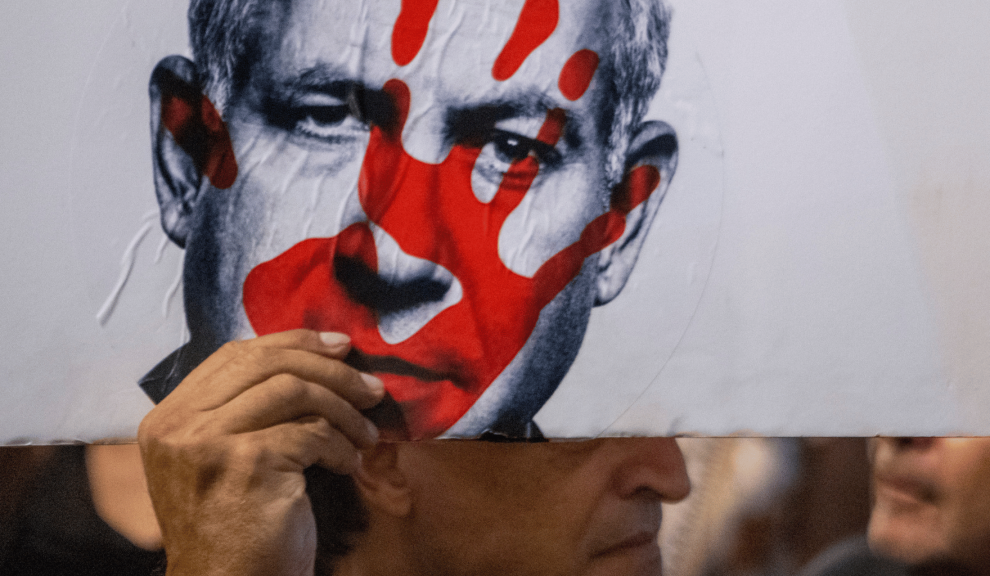

Recently, Jared Kushner—who is of Jewish descent and also Donald Trump’s son-in-law—remarked that Israel faces the prospect of global isolation. During a visit to Israel, Greek Health Minister Adonis Georgiades also observed that while Israel has defeated all its neighbors, it has lost the information war. As even Israeli leaders now acknowledge, Israel has indeed lost the war of information and propaganda. Moreover, despite their significant influence across the global media landscape, they have been unable to prevent this defeat.
Today, many of America’s largest mainstream media outlets are owned by businessmen of Jewish origin. They already held control over social media—one could even argue that they invented it—and the same applies to artificial intelligence. Furthermore, they have attempted to censor reports on the crimes committed by Israel—either by acquiring platforms (such as TikTok in the United States) or by pressuring owners to enforce censorship (as seen in the pressure exerted on Elon Musk regarding X)—yet these efforts have failed.
Israel is increasingly compared to Nazi Germany or the Soviet Union of the past. While it possesses military might, it is widely reviled. It cannot mask the crimes committed through its military power by leveraging “soft power.” Consequently, it has become a cold, unappealing, and deeply detested nation—a society viewed with intense animosity.Yet, until recently, they had managed to win people’s sympathy by playing the role of victims of genocide. Meanwhile, they used their influence—through the media, lobbying, and financial power—to cover up the occupation and massacres they were perpetrating in Palestine. Now, however, they have become the most hated country in the world.
There are several reasons for this failure. The first is social media, one of the most significant products of the internet. Ironically, although social media is largely controlled by Israel and the Jewish diaspora, it is also the very source from which they suffer their greatest blows. Platforms such as Google, YouTube, Instagram, Facebook, and WhatsApp generate hundreds of billions of dollars in revenue; yet, they have failed to reshape public perception. While they may own these social media applications, they do not own the users themselves. When people encounter something they deem wrong, they spread it immediately. Even though algorithms are used to impose censorship, they cannot contend with billions of individuals. No matter how heavily a massacre in Gaza is censored, anyone with a mobile phone can witness it. Ultimately, human intelligence proves more powerful than machines; people find ways to bypass these systems to convey or receive messages. Furthermore, if even one out of ten platforms allows for uncensored content, the message reaches everyone. What matters is not how many sources a message comes from, but whether it reaches its audience—and in the age of the internet, there is hardly any message that fails to reach its destination.
The second reason lies in the magnitude and persistent nature of the crime. For more than three years, Israel has been continuously slaughtering innocent Palestinians. Although the official death toll stands at 75,000, it is believed that the actual number of those killed is significantly higher. This is why these massacres are characterized as genocide. Had the death toll been lower and the conflict lasted only a few months, Israel’s atrocities might have been forgotten. Instead, for years, countless innocent people—including infants—have been killed; Gaza has been left in complete ruins; thousands have been slain in the West Bank; Southern Lebanon has been devastated just like Gaza; Southern Syria has been occupied; and, as if that were not enough, Iran has been subjected to bombings, with its leaders targeted and killed. Furthermore, the attacks on Iran have led to the closure of the Strait of Hormuz, causing oil prices to surge and the cost of living to rise. This is because Israel desires war.
Under these circumstances, hatred toward Israel continues to grow. Yet, Israel persists in claiming that it possesses the “most moral army,” that it is the “only democracy,” and that it is fighting on behalf of Western civilization. At the same time, it shows contempt for Christians, drains American resources, and makes life miserable for those who dare to criticize it. Just a few days ago, it filed a complaint with UEFA against the football club Galatasaray, solely because pro-Palestine banners were displayed—banners that did not even explicitly mention Israel. Such is their audacity and arrogance that they lodge complaints even over banners that do not name Israel; they oppose anyone who supports the cause of the occupied Palestinians. They seek to dictate whom people should love and whom they should not.
This arrogance is rooted in material power. Until now, they have managed to achieve most of their objectives through money. Just last week, they secured a resolution in the Swedish Parliament imposing a two-year prison sentence on those who deny the Holocaust. However, the power of money has its limits. They cannot pay everyone off, and not everyone is willing to turn a blind eye to atrocities in exchange for money. That is why they become isolated and are hated.On the other hand, there is another danger awaiting Israel—as well as those Jews who support it (and even those who do not): whenever an incident occurs, people immediately look to see if Israel is behind it. If an individual rises to prominence, people immediately scrutinize their ethnic or religious identity. If a crime is committed, they investigate whether the perpetrator has any connection to Israel or the Jewish community. For instance, if a case of pedophilia makes the news, people check whether the perpetrator is Jewish. If a foreign politician praises Israel, observers look into whether that politician has received support from Israel. If a cyberattack takes place, people ask whether Israel is the culprit.
In short, the Jewish community is being monitored and scrutinized as never before. This is because Jews are now being associated with acts such as killing, pedophilia, theft, and interference in elections. The situation has reached a point where individuals, institutions, and countries that support Israel are also being ostracized. For example, the United Arab Emirates’ relations with Israel were met with a strong backlash across the Arab and Muslim world. Similarly, the renowned writers’ association PEN International faced criticism for remaining silent regarding Israel, leading a group of journalists in America to decide to form an alternative organization. It could be said that those who align themselves with Israel are treated in the same way as Israel itself.
Israel seems to believe that it can thrive through oppression. Yet, throughout history, no state has ever managed to sustain its existence through such means. Just as Nazi Germany, the Soviet Union, and pre-1945 Japan—all of which were militarily powerful nations—eventually collapsed, Israel is now showing similar signs that point toward its own downfall. Those who win military conflicts must also win the hearts of other peoples. In other words, they must possess “soft power” alongside military might—and this soft power must be genuine, not contrived. People do not come to love a country or a society out of self-interest, fear, or for money; they merely feign such affection. This is precisely what foreign politicians do today. Yet, as seen in the United States, the intense hatred toward Israel has forced even these figures to forgo donations from Israeli or Jewish sources.
Through the use of “hard power,” Israel has defeated innocent Palestinians, but through its failure in “soft power,” it has lost the world at large. In the long run, it is quite possible that Israel will lose its military gains as well—for history offers no example of any entity that truly prospered through oppression.