
Iran is entering a dangerous phase where economic collapse, social unrest, and foreign-driven information warfare are converging, pushing the regime toward a critical decision point.
Iran faces a volatile intersection of deepening economic crisis, rising social frustration, and accelerating information warfare that exploits public vulnerability. As sanctions, mismanagement, and corruption fuel economic decline, scattered protests hint at broader unrest, while viral videos featuring “fake soldiers” calling for a national revolution reveal the extent of external influence operations. Tehran now confronts a strategic dilemma: reform risks unraveling the system, repression risks inflaming society, and hesitation risks facing both economic failure and internal chaos simultaneously.
Iran is entering one of the most fragile phases of its recent history. Years of sanctions, mismanagement, corruption, and costly regional engagements have pushed the economy toward a breaking point. Inflation remains punishing, the currency keeps losing value, and everyday life for ordinary citizens is becoming increasingly unbearable. As economic strain accelerates, the prospect of broad-based social unrest is no longer a theoretical threat—it is a real and growing possibility.
In this environment, hesitation has become Tehran’s most dangerous enemy. The longer the leadership delays decisive action, the higher the risk of confronting both economic collapse and internal chaos at the same time.
Economic Pressure Turns Into Social Volatility
Across several Iranian cities, scattered demonstrations have begun to surface—small in size, yet significant in meaning. These protests reflect a society pushed to the limit. What begins as economic frustration often shifts rapidly into political protest, because Iran’s rigid political structure offers no channels for peaceful, institutionalized dissent.
As grievances intensify, the security establishment finds itself walking a tightening rope: suppressing unrest without igniting a broader backlash.
A Viral Video and the Information War
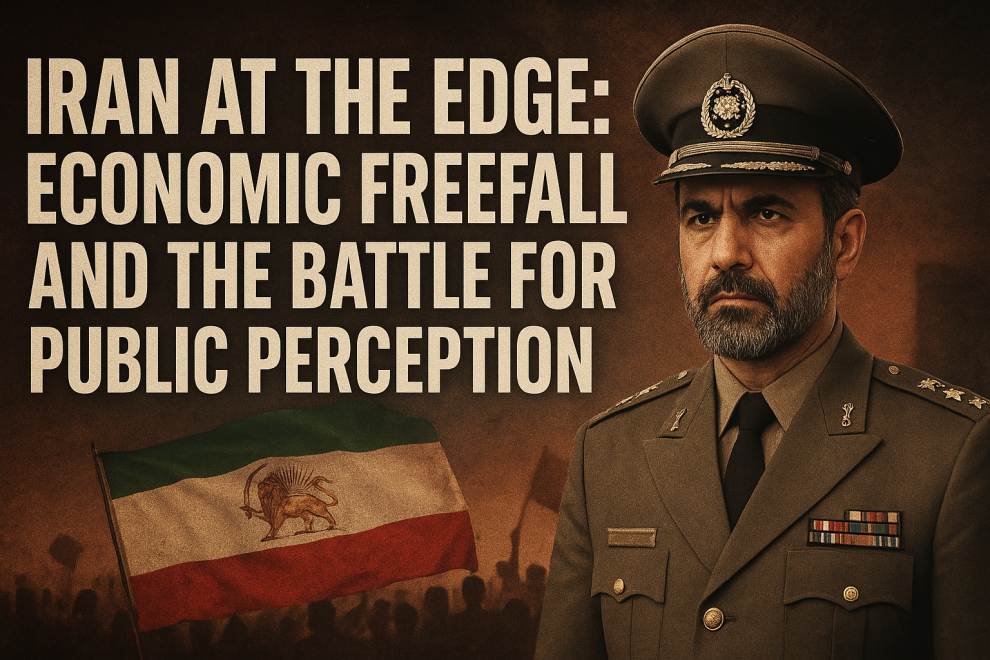
In the middle of this tense atmosphere, a video emerged online featuring a man identifying himself as Air Force Colonel Ebrahim Agaye Komazani, calling for a “national revolution” under the historic “Lion and Sun” flag. The message was calculated, dramatic, and instantly shareable—precisely the viral material that can ignite rumors in a crisis-prone society.
But within days, Iranian security officials announced that two individuals had been arrested, allegedly posing as military officers as part of a foreign-backed influence operation. According to Tehran, these figures were linked to U.S. and Israeli intelligence networks seeking to incite both the public and the military.
Whether or not those claims are fully accurate, one thing is clear:
A lone military officer calling for a coup is operationally implausible and strategically inconsistent with Iran’s military hierarchy.
Videos like these are typically designed to create:
- confusion within the ranks,
- false expectations among protesters,
- and a perception that the regime is losing control.
In other words, this is information warfare, not a genuine coup attempt.
Tehran’s Dilemma: Reform or Repression?
Iran’s leadership faces a harsh strategic choice.
- Reform risks undermining ideological foundations and triggering demands for deeper change.
- Repression may contain protests temporarily, but it accelerates economic deterioration and intensifies public anger.
This is the regime’s core dilemma: every path carries danger, but inaction carries the greatest danger of all.
The Myth and Momentum of “National Revolution”
The idea of an imminent nationwide uprising is largely a digital phenomenon rather than a coordinated real-world movement. Iran’s protest culture remains fragmented and primarily economic in origin. Yet, digital narratives—especially those framed as military defections or elite splits—can be powerful force multipliers.
Such narratives may:
- inflate expectations among ordinary Iranians,
- pressure the regime into excessive crackdowns,
- and widen the gap between society and the state.
The story of revolution, in other words, can be destabilizing even when no revolution exists.
Conclusion: A Country at a Critical Threshold
Iran is confronting an unprecedented convergence of crises:
- A deteriorating economy edging toward systemic failure.
- A restless society losing patience and confidence.
- An information battlefield where foreign actors and domestic dissidents compete to shape perceptions.
In this volatile equation, decisiveness—not delay—will determine Iran’s trajectory.
Every moment of hesitation sharpens the risk that the country could plunge into both economic freefall and social disorder simultaneously.