
By İdris Kardaş
2018 was a historic turning point for Christian Zionists.
U.S. President Donald Trump recognized Jerusalem as the capital of Israel and opened the American embassy there.
Immediately after the declaration of Jerusalem as the capital, Benjamin Netanyahu rushed to the White House and delivered the following speech:
“I want to say that the Jewish people have a long memory. We remember the proclamation of Cyrus the Great 2,500 years ago. He gave us the right to return to Jerusalem and rebuild our temple. And now we remember Donald J. Trump, who recognized Jerusalem as the capital.”
The streets of Jerusalem were decorated with giant billboards showing Trump’s photo with the words “Cyrus the Great Lives!”
The Jerusalem-based Mikdash Educational Center even minted a special coin to honor Trump’s recognition of Jerusalem as Israel’s capital.
On one side of the coin were the profiles of Trump and the Persian King Cyrus. On the reverse side was an image of the planned “Third Temple.”
King Cyrus of Persia was a ruler who conquered the Medes, then the Lydians, and later the Babylonian Empire about 2,500 years ago. He did not interfere with the beliefs or social order of the lands he conquered. Because he ruled a vast geography, he kept each region functioning according to its own system while binding them to his rule.
Cyrus’s central role in Jewish history begins with his conquest of Babylon. The fall of Babylon meant the end of a 70-year exile for the Jewish people. With the decree he issued, Cyrus allowed the Jews to return to Jerusalem and rebuild the Second Temple.
This was precisely the reason why King Cyrus became such a valuable myth for Israel. He was a historical figure perfectly suited for symbolic use, convenient for narratives of heroism and loyalty, and useful for modern-day Israel.
Identifying Trump with Cyrus—who ruled the largest empire of the known world at the time—was in fact a very clever strategy to consolidate both the U.S. president and tens of millions of Evangelical believers.
Indeed, with Trump’s rise to the political stage, an effort began within the American Evangelical community to attribute a certain sacredness to him. The strongest pillar of this effort has always been the claim that “Trump is a modern-day Cyrus.”
Today, the fact that Israel—killing the descendants of the Persian King Cyrus in Iran—has taken alongside it the U.S. president whom it calls a modern Cyrus will probably be remembered as one of the most ironic stories in history.
Evangelicalism can broadly be seen as an interpretation or movement within Protestantism. More precisely, it can be described as a religious current or tradition that emerged within Protestant Christianity.
Not all Protestants in the United States are Evangelicals, but a large portion of Protestants belong to the Evangelical tradition.
It is estimated that Evangelicals make up about one quarter of the U.S. population—roughly 90 million people. Globally, Evangelicalism is also on the rise in Latin American countries such as Brazil, in Africa, and in countries like South Korea. However, in those places the sensitivity toward Israel has not influenced political systems as strongly as it has in the United States. Still, the influence of this belief community helps explain why those countries occasionally make statements in favor of Israel.
The most concrete impact of Evangelicalism on American foreign policy is Christian Zionism.
According to Christian Zionism, God still has a separate plan for the Jewish people, and the return of the Jews to the Holy Land and the establishment of a state there represent the final stage before the second coming of Jesus Christ.
For Evangelicals, the existence of Israel and supporting it is less a political issue than the fulfillment of Biblical prophecy. As former U.S. President Jimmy Carter once expressed, the establishment of Israel represents the realization of the promises in the Bible—namely the return of the Jews to the land from which they had been exiled centuries earlier. For this reason, Carter is an important figure for Jews.
About 80 percent of the 90 million Evangelicals—that is, the overwhelming majority—are Christian Zionists. Therefore, the two terms are often used interchangeably.
For many American Evangelicals, the reason for America’s economic and military power is the divine reward that comes from supporting Israel. This is perhaps the backbone of the whole matter.
Because the re-establishment of Israel as a nation-state is not merely a political event for Evangelicals; it is seen as a major sign that God’s apocalyptic timetable has begun to unfold.
U.S. and Israeli foreign policy, the genocide in Gaza, the status of Jerusalem, the bombing of Iran, and many other issues all shape American domestic politics when considered together with the mobilization, direction, and electoral influence of this community.
During his long years as prime minister, Netanyahu pursued a policy that gradually moved away from relying on the traditionally liberal and Democratic-leaning American Jewish community regarding Israel-related issues.
Instead, he turned to the much larger Evangelical base that offered unconditional support. The liberal or Democratic Jewish community did not provide such unconditional backing. Voices within it—especially those critical regarding Palestine—were a constant headache for Netanyahu.
When we examine Netanyahu’s visits to the United States, we see that during his trips in 2024 and 2025, instead of meeting traditional Jewish organization leaders, he held his first meetings at Blair House with Evangelical leaders.
In other words, there existed a population in the United States ten times larger than the Jewish population, one that supported Israel unconditionally and even believed obsessively that supporting the Jews would help bring about the apocalypse.
After discovering this constituency, Netanyahu’s job became considerably easier. Whenever he had problems with the U.S. administration, he could appear on Evangelical television networks and deliver faith-based speeches that effectively pressured the sitting government. He frequently used this method during his disputes with the Obama administration.
The reason Netanyahu was able to discover the Evangelicals and receive open support—even for policies that include genocide and widespread destruction—also lies in his roots in America.
When Netanyahu moved to the United States with his family at the age of fourteen in 1962, he used the name Ben Nitai. He was educated in American schools and internalized the cultural and economic codes of the American right.
This formation allowed him to speak with the American right not as an outsider but with the same cultural grammar. Because Netanyahu knows this devoted mass so well, he is now able to produce discourses that can shape U.S. foreign policy and domestic politics.
Trump’s recognition of Jerusalem as Israel’s capital in 2018 and the decision to move the embassy there represented a theological victory for the Evangelical voting bloc.
In a speech in 2020, Trump even said that he had taken this decision “for the Evangelicals,” noting that they were more enthusiastic about the issue than the Jews themselves.
This move, carried out at the expense of disregarding international law, was essentially a political sacrifice offered to the most loyal voting base in American domestic politics.
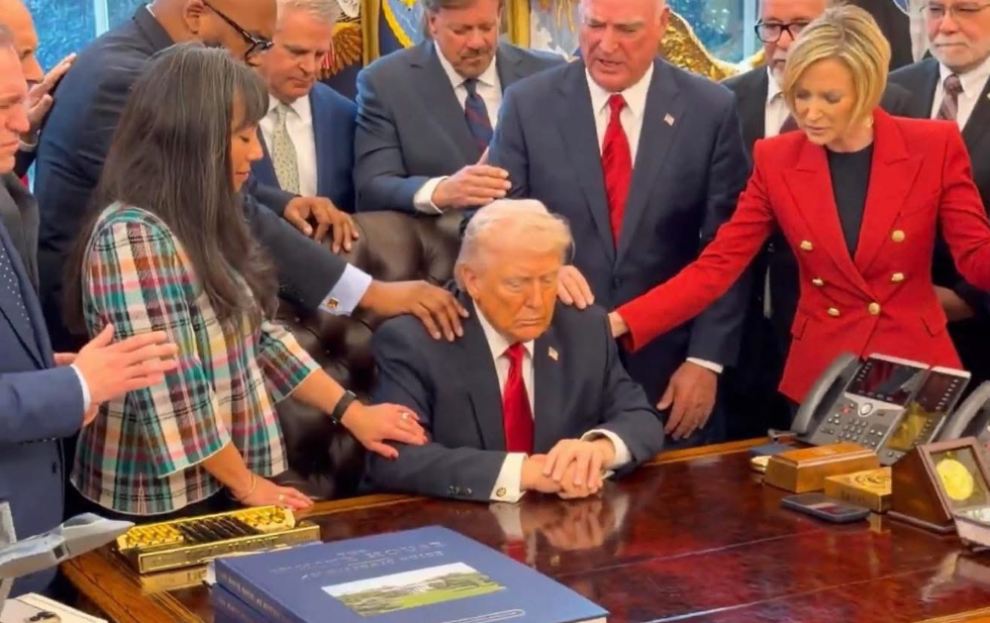
Last week we all discussed the White House prayer session where a group of Evangelical leaders placed their hands on Trump.
This was not the first photograph of a group surrounding Trump with prayers. During a prayer session on July 10, 2017, those gathered around him prayed for “supernatural wisdom, guidance, and protection.” That ceremony was one of the first major pieces of evidence that Evangelicals saw Trump not merely as a president but as a leader anointed by God.
With Trump’s return, these rituals have taken on a more institutional and political dimension.
On March 19, 2025, Evangelical leaders once again visited Trump in the Oval Office and prayed for him in a ceremony organized through the White House Faith Office.
For Evangelicals, placing hands on Trump signifies “commissioning.” They are not merely praying for him; they are assigning him a mission. Trump’s calm posture during these ceremonies renews the emotional and political contract between him and the community that sees him as God’s chosen servant.
In the language of the younger generation, Netanyahu seems to have found America’s bug and has been obtaining unconditional support through this community for decades.
Trying to evaluate the Iran war through rational explanations—state relations, diplomatic rules, or the laws of war—unfortunately leads nowhere today. Because the decisions being taken can easily justify every form of lawlessness, injustice, recklessness, and even the path toward genocide through an irrational form of legitimacy.
Source: https://www.haberturk.com/ozel-icerikler/idris-kardas/3867955-trump-pers-krali-kiros-mu