
Reaching an agreement is quite easy; however, maintaining and implementing that agreement requires sincerity and strong will from both parties. The fact that international agreements are made and broken repeatedly demonstrates the importance of this condition.
The Economic Community of West African States (ECOWAS) was a regional political and economic union of 15 West African countries; Burkina Faso, Mali, and Niger have since withdrawn. It was established by the former colonial powers France and Portugal with the aim of creating an African Economic Community, similar to the European Economic Community (which formed the basis of the EU), and eventually evolving into a political structure like the EU; however, today it exists only on paper.
The Sahel States Alliance was formed by Burkina Faso, Mali, and Niger with the ambition of encompassing the entire “Sahel” belt from the Atlantic to the Red Sea, but it has remained a common market among these three countries.
The bilateral alliances of the United States with Japan, South Korea, and the Philippines, the Collective Security Treaty Organization (organized by Russia to replace the Soviet Union, and including Belarus, Kazakhstan, Kyrgyzstan, Tajikistan, and Armenia), and the separate alliances of North Korea, Russia, and China, have not been able to become effective, influential, and long-lasting organizations like NATO. In fact, there is no other alliance like NATO; nor is there any effort to create one.
As Tekin Öget, a writer for TürkTime, a key element of our media for 23 years with his exclusive reports and commentary, points out, the Mecca agreement differs from previous ones in one respect: “In the vision of the Mecca Pact, which symbolizes the Ankara-Mecca-Islamabad security axis, a geographical giant, Türkiye, is included.”
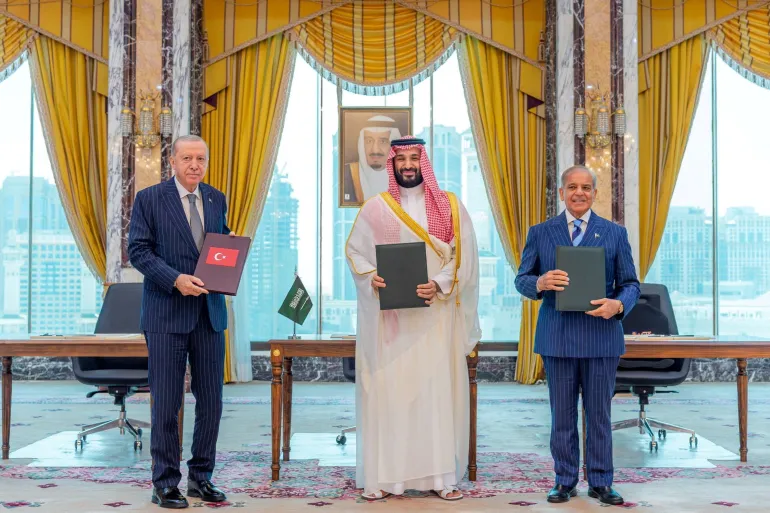
The agreement reached between these three countries, symbolizing solidarity and a security axis in the Islamic world, is truly an unprecedented alliance. This agreement replaces the bilateral agreement between Saudi Arabia and Pakistan signed approximately a year ago, and was expanded on Friday, August 7th, at the Safa Palace in Mecca to include Türkiye’s defense industry and its army built to NATO standards.
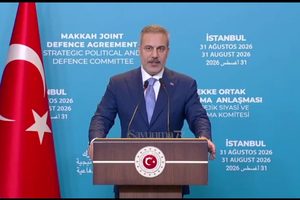
The signed text stated, “The States Parties undertake to consider any act of aggression against one of them as an act against all of the parties”; however, statements made by President Erdoğan and Pakistani Prime Minister Shahbaz Sharif indicate that this “collective security pact” is open to other countries as well. The first committee established under the agreement, the “Strategic Political and Defence Committee,” held its first meeting in Istanbul earlier this week. The meeting was attended by the foreign and defence ministers and chiefs of staff of the three founding countries. At the meeting, it was decided that the organization’s official name would be the “Mecca Defence Pact,” that its governing secretariat would be established in Riyadh, and that the first secretary-general would be Pakistani.
Foreign Minister Hakan Fidan reiterated that the alliance is based on “international principles such as respect for the sovereignty and territorial integrity of other states and non-interference in their internal affairs,” and stated that any country in the region could join the pact. The meeting, held just hours after hostilities resumed between Washington and Tehran following a month-long truce, led to speculation that the call for new members was directed at Iran.
However, it should not be forgotten that the Mecca Agreement was signed while the Gaza Genocide, which began on October 7th, and the war with Iran, launched by the US and Israel on February 28th, were ongoing. Not only Iran, but also the Middle East and the Islamic world, especially Jordan, Lebanon, Qatar, and Egypt, are affected and even targeted by these two events.
The Gaza Genocide and the war with Iran are, of course, testing the nerves and patience of the current and potential members of the Mecca Pact. Unfortunately, the US is either unaware of this test, or, despite all contradictory statements, views the issue solely from the perspective of Israel, or even not entirely from Israel’s perspective, but only from the perspective of the genocidal Prime Minister Netanyahu.
The US must now realize that its lack of foresight is pushing NATO, like other alliance experiences, towards the dustbin of history.
Source: https://www.milliyet.com.tr/yazarlar/hakki-ocal/mekke-anlasmasi-sekilleniyor-7653214