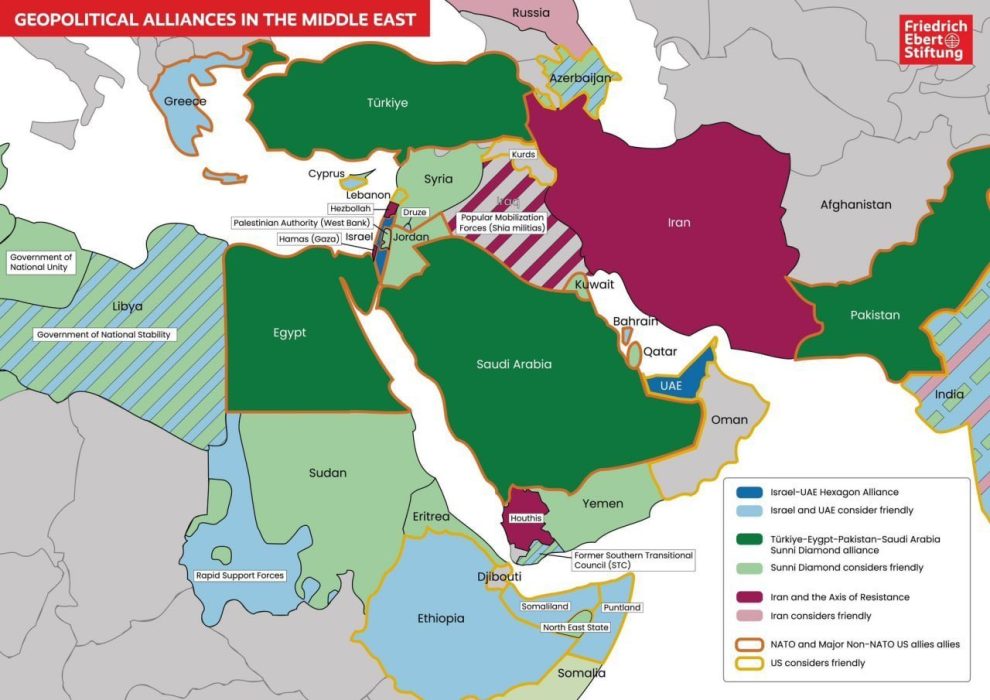

Israeli Prime Minister Benjamin Netanyahu displayed a map labeling Türkiye, Saudi Arabia, Egypt and Pakistan a “Sunni Diamond Alliance” while presenting a new national security doctrine on Sunday. The briefing came nine days before Israel’s October 27 parliamentary elections.
The map carried the logo of the German Friedrich Ebert Stiftung (FES), a think tank affiliated with Germany’s Social Democrats. It color-codes the region into competing camps. Türkiye, Egypt, Pakistan and Saudi Arabia appear in dark green. Israel and the UAE appear in blue under the label “Hexagon Alliance.” Iran and its network appear in purple as the “Axis of Resistance.”The doctrine itself is a three-page document of 10 principles. It prioritizes preemptive strikes, stronger deterrence and buffer zones along Israel’s borders. It was published on the Israeli government’s website with help from the National Security Council.Netanyahu did not make clear whether he regards every country on the map as an adversary. The labels also do not establish that any formal military alliance exists among the states shown. In his remarks he stressed diversifying partnerships beyond the United States and warned that a president “extremely hostile to Israel” could take office within two years.
The map was not produced by Israel. FES published it earlier this year as an analysis of regional realignment. The foundation’s text describes the Diamond as a bloc seeking to balance both Iranian expansion and an Israel-UAE axis. Marc Saxer, an FES analyst whose research helped outline the blocs, told Newsweek that Israel and Iran are competing for regional hegemony while a coalition of middle powers is trying to balance against both.
The “Hexagon” label connects to Netanyahu’s own rhetoric. On February 22 he described a “hexagon of alliances” meant to counter both a “radical Shia axis” and an “emerging radical Sunni axis.” Analysts quoted by Al Jazeera at the time called the concept closer to branding for existing relationships than a deliverable alliance. They also said the four Sunni states coordinate diplomatically but not as an ideological bloc.Opposition leaders criticized the doctrine as superficial. Former chief of staff Gadi Eisenkot said an opposition-led government would produce a formal national security strategy within 150 days of taking office. Critics also say Netanyahu has long used maps and visuals selectively to stress threats and strengthen his image on security.
The map’s placement of several actors remains contested, including Syria, Sudan, Libya and the former Southern Transitional Council in Yemen. Ankara, Riyadh, Cairo and Islamabad had not publicly responded to being presented as a single bloc at the time of writing.