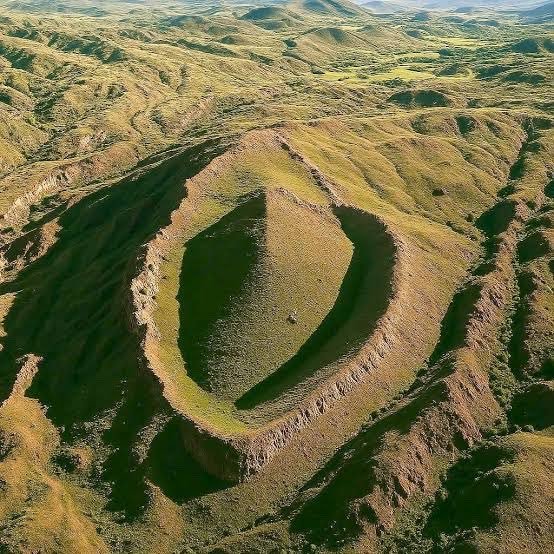

A new wave of fieldwork at a boat-shaped hillside near Mount Ağrı has revived one of the world’s oldest location debates: if a great vessel from the Flood ever came to rest in Anatolia, did it land south of Ararat or on Cudi Dağı?In late September 2026, an international team wrapped a roughly 90-day season at the Durupınar formation in Ağrı Province, about 29 kilometres south of Greater Mount Ararat. Researchers collected nearly 1,000 soil samples, recovered pottery fragments some described as possibly pre-Flood, drilled cores to depths of up to about 18 metres, and sent a small robot nicknamed Gopher into mapped voids. Ground-penetrating radar had earlier picked up angular features, right-angle intersections and a corridor-like anomaly running tens of metres through the mound.
The project is led by Prof. Dr. Cenker Atila of Sivas Cumhuriyet University, with support from the U.S.-based group Noah’s Ark Scans. Turkish authorities issued official permits for the most extensive coordinated study of the site to date. Atila has said winter laboratory work on cores and soils should yield clearer evidence, adding that if Noah’s Ark really exists, Durupınar could be the place. Founder Andrew Jones has gone further in public comments, arguing that organic-rich layers, elevated carbon inside the formation versus outside it, and a drill bit that shattered on a hard layer several metres down are consistent with decayed or mineralised wood rather than solid bedrock.
That is not the same as a confirmed discovery. Independent science coverage and even some creationist researchers have long treated Durupınar as a natural landform — typically described as a landslide or mudflow feature rich in limonite whose outline happens to resemble a hull when seen from the air. Captain İlhan Durupınar spotted it in 1959 aerial photos; amateur explorer Ron Wyatt later popularised the ark identification. Dimensions can be made to fit Genesis’ 300 cubits depending on which cubit length is used, but radar patterns can also come from fractures and soil contrasts. Pottery has not been independently dated. Lab results are expected through winter 2026–27, with a fuller report aimed at 2027. Nothing recovered this season is an intact wooden ship.
The other Turkish claimant sits hundreds of kilometres to the southwest. Mount Cudi (Cudi Dağı / Judi) in Şırnak Province, near Cizre and the Tigris, is the mountain named in the Qur’an. Surah Hud 11:44 says the vessel came to rest on al-Judi. That identification is older in the written record than the modern equation of biblical Ararat with the snow-capped volcano now called Ağrı Dağı. The Babylonian priest Berossus already pointed to the Corduene highlands in the third century BCE; Syriac Christians built a monastery on Cudi; early Armenian and Islamic tradition treated it as the place of descent.
Turkish public life still treats Cudi as sacred ground. In July 2026, Grand National Assembly Speaker Numan Kurtulmuş prayed at the Sefine site, visited the mosque rising there, and described the ridge as the place where Noah’s ark is said to have landed. AFAD used LIDAR in 2025 to map remains on the summit. Botanist Prof. Dr. Fevzi Özgökçe of Van Yüzüncü Yıl University has argued that wild olive trees around Cizre and Cudi’s foothills — and their absence around Ağrı — match the dove returning with an olive branch, a detail shared by the biblical and later flood traditions.
The two traditions are not talking about the same mountain. Genesis 8:4 says the ark rested on “the mountains of Ararat,” a phrase that originally pointed to the kingdom of Urartu — a broad highland, not necessarily today’s 5,137-metre peak. Medieval European and later Western explorers fastened on Greater Ararat; Islamic and much of the earlier Near Eastern tradition stayed with Cudi. Some writers have even tried to blur the names by claiming a local peak near Durupınar was once called Cudi; that claim is weakly supported by local toponymy.What the sites actually offer is different. Durupınar has a photogenic outline, decades of amateur promotion, and now permitted drilling and scans. Cudi has the explicit Qur’anic name, the oldest continuous claim, a shrine landscape, and botanical and geographic arguments tied to Mesopotamia rather than a high volcanic cone where olives do not grow. Neither has produced wood, fittings, or a structure that the wider archaeological community accepts as a Bronze Age or earlier vessel.
The honest present tense is therefore the headline’s question, not an answer. Türkiye contains both the mountain named in the Qur’an and the hillside that looks like a ship from the air. New cores and a winter of lab work may change what can be said about Durupınar’s chemistry and voids. They will not, by themselves, settle which mountain — if any — a historical ark touched, or whether the shared Flood story is best read as history, memory, or sacred narrative. Until peer-reviewed dates and materials are public, the ark remains in Türkiye only as a debate with two addresses.