
By Dr. İdris Kardaş
On the morning of April 6, Gandhi reached the shore. After silently praying, he bent down and took a handful of salty mud into his hands.
“With this, I am shaking the foundations of the British Empire,” he said.
That moment marked the rebirth of a people against the colonial order. A handful of salt had become a moral force that shook an empire.
How?
On February 5, Gandhi announced in the newspapers that he would launch a campaign of civil disobedience against Britain’s salt tax.
The campaign would begin on March 12 and end on April 6, when Gandhi would break the Salt Act in the coastal village of Dandi. Throughout this process, Gandhi made regular statements in every village and city he stopped at, held collective prayers, and made direct contact with the international press, attracting great attention not only in India but around the world.
Gandhi’s Salt March was a turning point. This march was a concrete manifestation of his principle of nonviolent resistance, which he called “satyagraha.”
Satyagraha is a concept derived from the Sanskrit words satya (truth) and agraha (persistence). In Gandhi’s words, it means “holding on to truth” or “the power of truth.”
The Salt March was a 390-kilometer route that passed through 4 districts and 48 villages over 24 days. As the march progressed, hundreds of people gathered around Gandhi, and thousands lined the roadsides to greet him. Dozens of journalists from Europe and America and film crews shooting documentaries followed this dramatic march.
On April 6, Gandhi obtained illegal salt by boiling a pile of salty mud he had picked up in seawater. He asked his thousands of followers to start producing salt in the same way along the coast, wherever possible, and to teach the villagers to produce illegal but necessary salt. The British taxing salt, one of the most basic necessities after air and water, was one of the most fundamental immoralities of the colonial mentality.
This symbolic act quickly turned into a massive wave of civil disobedience across India. Millions of people collected salt from the sea, bought contraband salt, and openly defied British laws.
The British administration arrested more than sixty thousand people within a month to suppress this wave. However, the pressure did not stop the resistance; on the contrary, it intensified it.
The Salt Satyagraha quickly turned into a mass Satyagraha movement, ranging from cloth boycotts to tax strikes. This moral rebellion, which Gandhi started with salt, was a turning point in India’s struggle for independence.
Years later, this idea would also influence the American continent. When Martin Luther King Jr. marched for black civil rights in the 1960s, he cited Gandhi’s Salt March as a guide.
Gandhi’s satyagraha had transformed into what King called “soul force.” Thus, the voice of truth that rose on the Dandi shore echoed once more in the streets of Alabama.
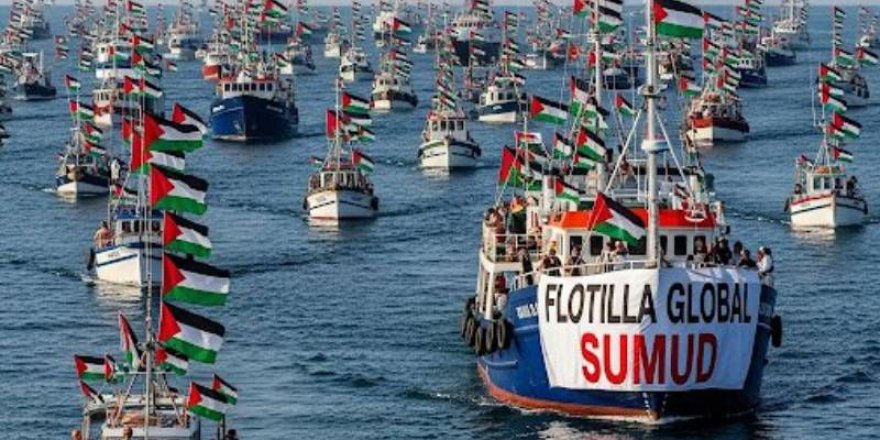
And years later, in 2025, a handful of brave people set sail to draw attention to the ongoing genocide in Gaza and the severe famine, and to break Israel’s blockade.
Just as Gandhi exposed British colonialism by walking to the sea and producing salt, the Sumud fleet exposed the moral contradictions, helplessness, and exhaustion of the modern world by attempting to reach Gaza.
Just as Gandhi went to the sea to produce salt, the activists heading for Gaza drew attention to the inhuman nature of the blockade by sea.
Both actions were physically modest but morally revolutionary.
The Salt March was an illegal act in the eyes of the British; the Sumud fleet was a provocation in the eyes of Israel.
Gandhi’s march was met with harsh intervention by the British, while the Sumud fleet faced an attack by Israeli soldiers. However, history recorded not the manner in which these two nonviolent actions were suppressed, but the moral resonance they carried.
The Sumud flotilla set sail for the Gaza coast with more than 40 ships and participants from over 44 countries.
Almost the entire world held its breath and prayed in every language for the flotilla to reach Gaza.
As the flotilla approached the Gaza coast, people all over the world poured into the streets to show their support and condemn Israel. Dozens, perhaps hundreds, of international media channels broadcast live for days. Hundreds of millions watched the Israeli soldiers’ attacks on the flotilla live. In addition to the streets, people also kept vigil on social media in support of the Sumud flotilla, completely dominating the agenda with this issue. All eyes turned to this great tragedy unfolding in Gaza. The Sumud flotilla exposed Israel’s blockade to the world.
Just like the British, Israel arrested unarmed, civilian, and honorable people. Gandhi was luckier and managed to reach the shore and extract salt. Unfortunately, however, the Sumud flotilla could not actually reach the Gaza coast. Yet this initiative by unarmed, civilian people against a major genocide, where states could do nothing and the international system merely watched, affected the entire world. The world saw with its own eyes the tragedy unfolding in Gaza and how Israel is a lawless monster.
The prayers, songs, poems, and cries of children waiting on the Gaza coast for a morsel of food, a pair of toys, were watched by the whole world.
Palestine’s Satyagraha, its insistence on truth, is today Sumud. Of course, it should not stop at Sumud. Boycotts by the world public, by civilians, will be as effective as the boycotts in India. This honorable resistance, which made India independent, will surely liberate Palestine in the end.
Just as Gandhi said, “I am shaking the foundations of the British Empire,” the foundations of Israel will also be shaken thanks to the resistance of the Palestinian people and the efforts of all conscientious people around the world. It may seem difficult today, but one day it will surely happen.
Source: https://www.haberturk.com/ozel-icerikler/idris-kardas/3827922-filistin-satyagrahasi-sumud