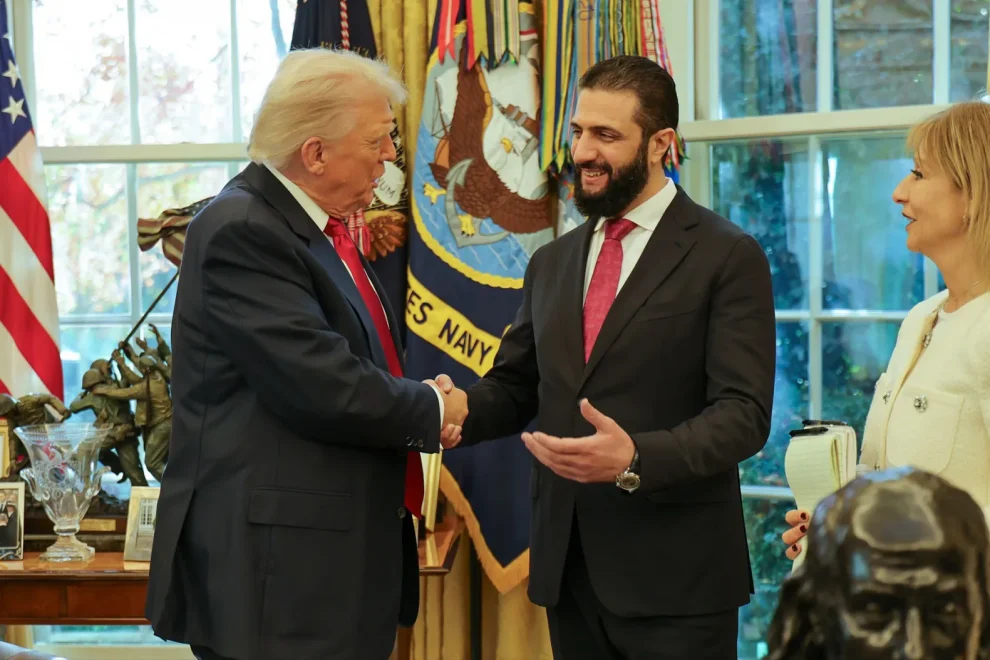

Shara’s visit to the White House marks a pivotal moment, signaling Syria’s gradual return to the international stage after years of isolation and hinting at a possible shift in the balance of power across the Middle East.
Recent diplomatic moves suggest that Syria is once again seeking a place within the global order following years of conflict, sanctions, and political exclusion. Shara’s meeting at the White House reflects a clear shift in U.S. policy—from strict isolation to cautious, pragmatic engagement. Meanwhile, Turkey’s growing regional influence, the potential easing of sanctions, and Syria’s cooperation in the fight against ISIS are adding new layers to this evolving dynamic. This emerging diplomatic balance among Washington, Ankara, and Damascus could ultimately reshape not only Syria’s trajectory but also the broader geopolitical landscape of the Middle East.
A New Era in Syria: Signs of Shifting Diplomatic Balances
In recent months, the Middle East has witnessed a surge of diplomatic activity, particularly concerning Syria. Once the epicenter of civil war, regional rivalries, and international interventions, Syria now appears to be entering a phase of diplomatic normalization amid a broader reshuffling of regional power dynamics.
One of the most striking developments in this process is the official visit to the United States by Sharaa, a long-standing and influential figure in Syrian politics. The meetings held at the White House are widely seen as a milestone that could reshape not only the relationship between Washington and Damascus but also the strategic positioning of key players across the region.
The visit carries both symbolic and strategic significance. While U.S. policy toward Syria has shown signs of softening in recent months, the implications of this shift for other influential actors—such as Russia, Iran, and Turkey—are being closely monitored in diplomatic circles. Sharaa’s reception in Washington is being interpreted as the first meaningful indication that the West may be ready to reopen limited channels of dialogue with the Damascus government, long regarded as a political outcast.
Furthermore, the fact that Syria policy has long been a deeply divisive issue in U.S. domestic politics makes this visit all the more significant. The White House’s decision to engage directly with Sharaa has sparked debate, with critics arguing that Washington is attempting to rebuild ties with an established institutional figure rather than with more radical or fragmented elements within Syria.
From Damascus’s perspective, this contact reflects its broader effort to emerge from more than a decade of diplomatic isolation and to restore its international legitimacy. It also marks an extension of the regional normalization wave—initially driven by Arab countries—now reaching as far as the United States.
In this context, Sharaa’s visit to Washington is more than just a diplomatic meeting; it stands as a potential turning point that could redefine the regional status quo. The true impact of this move—both on Syria’s future and on the balance of power across the Middle East—will become clearer in the months ahead.
The Nature of U.S.–Syria Contacts
Although Sharaa’s visit to the White House appeared relatively understated, it carried considerable diplomatic weight. There was no official welcoming ceremony, no military escort, and no personal greeting at the door by U.S. President Donald Trump. Moreover, unlike past visits by other foreign leaders, no joint press conference was held.
This restrained protocol underscores Washington’s cautious and incremental approach to redefining its relationship with Syria. While the U.S. administration has opened limited channels of communication, it is also signaling to the international community that this step does not amount to full diplomatic normalization.
According to White House sources, the meeting was “preliminary in nature,” focusing on issues such as security, humanitarian assistance, and regional stability in Syria. However, many diplomatic observers interpret the encounter as a sign that Washington is crafting a new pragmatic engagement policy—one that reflects the evolving realities on the ground rather than rigid ideological positions.
In this context, it is particularly noteworthy that the U.S. appears to be shifting away from its long-standing “regime change” rhetoric toward a model of behavior-based cooperation. This approach envisions selective collaboration with local actors to mitigate instability and prevent the resurgence of ISIS. Sharaa’s reception at the White House can thus be viewed as a symbolic yet strategic step within this emerging framework.
Perception
While the visit’s formal importance may be limited, its symbolic weight is considerable. According to experts, the United States conveyed a dual message through this diplomatic gesture:
- To the Syrian government: “Comprehensive normalization is not yet on the table, but a channel for dialogue has now been opened.”
- To regional actors: “Washington is no longer turning a blind eye to the Syrian issue; however, it is also not pursuing an unchecked expansion of its involvement.”
In essence, the visit reflects a carefully calibrated message—one that balances openness to engagement with a clear intention to avoid overcommitment or abrupt policy shifts.
This balanced stance reflects the U.S. administration’s effort to manage risks on both the domestic and international fronts. By cautiously engaging with Syria, Washington seeks to explore diplomatic openings without triggering political backlash at home or destabilizing its broader regional strategy.
At the same time, the move is being closely monitored by key power brokers in Syria—particularly Russia and Iran. Moscow views Washington’s renewed outreach as a challenge to its established influence in Damascus, while Tehran fears that Syria’s gradual re-engagement with the West could undermine its strategic foothold and reduce its leverage in the region.
Diplomatic Realism and a New Era of Communication
In the limited press statements released following the visit, both sides underscored their commitment to “Syria’s territorial integrity” and “regional stability.” These carefully chosen words highlight the cautious approach both parties are taking amid a host of unresolved and sensitive issues.
In this light, Sharaa’s engagement with Washington stands as one of the first tangible signs of Syria’s post-war effort to reposition itself within the international system. For the United States, the decision to reopen diplomatic channels marks the beginning of a “new era of communication”—one that prioritizes pragmatic dialogue, security cooperation, and a recalibration of regional balance policies over ideological confrontation.
Sanctions and Changes in Legal Status
Over the past eleven months, Syria has once again found itself at the center of discussions about economic pressure and political reform, with noticeable signs of a gradual easing of restrictions. This development reflects not only a shift in Washington’s regional priorities but also a broader evolution in the international community’s approach toward Damascus.
For years, the sanctions imposed on the Syrian government reached their peak with the “Caesar Syria Civilian Protection Act” of 2019. This legislation extended secondary sanctions to individuals and institutions conducting business with Damascus, effectively seeking to isolate Syria from the global economy. However, by the final quarter of 2024, the U.S. began reassessing the effectiveness of this hardline policy. Concluding that the sanctions had failed to bring about the desired political transformation—and had instead deepened the country’s humanitarian crisis—Washington initiated a measured relaxation of certain restrictions.
Relaxation of Economic Restrictions
In early 2025, the U.S. Treasury Department announced the issuance of new “humanitarian and civilian trade licenses” for select sectors. These permits allowed limited commercial activity by international organizations involved in essential areas such as healthcare, infrastructure rehabilitation, and food supply. This move represented the first controlled easing of the long-standing economic embargo.
The decision, which received support from the United Nations (UN), was intended both to strengthen humanitarian aid mechanisms and to help stabilize Syria’s struggling local economy. Washington described this policy adjustment as a “humanitarian exception,” emphasizing that while the broader sanctions framework remained intact, flexibility would be introduced in areas directly affecting civilian welfare.
“Caesar Act” Exemptions and Their Political Meaning
The partial exemptions granted under the Caesar Syria Civilian Protection Act represent more than a technical policy adjustment—they carry clear political significance. By giving the green light to specific projects, particularly those related to energy transfer, infrastructure rehabilitation, and cross-border trade, the United States is signaling a strategic shift from a policy of total exclusion toward a model of “manageable engagement.”
These exemptions form part of Washington’s broader effort to preserve its leverage over regional security and energy dynamics. In practical terms, the move could help facilitate Syria’s trade and logistical connections with neighboring countries—especially Jordan, Lebanon, and Turkey—thereby softening some of the economic isolation that has constrained Damascus for years.
HTS and Status Change
Another notable development has been the removal of Hayat Tahrir al-Sham (HTS) from certain terrorist organization lists. This decision, involving a group long designated as a terrorist entity by much of the international community, is widely viewed as a reflection of the evolving realities on the ground and a sign of diplomatic recalibration.
The U.S. rationale for this change is reportedly linked to HTS’s recent transformation into a localized governance structure, its efforts to expel foreign fighters, and its attempts to distance itself from transnational jihadist movements. However, many countries and analysts interpret the move as an act of political pragmatism, cautioning that counterterrorism standards must not be diluted for the sake of short-term diplomatic convenience.
Change in Sharaa’s International Status
At the same time, reports indicate that previous international arrest warrants and bounty notices targeting Sharaa have been lifted. This marks a significant shift in Washington’s approach to individual sanctions. The removal of Sharaa’s “terrorist designation” sends a powerful message: the United States now regards him as a legitimate political actor capable of contributing to Syria’s future trajectory.
This decision also eliminates one of the major legal and diplomatic barriers to reopening formal communication channels between Washington and Damascus. From an international law perspective, it reignites the broader debate over how far governments can—and should—exercise flexibility when using individual sanctions as instruments of political leverage.
A New Balance
Taken together, these developments suggest that Washington is transitioning toward a policy of direct yet limited engagement with actors inside Syria. While seeking to preserve its influence on the ground, the United States appears intent on making the region’s crises more manageable through the careful use of diplomatic tools.
This evolving political orientation reflects a shift from the traditional strategy of “isolation and pressure” toward one based on conditional engagement—a calibrated balance of incentives and constraints. In the long run, this pragmatic approach is expected to gradually reshape Syria’s position within the international system and open the door to a new era of diplomacy in the Middle East.
The Turkish Factor
Turkey’s role remains a decisive element in the diplomatic dynamics surrounding Syria. U.S. President Donald Trump’s earlier statements underscored that Ankara is viewed as a central actor in the Syrian peace process. Trump openly acknowledged that the decision to lift sanctions on Sharaa and to initiate a diplomatic opening toward Damascus was made only after consultations with Turkish officials.
This statement underscores the depth of Turkey’s influence on Washington’s Syria policy. Indeed, Turkey’s Euphrates Shield, Olive Branch, Peace Spring, and Spring Shield operations—launched by the Turkish Armed Forces since 2016—have been interpreted not merely as border security measures but as strategic military interventions that have significantly reshaped the regional power balance and the diplomatic landscape surrounding the Syrian conflict.
Turkey’s Syria Policy: From Security to Diplomacy
Since the onset of the Syrian crisis, Turkey has pursued a multi-dimensional policy encompassing humanitarian, security, and political considerations. Hosting millions of refugees after 2011 made Ankara one of the countries most directly affected by the conflict. However, beginning in 2016, Turkey’s priorities began to shift toward eliminating terrorist threats along its southern border and establishing a de facto security zone to safeguard its national interests.
The series of military operations conducted during this period provided Turkey with a new level of negotiating leverage, both on the battlefield and at the diplomatic table. Ankara’s active role in the Astana and Sochi processes allowed it to shape the key parameters of Syria’s future through trilateral coordination mechanisms with Russia and Iran.
From Washington’s perspective, Turkey’s emergence as a balancing actor in the complex equation involving ISIS and the PYD/SDF has prompted a reassessment of U.S. strategy in the region. The U.S. administration has increasingly recognized that it cannot sustain cooperation with the SDF in northern Syria while disregarding Turkey’s legitimate security concerns.
Diplomatic Coordination and the Ankara–Washington Line
Turkey’s diplomatic influence was also felt behind the scenes during the process that led to Sharaa’s engagement with Washington. According to diplomatic sources, Ankara’s regional dominance in Syria and its extensive networks of communication with local actors were decisive factors in shaping the U.S. decision to open channels with Sharaa.
This behind-the-scenes coordination illustrates how Turkey has evolved from a primarily security-focused actor to a key diplomatic facilitator in shaping the post-war political architecture of Syria.
Syria’s Position in the New Era
In the evolving geopolitical landscape of the Middle East, Syria is gradually emerging from a prolonged period of isolation toward a phase of cautious reintegration. While the country remains burdened by the legacies of civil war, economic collapse, and fragmented governance, recent diplomatic developments suggest a potential redefinition of its role in regional and international affairs.
From an international security perspective, Syria’s position is being reshaped by a more pragmatic understanding among global powers. The United States, Russia, and regional actors such as Turkey and Iran appear to have moved away from zero-sum approaches toward a framework of limited coexistence. This approach does not imply full normalization but rather a recognition of mutual constraints and shared interests—particularly in preventing the resurgence of ISIS, managing refugee flows, and stabilizing border regions.
For Damascus, this period represents both an opportunity and a test. The gradual easing of sanctions, the reopening of limited diplomatic channels, and the resumption of trade in select sectors have provided some breathing room for the Syrian economy. However, the state’s reintegration into the international system will depend largely on its ability to demonstrate behavioral changes—particularly regarding governance, human rights, and regional cooperation.
At the domestic level, the focus has shifted toward reconstruction and the reassertion of state authority across fragmented territories. Yet, this process remains constrained by resource scarcity, internal political divisions, and the competing influence of external actors. While localized governance models have emerged in the north and east, a sustainable national reconciliation process has yet to take shape.
In sum, Syria’s position in the new era is characterized by measured engagement, conditional legitimacy, and strategic balancing. Rather than returning to pre-war patterns of isolation or domination, Damascus now faces the challenge of redefining its sovereignty through incremental diplomacy and practical cooperation. The success of this transformation will depend on whether Syria can leverage the current wave of pragmatic engagement to rebuild both its institutions and its credibility within the broader regional order.
Syria’s Position in the New Era
The official inclusion of Syria on the United States’ list of partners in the fight against ISIS is not merely a symbolic move; it represents a strategic recalibration with the potential to reshape regional and global power dynamics. This development signals that Washington no longer views Syria solely as a party to the civil war but increasingly as a state actor capable of limited cooperation in counterterrorism efforts.
Syria’s addition to this list marks a clear acknowledgment that the realities on the ground are shifting. For years, the U.S.-led coalition primarily relied on the Syrian Democratic Forces (SDF) as its principal partner in combating ISIS. Yet over time, the sustainability of this model has been called into question—largely due to the SDF’s limited political legitimacy and its sensitive ethnic composition within Syria’s complex regional context. Washington’s recent decision to open restricted channels of communication with the central government in Damascus signals a strategic shift toward institutionalizing counterterrorism cooperation within a national framework.
The Military–Political Integration Process
A core element of this evolving U.S. approach is the idea of integrating the SDF’s military structure into the Syrian Arab Army (SAA). Such a move is seen as essential for stabilizing local security, unifying command structures, and reasserting state authority across fragmented regions. Although no formal mechanism has yet been outlined, Washington’s message of “time for integration” indicates the beginning of a new phase in Syria’s internal security architecture.
If implemented successfully, this process could redefine the status of the autonomous regions in northern and eastern Syria, paving the way for reconciliation between Damascus and local governance structures. Over time, it may also help consolidate the fractured networks of authority that have divided the country for more than a decade.
Regional Balances and Geopolitical Implications
Recognizing Syria as a legitimate partner in regional security will have profound implications for the Middle East’s balance of power. First, it may alter the roles of Damascus’s long-standing allies, Russia and Iran. Washington’s renewed diplomatic presence could reduce Moscow’s dominant influence, gained during the latter stages of the civil war, while simultaneously challenging Tehran’s entrenched position.
For Iran, this development could undermine the legitimacy of its military presence in Syria, as U.S. engagement with Damascus introduces new channels of influence. Tehran’s deep involvement in Syria’s defense networks, militias, and infrastructure may now face constraints as Damascus seeks to diversify its partnerships.
Meanwhile, Turkey is watching these shifts closely. Direct U.S.–Syrian engagement could reshape Ankara’s strategic priorities—particularly regarding border security and migration management. Yet Syria’s inclusion in the anti-ISIS framework may also align, at least partially, with Turkey’s counterterrorism agenda, lending international legitimacy to joint efforts to prevent an ISIS resurgence in northern Syria.
International Legitimacy and the Reconstruction Process
Syria’s partial re-engagement with the United States and the broader Western community could initiate a gradual restoration of international legitimacy. Beyond the security realm, this normalization carries significant implications for economic recovery and reconstruction.
After years of isolation from global financial systems due to sanctions, Damascus may now find limited openings to reconnect with international development institutions. However, tangible progress will depend on meaningful domestic reforms—improving governance, easing humanitarian suffering, and advancing the safe and voluntary return of refugees. Without such measures, any reintegration into the international community will remain conditional and fragile.
Conclusion: A Period of Controlled Normalization
Taken together, these developments suggest that Syria has entered a phase of controlled normalization—a pragmatic recalibration rather than a full-scale political reintegration. Washington’s engagement with the Sharaa administration can be seen as an acknowledgment of on-the-ground realities, coupled with an effort to limit instability through cautious, results-oriented diplomacy.
However, for this process to evolve into lasting peace, a broader consensus within Syria’s domestic politics and sustained coordination among regional actors will be essential. Without such cooperation, the current initiatives risk producing only a temporary equilibrium.
In this new era, Syria holds the potential to transform from a theater of external intervention into a crossroads of multipolar diplomacy. The emerging balance among Washington, Ankara, Moscow, and Tehran will ultimately determine not only the trajectory of Syria’s reconstruction but also the future geopolitical architecture of the entire Middle East.
Sharaa’s visit to the White House is far more than a symbolic diplomatic gesture—it marks a turning point in Syria’s gradual return to legitimacy within the international system. Occurring after years of civil war, sweeping sanctions, and prolonged diplomatic isolation, this engagement signals a paradigm shift in how both Washington and regional actors perceive Syria’s role in the Middle East.
The United States’ decision to engage directly with Sharaa—while recognizing the realities on the ground—reflects a broader transition from idealism to pragmatism in U.S. foreign policy. Washington appears to be prioritizing stability and controlled engagement over the once-dominant rhetoric of “regime change.” This recalibration may mark the beginning of a new phase in which the search for a diplomatic settlement in Syria regains momentum.
Redefining Regional Alliances
One of the most significant implications of this process is its potential to reshape the regional power architecture. Syria’s reintegration into the diplomatic system could serve as a counterweight to the unilateral influence exerted by Iran and Russia throughout the conflict. Moreover, when viewed alongside the Arab League’s 2023 decision to readmit Syria, this development suggests a gradual convergence between Western and Arab positions on the Syrian question—a notable step toward a broader regional accommodation.
For Turkey, the implications are equally profound. As a country deeply embedded in the Syrian crisis—both in terms of security and humanitarian impact—Ankara remains a key player in shaping outcomes on the ground and at the negotiating table. Washington’s new initiative toward Damascus has the potential to redefine Turkey’s diplomatic leverage, reinforcing its role as both a regional stabilizer and a mediator in Syria’s future.
The Washington–Ankara–Damascus Triangle
In the period ahead, the diplomatic equilibrium among Washington, Ankara, and Damascus will be central to determining Syria’s trajectory. This triangular dynamic presents both risks and opportunities for regional security. Should U.S. policy evolve in alignment with Turkey’s security priorities, joint progress could be made on critical issues such as countering ISIS, managing migration flows, and securing borders.
Yet, the success of this arrangement will depend on more than military coordination—it will require the rebuilding of diplomatic trust between Ankara and Washington, whose relations have often been strained by strategic divergences. For Damascus, this triangular framework offers a potential pathway out of isolation, enabling participation in regional reconstruction and dialogue mechanisms for the first time in over a decade.
Future Perspective
Syria’s reintegration into international diplomacy does not equate to full normalization in the short term. The durability of this process will hinge on tangible progress within Syria itself—particularly in political reform, economic stabilization, and the safe return of refugees. Furthermore, the re-opening of U.S. diplomatic channels introduces the possibility of a renewed international role in the country’s post-war reconstruction, aligning humanitarian and strategic priorities.
In this emerging context, Syria is no longer merely a zone of crisis but increasingly a crossroads of cooperation and competition in Middle Eastern diplomacy. Sharaa’s visit to the White House may, in retrospect, come to symbolize the beginning of this transformation—a cautious yet historic step toward reconfiguring regional engagement.
Concluding Remarks
In summary, this process represents the first stage in a series of interconnected developments that could reshape not only Syria’s future but also the broader balance of power across the Middle East. As diplomatic realignments continue to unfold, Syria’s role is evolving from a passive object of intervention to a potentially decisive actor capable of influencing the regional order.
The emerging dialogue among Washington, Ankara, and Damascus will be a defining factor—not only for the future of one nation but for the stability of the entire region. In this sense, Syria stands at the forefront of a new test for Middle Eastern diplomacy—one that will measure the world’s capacity to transform a decade of conflict into a sustainable framework for peace and reconstruction.