


What Tom Cruise couldn’t achieve in The Last Samurai was accomplished by a Janissary who escaped from Vienna and reached Italy in 1683.
The Last Samurai was fiction — and its hero was ultimately defeated. This, however, is a true story: the story of Hasan, a Janissary who became the leader of the very village he had fled to as an enemy — a man who defied an oppressive system and won. His name became legend: “Il Turco” — The Turk.
The year is 1683.
The Second Siege of Vienna — the battle that shaped Europe’s fate.
The Ottoman army suffers a crushing defeat before the walls of Vienna. Thousands of soldiers retreat in disarray.
One of them is Hasan, a wounded Janissary. To survive, he flees south through the Alps, deep into enemy territory. After weeks of wandering — exhausted, wounded, and freezing — he collapses near the small mountain village of Moena, in northern Italy’s Fassa Valley.
When the villagers of Moena find him, they face a simple “choice”:
The man before them is their enemy — a soldier of the “Turks,” against whom the Holy League was fighting. The “proper procedure” (or fear) dictated that he be handed over to the nearest Austrian garrison.
But the people of Moena chose humanity over procedure.
They secretly carried the wounded soldier into their village, hid him, cared for him, and gave him a new name: “Il Turco.”
When Hasan (Il Turco) recovered, he did not leave. Out of gratitude, he offered what he knew best — leadership and knowledge of governance.
At that time, the people of Moena were suffering under the heavy and unjust taxes imposed by the German Prince-Bishopric of Augsburg (and local feudal lords). When Hasan saw this corrupt system, he taught the villagers the Ottoman methods of fair taxation, civic organization, and resistance — methods far more advanced than those in contemporary Europe.
He became their leader, organized the peasants, and led them in revolt against oppressive tax collectors and feudal rulers.
The man who entered the village as an enemy became its hero and savior.
Hasan married there, had children, and eventually died in Moena. But his legacy has remained alive for more than 340 years.
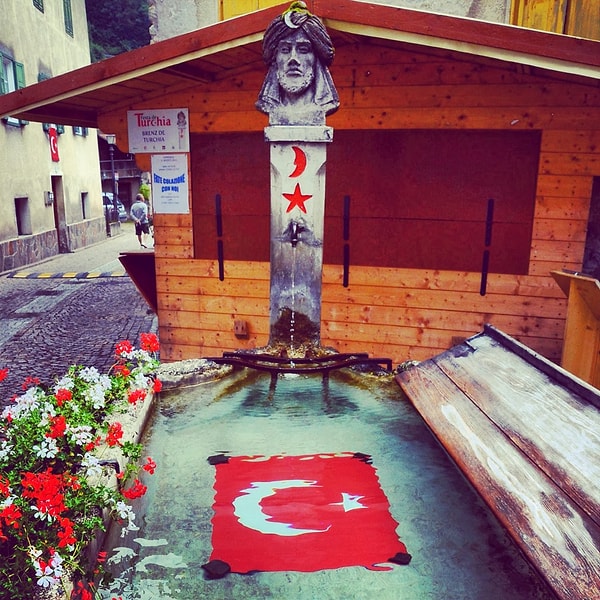
Even today, Moena has a district called “Rione Turchia” (Turkish Quarter). In its fountain stands a bust of Il Turco.
And every August, the villagers of Moena — Italians — celebrate the “Festa di Turchia” (Turkish Festival): wearing fezzes and turbans, wrapping sashes around their waists, waving Turkish flags through the streets to honor the legacy of their liberator.
The villagers of Moena could have chosen to destroy a wounded “enemy” who crossed their path.
Instead, they showed mercy — a risky act of compassion. In return, they gained a leader who freed them from an oppressive system.
Sometimes, the solution your organization or community most needs comes from the most unexpected place — even from a culture you see as a rival or a person you’ve labeled an enemy.
True leadership is not about rejecting the “foreign,” but about integrating the valuable.



