

Thomas Massie, the libertarian-minded Kentucky congressman who spent years bucking Washington’s bipartisan consensus on foreign policy, is going home. His defeat Tuesday night at the hands of Ed Gallrein — a Trump-endorsed former Navy SEAL — closes the chapter on one of the most unconventional careers in recent Republican politics. It also answers a question that has been hovering over American politics for months: what happens when you tell the pro-Israel lobby and a sitting president to mind their own business?
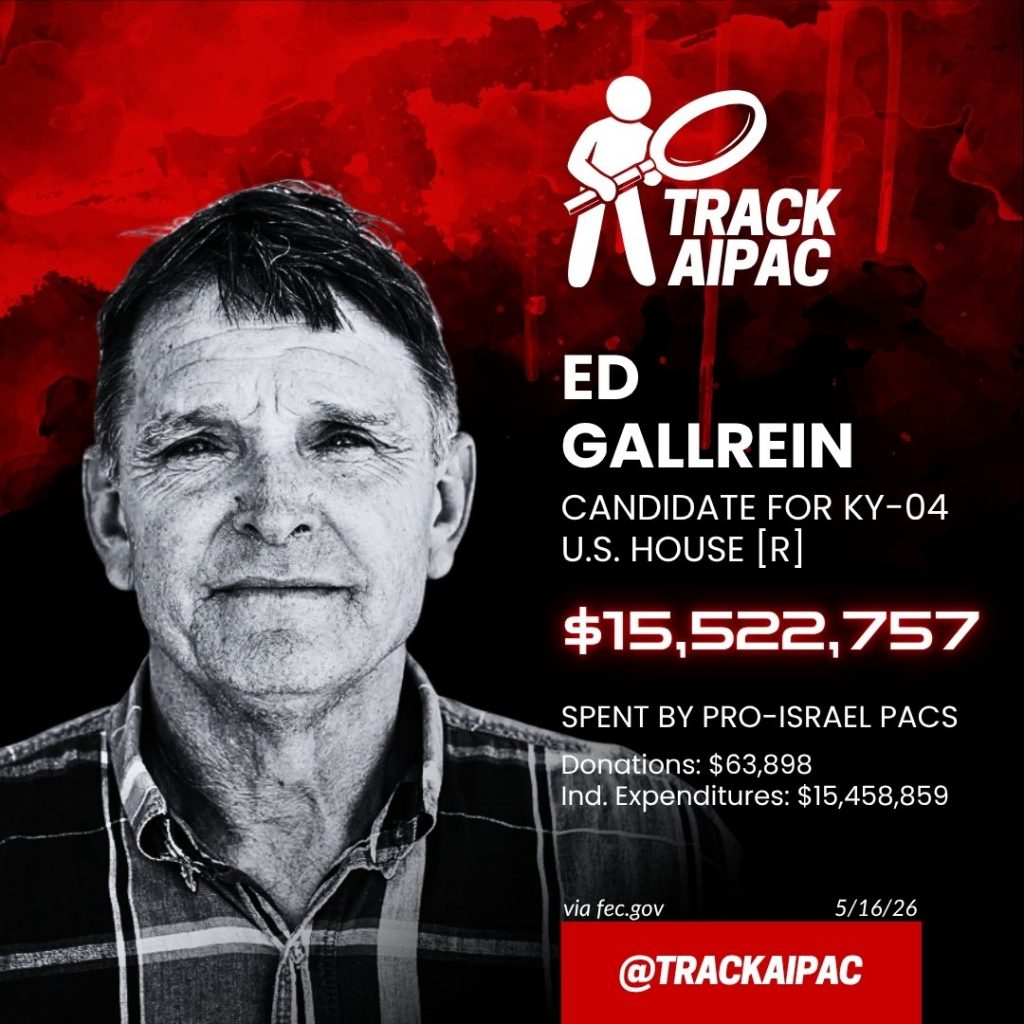
The answer, it turns out, costs $32 million to deliver.
When the race was called, Gallrein had captured 54.4% of the vote in Kentucky’s deep-red fourth district, running almost entirely on Trump’s endorsement. Behind him stood the full machinery of the pro-Israel donor network. AIPAC’s super PAC and two other groups backed by pro-Israel donors poured more than $15.8 million into the race — making it the most expensive House primary in American history, with overall spending reaching $32 million.
Massie had seen it coming. For months, he framed the race not as a traditional primary but as something closer to a constitutional test. He accused pro-Israel donors of trying to “buy seats in Congress,” denied being antisemitic, and said he opposed efforts to equate criticism of Israeli policy with antisemitism. He warned that AIPAC’s intervention, if left unchallenged, would set a precedent for how any member of Congress who deviated from the lobby’s preferred line could expect to be treated.
AIPAC’s super PAC labeled him “the most anti-Israel Republican in the House.” The charge was not exactly a revelation. Massie had voted against foreign aid packages, opposed the June 2025 strike on Iran, and railed publicly against what he saw as an American foreign policy held hostage to overseas interests rather than domestic ones. His brand was simple: America first, in the most literal sense — not as slogan, but as policy.
It was a brand that resonated with a growing slice of the Republican base, even if it made him enemies in powerful places. Polling from last month found that 44% of Republicans under 50 view Israel favorably while 33% view it unfavorably — a dramatic contrast with Republicans over 50, where favorability sits at 78%. Massie was, in other words, ahead of a demographic tide, even as he was crushed by the current one.
The forces aligned against him were not purely ideological. Trump’s fight to unseat Massie began after the Kentucky congressman lambasted the so-called “One Big Beautiful Bill” and opposed the June 2025 attack on Iran. The president, who tolerates dissent poorly, made defeating Massie a personal priority. A new anti-Massie super PAC, created by Trump and heavily funded by pro-Israel billionaires, spent another $5.6 million on top of AIPAC’s own contributions.
The result was a peculiar alliance: a president who ran on “America First” joining hands with a foreign policy lobby to destroy the congressman who took that slogan most seriously.
After the race was called, AIPAC declared victory on X: “Pro-Israel Americans are proud to back candidates who support a strong U.S.-Israel alliance and help defeat those who work to undermine it. Being pro-Israel is good policy and good politics!”
Whether that last line ages well remains to be seen. At CPAC in March, commentator Jack Posobiec named 45 years old as the new dividing line on Israel and Palestine in Republican politics. Massie may have lost his seat, but the generational shift he was surfing is not going away. If anything, the spectacle of $32 million being spent to silence one congressman may accelerate it.
Gallrein, thanks to the district’s deep-red nature, is now a shoo-in to win the general election in November. Washington will look more compliant. But the question Massie posed — whose interests does Congress actually serve? — will not be so easy to retire.