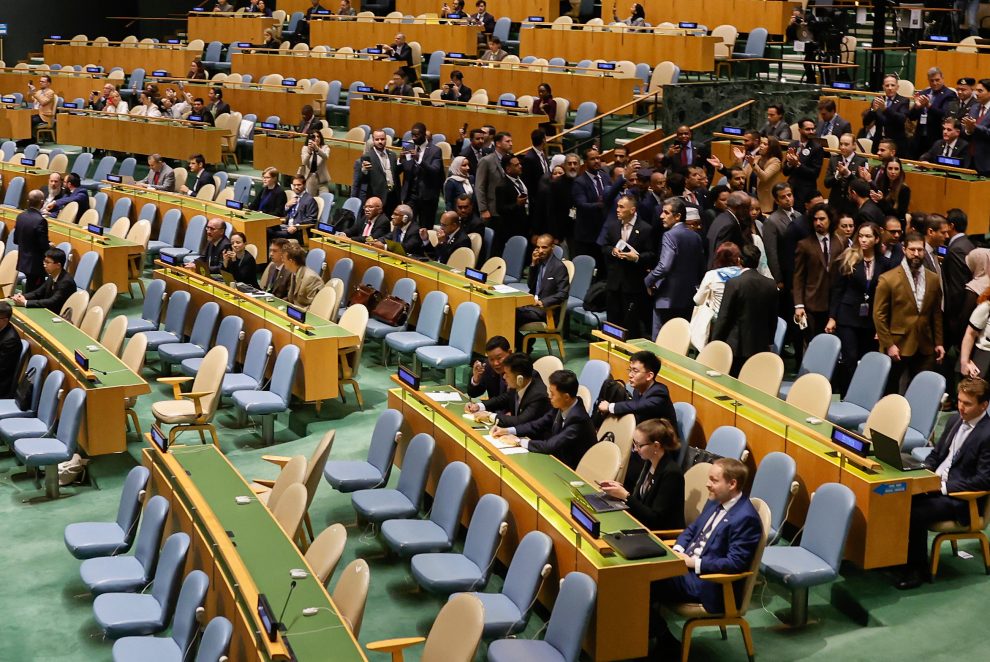

When Israeli Prime Minister Benjamin Netanyahu began his speech at the United Nations General Assembly, representatives of 77 countries left the hall. While Netanyahu was speaking to mostly empty seats, he also had the audacity to threaten the world. The Israeli leader, who would normally be expected to be arrested and put on trial, defied the entire world.
Among those who remained in the hall while Netanyahu insulted the entire world, and Muslims in particular, were representatives of the UAE, Bahrain, Albania, Morocco, Senegal, Kazakhstan and Azerbaijan. The representatives of these seven Muslim countries listened without moving from their seats as Netanyahu insulted Islam and communities belonging to the same peoples—Turks and Arabs.
The UAE, Bahrain and Morocco are three of the countries that have signed the Abraham Accords. Kazakhstan is also expected to sign the accords. The governments of Azerbaijan, Senegal and Albania, meanwhile, have good relations with the Israeli government. It is also known that other Muslim countries prefer to maintain good relations with Israel in order to gain a place for themselves on the international stage and gain access to the U.S. administration. However, at a time when Israel has killed more than 70,000 Palestinians and has not only declared Muslims to be its enemies but has also launched attacks against them, listening to Netanyahu at the UN podium has not been approved by anyone and has rightly drawn severe criticism.
The Muslim world does not accept the rhetoric of these countries that “Israel stood by us when we were going through difficult times.” First of all, forming an alliance with a country whose genocidal conduct has been established is contrary to basic human morality. When you stand alongside a murderer, it means that you have applauded, endorsed or remained silent about their crime. Even if you have not physically participated in the crime, you have a moral association with it.
There is another dimension to this issue: those being killed are Muslims. While tens of thousands of people are being killed in plain sight, territories are being occupied and national leaders are being assassinated, further developing relations with Israel and its government and signing military and commercial agreements with it causes deep moral discomfort and disappointment. The Muslim world at least wants these countries not to appear to be standing in the same camp as Israel. Under the current circumstances, even the non-Muslim world—just look at Ireland, Britain and Spain, as well as Brazil—is criticizing Israel in the strongest terms, while the embrace of Israel by some Muslim countries comes as a shock.
The third issue, namely the claim that Israel stands by these countries in difficult times, needs to be examined more closely. If Israel provides support, it does so for two reasons. First, it seeks to take sides among Muslim countries and turn them against one another, as we see in the examples of Azerbaijan-Iran, Morocco-Algeria and the UAE-Qatar. Second, it seeks to make money by selling weapons. The countries mentioned above purchase large quantities of weapons from Israel. Yet there are countries with richer weapons inventories than Israel, and weapons can also be purchased from those countries. Therefore, Israel is not indispensable.
Ultimately, buying weapons from Israel does not mean that one owes Israel anything. It is obvious that friendship with Israel has certain benefits in Washington. However, remaining silent about a genocide merely for this reason is not foreign policy. At a time when the entire world is turning against Israel, the countries mentioned above should reconsider the friendships they have established with Israel. They should once again take stock of what—and whom—they have lost, particularly among their own peoples, because of Israel. In the past, being a friend of Israel was an advantage. But after the genocide in Gaza, even the American public has grown colder toward Israel, and it is expected that U.S. politics will soon distance itself from Israel as well. In other words, they have, in a sense, bet on the wrong horse at the wrong time.
From now on, standing alongside Israel will be a disadvantage rather than an advantage. Particularly at a time when Israel is defying the entire world, being friends with Israel will not be remembered favorably in the future. Just as those who supported Nazi Germany later paid a price and lived with shame, those who support Israel today will experience the same shame. Their own peoples, in particular, will not forgive them.
Moreover, those who honored Netanyahu by listening to him have also placed their own positions under scrutiny. Take the UAE, for example. For decades, the UAE has denounced the Muslim Brotherhood and worked to persuade other countries to designate the group as a terrorist organization. According to the UAE, the Muslim Brotherhood and groups it describes as Islamist political movements are organizations seeking to create an anarchic environment through the use of violence. Yet by standing alongside Israel, providing intelligence concerning Palestinians and remaining silent about the genocide, the Abu Dhabi government gives the impression that it shares the same mentality and ruthlessness as Israel. Even if this is not actually the case, such an image is being formed in the eyes of the public. Under these circumstances, whenever the UAE accuses others of terrorism, it will be reminded of its friendship with Israel—and indeed, it already is. If not only the Muslim world but also many other countries around the world currently hold a negative view of the UAE, one reason is its friendship with Israel.
A similar situation exists with Azerbaijan. Azerbaijan received substantial support from the Muslim world in its legitimate cause against both Iran and Armenia. When it fought Armenia, it achieved victory through its own efforts. Therefore, it would be unfair to Azerbaijan to say that it won the war with Israeli weapons. The Azerbaijani government may choose not to confront Israel over Iran, but it should not have remained silent about Israel’s oppression of the Palestinians. With this conduct, it will be difficult for Azerbaijan to explain the occupation of Karabakh and massacres such as Khojaly to the international community. Whenever they speak about massacres, people will remember Azerbaijan’s support for Israel’s massacres. Moreover, the fact that Armenians are opposed to Israel makes Azerbaijan’s position even more difficult.
Countries such as Senegal, Kazakhstan, Morocco and Bahrain, whose representatives were present in the hall, have also suffered reputational damage by supporting Israel. They will soon realize that it is impossible to win the world’s favor by aligning oneself with a country that has fallen out of favor.
In conclusion, it can be said that the Muslim world, in general, has not performed well in the test posed by the genocide in Gaza. The fact that almost all Muslim countries are weak is an important reason. The absence of unity among the countries is another. It may not be fair to blame the countries for their lack of unity, because their political, economic and ideological differences are considerable. However, on an individual level, the degree of closeness that some countries have shown to Israel—even greater than Israel itself would expect—is harming both those countries and the Muslim world. These friendships are not even accepted by the peoples of the countries concerned themselves. Unfortunately, by making a misguided calculation, the aforementioned countries have done a great favor to Israel, which has become increasingly isolated and excluded. Of these unsustainable policies, Israel alone will benefit. Genuine cooperation in which both Israel and its friends win has rarely existed. One only needs to look at Israel-U.S. relations to see this.
For the countries mentioned above, reversing this mistake is essential, particularly for the sake of their domestic and international reputations.