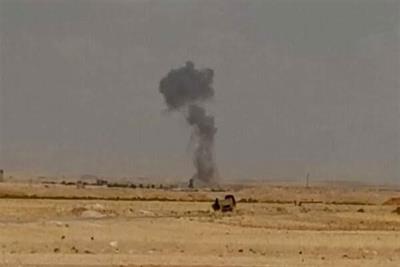

IDLIB/ANKARA — Israel’s eight-strike bombardment of the disused Abu al-Duhur military airfield in Idlib province on August 18 has sharpened a question that has been building since the fall of Bashar al-Assad, how far north does Israel intend to push the security perimeter it has declared for itself inside Syria.
American analyst Rich Outzen argued on X that the strike amounts to Israeli Prime Minister Benjamin Netanyahu asserting a security zone stretching all the way to the Turkish-Syrian border. The facts on the ground since December 2024 support that reading.
From the Golan to Idlib
Israel’s declared security zone began in the south. After Assad’s collapse, Israeli forces crossed the 1974 disengagement line in the Golan Heights, seized the summit of Mount Hermon, and established a chain of positions and checkpoints inside Syrian territory that Damascus and much of the international community regard as an occupation beyond Israel’s own annexed Golan. Israeli officials have said openly they intend to keep forces in that southern zone and are pushing for a broader demilitarized area around it.
What has changed is the geography of the strikes meant to enforce that logic. Abu al-Duhur sits roughly 70 kilometers from the Turkish border, in Idlib province, far outside the Golan periphery and deep inside what has functioned as a Turkish sphere of influence since the civil war. The base had been out of service for over a decade and was being used only as a training site for Syria’s new army. Israel’s stated rationale, that Damascus was preparing to let Turkish forces use the facility, was not about a threat emanating from the south. It was about blocking a Turkish military footprint in the north.
A pattern, not an isolated strike
Regional analysts have placed the Abu al-Duhur raid in a sequence rather than treating it as a one-off. Israel struck the T4 and Palmyra airbases in March 2025 after reports that Turkish military delegations had visited them. It hit Syria’s Ministry of Defense in July of that year. In each case the target had a prior or reported Turkish connection, and in each case Israel acted before any Turkish deployment materialized rather than after. The message has been consistent, that any Syrian military infrastructure Ankara might use is fair game regardless of its distance from Israel’s own borders.
Netanyahu and Katz name Türkiye directly
Unlike earlier strikes framed around Iran-linked militias or weapons transfers, the language coming out of Jerusalem has increasingly named Türkiye specifically. Israeli Defense Minister Israel Katz has issued direct warnings to President Recep Tayyip Erdoğan, saying Israel will not tolerate Syrian military capabilities being strengthened in ways that could threaten it. Netanyahu’s office described the Abu al-Duhur strike as a response to Damascus coming close to breaching an understood security status quo by permitting Turkish access to the base. Naftali Bennett, a former prime minister positioning himself for October’s elections, has gone further still, calling Türkiye “the new Iran,” a framing that signals the rivalry is being folded into Israel’s domestic political discourse, not just its Syria policy.
Ankara’s response
Türkiye’s Foreign Ministry condemned the strikes as a violation of international law and called for a firmer international response to what it described as escalating Israeli aggression. Foreign Minister Hakan Fidan had already warned in early August that Israel’s repeated attacks continued to threaten Syria’s security, urging pressure on Israel to respect Syrian territorial integrity. The rhetoric from both capitals has hardened in tandem, with each side treating the other’s presence in Syria, however indirect, as the primary threat to manage.
Washington’s discomfort
The strike drew an unusually direct rebuke from Tom Barrack, the US special envoy for Syria, who called it an unnecessary escalation and noted that the al-Sharaa government had shown a consistent preference for de-escalation rather than confrontation. That criticism matters because it came from an administration that has otherwise moved to normalize relations with Damascus, lifting sanctions and courting Ahmed al-Sharaa. A strike that Washington itself is uncomfortable with suggests Israel is acting on its own threat calculus in the north, independent of American preferences for the broader Syria file.
The throughline
Individually, each strike since December 2024 has been justified by Israel as preventing a specific capability from developing near a specific location. Taken together, from the Golan checkpoints in the south to an idle airfield 70 kilometers from Turkish territory in the north, they describe a single continuous claim: that Israel reserves the right to act anywhere inside Syria where it judges its interests, or its rivalry with Türkiye, to be at stake. Outzen’s framing, that this now constitutes a security zone running the length of the country, is difficult to dispute on the current trajectory.