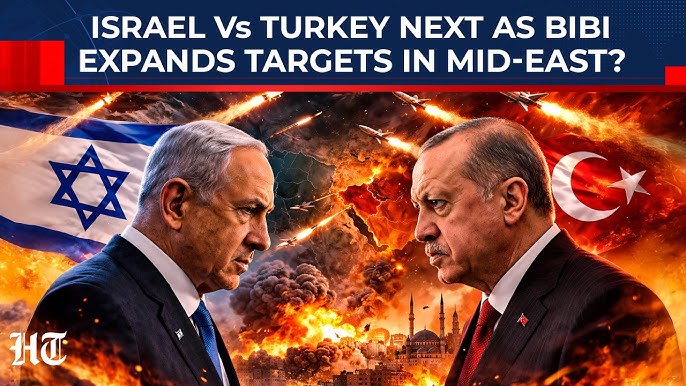

As US-brokered deals create contradictory paths for Lebanon and Iran, Israeli political and military leaders are increasingly framing Turkey as the region’s next major threat.
A new analysis warns that Israel, having secured significant military and diplomatic gains against Iran and Hezbollah, is now turning its strategic focus toward Turkey. This shift in posture follows the signing of two conflicting US agreements and a chorus of Israeli political voices declaring Ankara the new “existential enemy.”
The report details how the US administration signed contradictory deals to end its war on Iran. One agreement, signed with Tehran, links the cessation of hostilities to an end to military operations in Lebanon, theoretically respecting Iranian sovereignty. The other, a framework deal signed by Israel, Lebanon, and the US, allows for the indefinite occupation of southern Lebanese territory by Israeli forces and reportedly includes clauses that could grant immunity to Israeli troops for alleged war crimes.
This latter agreement has sparked fury in Beirut, with Lebanese Speaker Nabih Berri vowing to block the deal, warning it could ignite a civil war. Critics, including Lebanese MP Halima Kaakour, argue that the agreement trades away Lebanon’s legal rights for a withdrawal that is already an international obligation.
The ‘Sunni Axis’ Rhetoric
While the Lebanon deal is seen as a blow to Iran by Prime Minister Benjamin Netanyahu, the analysis argues that Tel Aviv’s political establishment has quickly pivoted, now portraying Turkey as its new primary challenge. A bipartisan chorus of Israeli politicians, including figures like Naftali Bennett and ministers Amichai Chikli and Gila Gamliel, has raised the alarm about a “new Sunni axis” composed of Turkey, Syria, and Qatar, using rhetoric that frames Turkey as the “new Iran” or a resurgent “Ottoman Empire.”
This narrative has reportedly not been welcomed by US President Donald Trump, who has praised his Turkish counterpart, Recep Tayyip Erdogan. Furthermore, US Vice President JD Vance has appeared to caution the Israeli government, reportedly stating that a country of nine million people “can’t just kill your way out” of security problems, in a clear reference to the “kill first” doctrine.
However, the groundwork for confronting Turkey appears well-laid. Since the fall of Bashar al-Assad in Syria, Israel has moved to destroy Syrian military assets and limit the new government’s authority, directly challenging Turkey’s growing influence in Damascus. Israeli moves also include supplying Cyprus with advanced air defence missiles and fostering tensions in the Eastern Mediterranean to counter Turkey’s rising naval power.
Ankara’s Calculated Response
Turkey’s reaction to Israeli moves has so far been cautious. Despite strong rhetoric from President Erdogan, who recently stated that Israel’s attacks on Syria and Lebanon directly threaten Turkey, Ankara has maintained military deconfliction lines with Israel and reportedly kept oil flowing to the Israeli port of Ashkelon via its Ceyhan terminal.
This cautious approach is attributed by the analysis to Turkey’s military timeline. Turkish defence analysts believe it will take three to five years to bring its air defence systems to operational capacity against the Israeli Air Force. In the meantime, Ankara is focusing on building its naval and air power, accelerating the construction of a 60,000-tonne aircraft carrier and developing its Kaan stealth fighter with US engines.
The analysis also highlights reports from Israeli sources that frame Turkey as the next target, with a recent article declaring “Iran was the rehearsal. The Turkish file is open.” These views have caused concern in Turkey, though the article’s author has been distanced by his former employer. Some Israeli officials have also downplayed the idea that Turkey is the “next Iran.”
Nevertheless, the analysis concludes that Israel’s rhetoric is a serious indicator of intent, reminiscent of its strategy against Iran. The article warns that the main battle line will be drawn in Lebanon and Syria, and that hard power will be needed to halt Israel’s ambition to redraw the borders of the Middle East.