
The crisis in Sudan is not a coincidence but a calculated move within long-standing imperial strategies aimed at blocking Turkey’s growing influence in Africa.
The ongoing conflict in Sudan reflects the continuation of colonial-era “grand strategies” in which every crisis serves broader imperial goals. Since its 1898 colonization by Britain, Sudan has been deliberately kept unstable through external manipulation—from civil wars to the Darfur conflict—preventing genuine independence. As Turkey reasserted its presence in Africa after 2005, global powers like the U.S. and its allies countered by supporting proxy forces such as the Rapid Support Forces (RSF). Recent developments, including U.S. interference in peace efforts and RSF’s atrocities in Darfur, reveal a plan to reshape Sudan’s political order in line with Western and Israeli interests while curbing Turkish and Chinese influence.
In imperial projects there are no coincidences. Everything unfolds as a series of “planned accidents.” The “grand strategy” never changes. Different events are always coordinated. Every incident that looks like a surprise to us is actually a deliberate move in the imperial chess game. Therefore, we must read every development as a piece of a much larger puzzle. We are witnessing that truth again in Sudan.
The Bilād al-Sūdān—the “Land of the Blacks” that the British colonized in 1898—has been trapped in the same whirlpool for 127 years. Although Sudan formally gained independence in 1956 and escaped direct colonial occupation, it was soon plunged into chaos through internal occupation projects. After the 1956–72 civil war, a second internal conflict that lasted from 1983 to 2005 eventually led to the partition of Africa’s largest country. Oil-rich South Sudan, which had a stronger African identity, declared independence on 9 July 2011 and became the UN’s 193rd member.
But imperial powers moved to activate a new crisis in Darfur—rich in gold, uranium and oil—instead of the fading problem in South Sudan. In February 2003 two groups in Darfur raised the banner of rebellion against a government they accused of oppressing non-Arab populations. It was notable that the Darfur crisis coincided with the 2001 Afghanistan and 2003 Iraq invasions. Indeed, by 2006 a scenario for intervention in Somalia via Ethiopia had already been set in motion.
Because the successor of the Ottoman state that had asserted control over Sudan in the 1820s—Turkey—was returning to its historic lands. Turkey’s declaration of 2005 as the “Year of Africa” and the opening of the continent’s first TİKA office in Addis Ababa sent shockwaves through imperial centres. The U.S. quickly responded by creating AFRICOM in 2007. China, for its part, declared 2006 the “Year of Africa.” For colonial powers Sudan has always been of strategic importance.
Beyond its water, energy and mineral resources, Sudan possesses a geopolitical weight that affects balances across regions stretching from the Persian Gulf to the Red Sea, from the Eastern Mediterranean to the Horn of Africa. That is why they never truly left Sudan alone. The jubilation of the Sudanese people when Omar al-Bashir’s 30-year rule ended in 2019 was short-lived. General Abdel Fattah al-Burhan and the commander of the Rapid Support Forces (RSF)—known locally as the Janjaweed—Mohammed Hamdan Dagalo overthrew the newly formed civilian government in 2021. Then, on 15 April 2023, Dagalo rebelled against al-Burhan and lit the fuse of a civil war.
John Godfrey, whom the U.S. appointed as its envoy to Sudan in 2021, played a key role in the RSF’s uprising. He helped foment the conflict. Without chaos, a new Sudan could very well have fallen into Turkey’s sphere of influence, as happened with Libya. In fact, in December 2024 al-Burhan, with the support of Turkish armed drones, gained the upper hand over the RSF. The following month, January 2025, peace talks centered on Turkey entered the agenda.
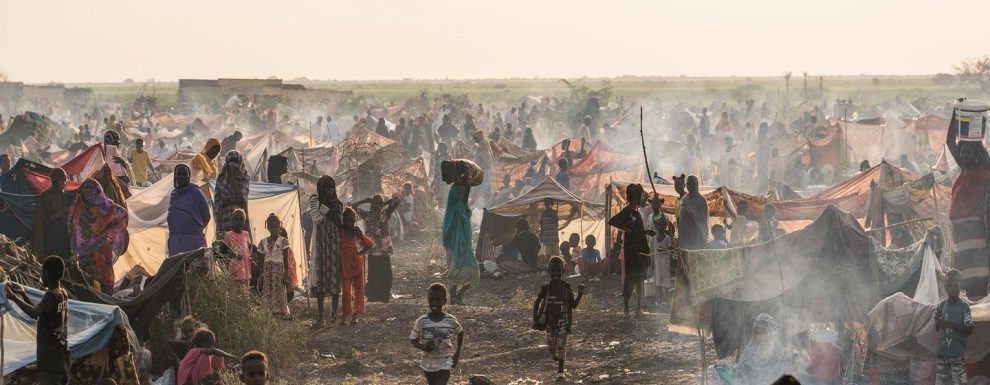
But the United States intervened and undermined the process. At the Gaza summit in Sharm El-Sheikh on 10 October, the U.S. met with Sudanese parties and subsequently hosted them in Washington. The aim was to whitewash the RSF—an armed force that uses rape, torture and starvation as weapons of war—by portraying it as a legitimate actor. The U.S. pressured al-Burhan to make concessions to the RSF. What followed was catastrophic: emboldened by Washington’s green light, RSF militias intensified their campaign, attacked Darfur’s capital El Fasher and seized the city after committing another mass atrocity against civilians.
The U.S. now seeks to control all of Sudan through the RSF, which is terrorizing six of the country’s eighteen states. The RSF promises Israel that the western, southern, central and eastern districts of Darfur—along with South Kordofan and Gezira—could be placed under the authority of displaced Gazans to be resettled there. It also promises a secular alternative to the Islamist al-Burhan and pledges to end alleged arms shipments from Port Sudan to Hamas—thereby vowing to eliminate Turkish and Chinese influence in Sudan.
As we see, the RSF is a highly useful instrument for the U.S. and Israel. But Sudan is not Gaza. A Syrian-type outcome could succeed in Sudan, and that would be a disaster for Turkey; it is a matter of time, and everyone knows it.
Therefore, if a reasonable compromise is not reached, Turkey—together with regional actors such as Egypt, Saudi Arabia and Libya—will sooner or later apply its own national remedy to the imperial crisis in Sudan. Current developments point in that direction.