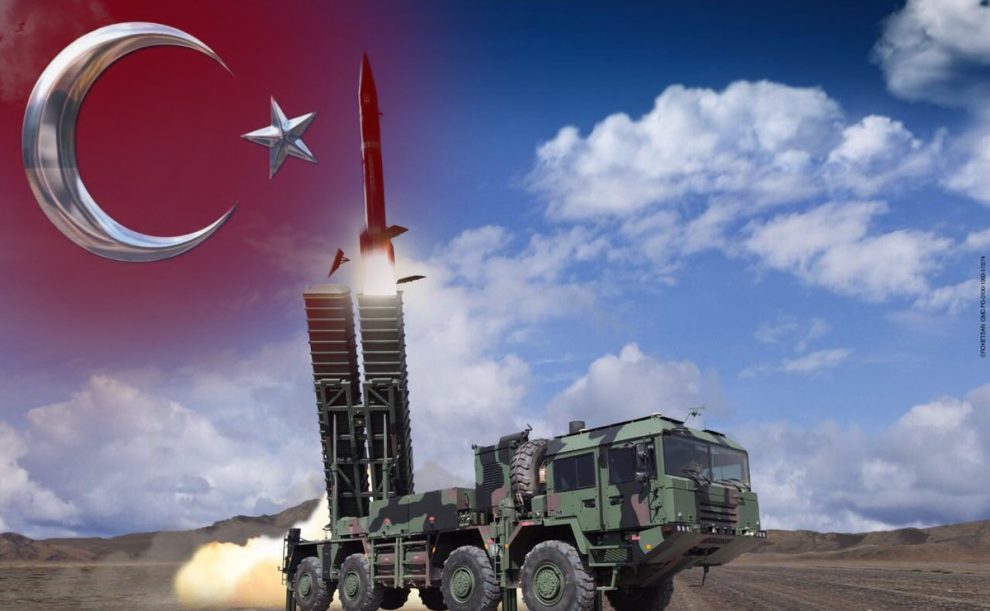

In the volatile geography of the Eastern Mediterranean and the Black Sea, strategic depth is measured in kilometers. Over the last decade, Türkiye has transformed from a dependent importer of defense systems into a burgeoning independent power, primarily driven by a highly ambitious missile development program. According to the Stockholm International Peace Research Institute (SIPRI), Türkiye currently possesses an estimated 322 ballistic missiles, ranking seventh globally and placing it ahead of nuclear powers like France and India. This arsenal is no longer just about quantity; it is about the indigenous sophistication of systems like the Tayfun and Atmaca, which are redefining the country’s deterrence posture.

The Current Inventory: The “Cayenne” and the “Typhoon”
Ankara’s current strike capabilities rely on a mix of legacy systems and domestically produced workhorses. The backbone of the near-term deterrent is the Bora (Storm) missile. Developed by Roketsan, this short-range ballistic missile (SRBM) has a range of approximately 300 kilometers. It represents Türkiye’s first major step toward deep-strike autonomy, allowing land-based batteries to strike high-value targets deep behind borders.

However, the current crown jewel is the Tayfun (Typhoon). Tested in a high-profile launch over the Black Sea in October 2022, the Tayfun shattered previous records by striking a target 561 kilometers away. With its high speed, precision guidance, and reported terminal-phase maneuvering capabilities to evade air defenses, the Tayfun poses a significant challenge to regional adversaries. President Recep Tayyip Erdoğan has already declared the current range insufficient, setting a public target to extend the Tayfun’s reach to 1,000 kilometers.
Beyond ballistic arcs, Türkiye is mastering sea-skimming technology. The Atmaca (Hawk), an all-weather, long-range anti-ship cruise missile, is now entering widespread service. With a range of 250+ kilometers and a 250 kg high-explosive warhead, it surpasses the aging U.S. Harpoon missiles it is replacing. Crucially, the Atmaca utilizes advanced 3D mission planning, data-link for “man-in-the-loop” control, and an active radar seeker, making it resistant to electronic countermeasures.
Emerging Capabilities: Land-Attack and Naval Integration
A significant shift is currently underway regarding the role of naval assets. Until recently, Türkiye’s surface fleet was primarily optimized for anti-shipping (ASuW) or anti-submarine warfare (ASW). However, a landmark test in March 2026 changed this dynamic. Roketsan successfully launched an Atmaca missile from the TCG Burgazada corvette that struck a designated land-coordinate target. This demonstration validated the missile’s land-attack capability, sometimes referred to as the “Kara Atmaca” concept.
For the Turkish Naval Forces, this means that every Ada-class corvette or future Hisar-class OPV equipped with Atmaca is no longer just a ship-killer but a precision strike platform against coastal infrastructure, radar sites, and logistics hubs. This capability is enhanced by the use of the indigenous KTJ-3200A turbojet engine, ensuring the supply chain remains sovereign.

Future Inventory: The Next Generation
Looking ahead, Türkiye is aggressively filling future gaps in its arsenal, moving toward layered deterrence. Perhaps the most anticipated strategic asset is the Gezgin (Cruiser/Loiterer) land-attack cruise missile (LACM), analogous to the U.S. Tomahawk. Expected to reach operational capability soon, Gezgin is projected to have a range between 800 and 1,200 kilometers. This would give Türkiye a “strategic depth” capability, allowing it to strike deep inland from mobile launchers or submerged submarines.
Roketsan is also marketing the Çakır (Falcon), a smaller, modular cruise missile. Unlike the Atmaca, the Çakır is designed for network-enabled swarming. It can be launched from land, ships, helicopters, and even UAVs like the Bayraktar AKINCI. With a range of approximately 150 kilometers and an IIR (Imaging Infrared) seeker, Çakır will add a low-cost, precision-swarming layer to the inventory.
While offensive missiles grow, so do defensive shields. The Siper (Fortress) project aims to create a long-range Area Air Defense System with a range of 100+ kilometers, filling Türkiye’s long-standing need for a domestic equivalent to the S-400 or Patriot. According to recent defense ministry timelines, mass production and delivery of Siper Block-I are imminent. Simultaneously, MKE (Makine ve Kimya Endüstrisi) is preparing the Tolga Close-In Air Defence System. Unlike traditional gun-based CIWS, Tolga integrates the Enfal-17 missile, a laser weapon, and acoustic detection. Its debut at SAHA 2026 signals a move toward layered, hard-kill local defense for forward-deployed assets. As stated by President Erdoğan, work on a ballistic missile exceeding 1,000 kilometers is officially underway. This would place almost all regional capitals within theoretical range of Turkish conventional retaliation.
Strategic Context: NATO and the Region
It is crucial to note the constraints and context. As an MTCR (Missile Technology Control Regime) signatory, Türkiye is politically bound against exporting missiles with a 300km/500kg payload, but domestic development is unrestricted. Consequently, Türkiye is building a massive industrial base. Recent events underscore the urgency of this build-up. The interceptions of Iranian ballistic missiles over Turkish airspace in March and April 2026 highlighted the fragility of air defense reliance on NATO allies. This has accelerated the push for autonomous systems like the Karapel and the deployment of indigenous radars. Furthermore, the export market is thriving. Malaysia recently signed a contract for the Atmaca missile to arm its new Littoral Mission Ships (LMS), proving that Turkish missiles are not just effective but competitive in the global defense market.
Conclusion
Türkiye’s missile program has moved past the prototype phase. With the Tayfun pushing boundaries, the Atmaca proving multi-role lethality, and the Gezgin waiting in the wings, the country is constructing an “A2/AD” (Anti-Access/Area Denial) bubble across its maritime and territorial borders. For Ankara, the missile is no longer just a weapon; it is the primary instrument of sovereign diplomacy in a multipolar world.