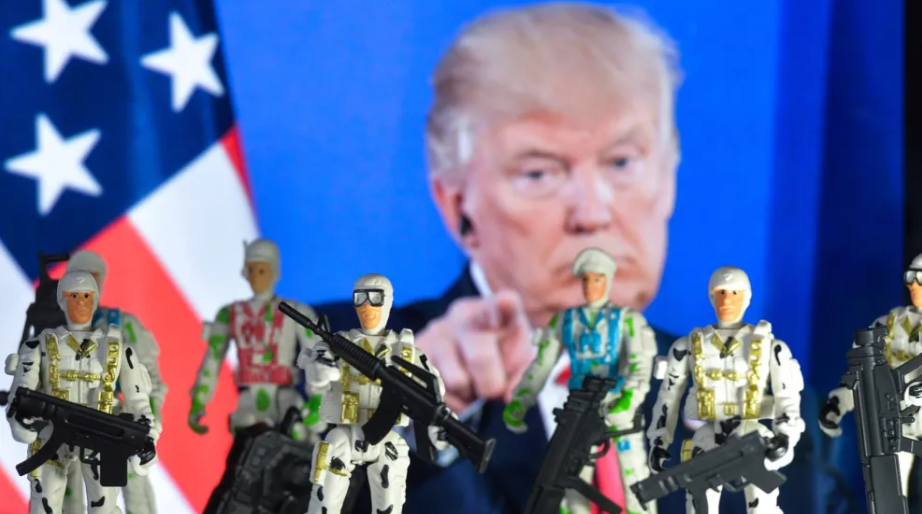

Even if you occasionally visit online media or platforms, one of the first things you’ll see is almost the entire social sphere, including his own country, mocking Trump, some with tears, others with anger, giving him nicknames and ridiculing his decisions. Even leaders such as French President Macron and, if still in office since yesterday, British Prime Minister Starmer, have made official‑looking dismissive remarks aimed at Trump.
German Chancellor Friedrich Merz, last week, said that the Iranians “have humiliated the United States.” Merz stated that Washington entered this war “clearly without any strategy” and that “not only Trump but the entire American people are being insulted by the Iranian Revolutionary Guard.”
Trump, known for being “overly sensitive” to such things, reacted on his own social‑media platform, first writing “He doesn’t even know what he’s saying!” in anger; but as he read the German chancellor’s words, he apparently grew even more furious, telling him “He should mind his own business; end the war in Ukraine!”—using the same colloquial tone found in the neighborhood‑fight depictions of Orhan Kemal and Said Faik. After the “last assassination” attempt, while heading to Florida to play golf, Trump, confronted by cameras, became even angrier when mischievous reporters reminded him of Merz’s comments and said, “I can pull American troops out of Germany!”
Before 1991, the United States had 218 bases and facilities (not part of NATO) across West Germany and then the whole of Germany, with more than 90,000 soldiers; however, former President Democrat Joe Biden reduced the number of bases to 46 and the troop count to 29,000.
The idea of the U.S. withdrawing troops from Germany was not considered by the government until Trump uttered those words on Friday, and until the statements were published, neither the U.S. Secretary of Defense nor any other official had addressed the issue. After Trump, however, Defense Secretary Pete Hegseth made successive statements and published tables showing from where 5,000 American soldiers would be pulled.
Even Rupert Murdoch’s Wall Street Journal editorial board, despite being a Trump supporter, wrote in an article titled “Trump’s 60‑day resolve on Iran,” that the German chancellor was right to condemn the United States. The newspaper described Trump’s troop‑withdrawal decision—whose origin in the Pentagon’s chain of command is unclear—as “a knee‑jerk reflex.” Axel Springer’s newly acquired Politico, whose editor seems willing to risk dismissal, noted in a review of the Pentagon’s last‑year assessment of U.S. forces that there was no suggestion of any reduction in Europe, and that the Defense Department “did not anticipate the 5,000‑troop decision and has no withdrawal plan.” (On the day Springer bought Politico, it sent a letter to staff saying, “If you don’t like Trump, resign!”)
NATO, the Pentagon, and Russian leader Vladimir Putin are left to calculate the strategic impact of reducing American troops in Europe. The Daily Beast, coining the acronym TACO—“Trump Always Chickens Out”—named after the phrase’s initials, reported that Merz gave the U.S. president an “anger fit.” In journalist Mary Papenfuss’s article, she wrote that Trump, who came to power promising “to end endless wars,” finally found himself in his own endless war, entering the 60th day of the Iran conflict; she quoted him as saying, “I will relieve my anger at Merz by pulling the bullet soldiers out of Germany.”
Who benefits from Trump’s decision, on the 60th day, to pull American troops out of Germany as the Iran‑Israel war seems to be reigniting? Nobody knows. But the mothers, wives, and children of those soldiers will certainly be very relieved.
Source: https://www.milliyet.com.tr/yazarlar/hakki-ocal/trump-kursun-askerlerini-geri-cekiyor-7581755