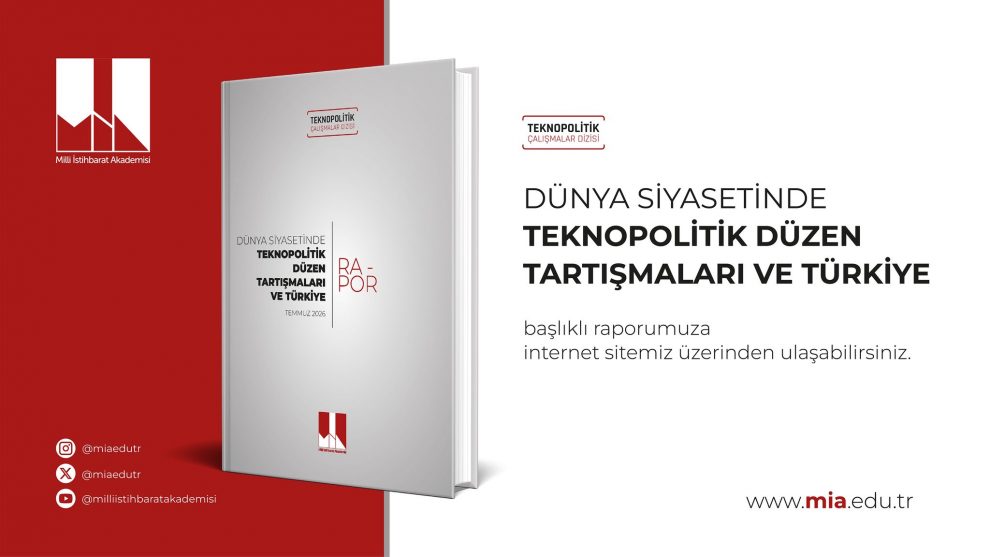

Ankara’s Millî İstihbarat Akademisi (National Intelligence Academy, MIA) has published a new report arguing that the global debate over artificial intelligence has moved well beyond questions of technical performance and is now reshaping state power, economic hierarchy and the place of the individual in public life. The report, titled “Dünya Siyasetinde Teknopolitik Düzen Tartışmaları ve Türkiye” (Technopolitical Order Debates in World Politics and Türkiye), was released in July 2026 as the first installment of the Academy’s new Technopolitical Studies series.
Three competing worldviews
The report identifies three dominant schools of thought currently competing to define the emerging “technopolitical order.”
The first, which it calls techno-realism, treats AI primarily as an instrument of state power, defense and intelligence capability. The report links this camp most closely to Palantir chief executive Alex Karp and co-author Nicholas Zamiska, whose book “The Technological Republic” argues that Silicon Valley spent three decades diverting engineering talent away from national projects toward consumer applications, and calls for a Manhattan Project-scale reunification of the tech sector with state power. The report also traces techno-realism’s intellectual roots to figures such as Peter Thiel, Palmer Luckey and Marc Andreessen, and notes its more radical fringe overlaps with the “Dark Enlightenment” ideas associated with Curtis Yarvin and Nick Land, who favor centralized, corporate-style governance over democratic participation.
The second school, labeled techno-pragmatism, is associated with Anthropic and figures such as chief executive Dario Amodei and interpretability researcher Chris Olah. This camp accepts that advanced AI systems carry both enormous benefits and serious risks, and argues that safety, staged deployment, testing and external oversight must be built into system design from the outset rather than added afterward.
The third approach, techno-humanism, centers on human dignity, the common good and social justice. The report points to Pope Leo XIV’s encyclical “Magnifica Humanitas” as a recent and influential articulation of this position, alongside secular reference points such as UNESCO’s AI ethics recommendations and Microsoft’s responsible-AI principles.
Each approach diagnosed — and each found wanting
The report credits techno-realism with correctly identifying the risks of a technologically weak state, but warns it risks subordinating legal and social limits to security imperatives and legitimizing a hierarchical world order that separates “functional” from “dysfunctional” cultures. It credits techno-pragmatism with the most developed engineering-safety framework, but says this framework is produced within a corporate and elitist structure rather than through democratic oversight. It credits techno-humanism with the strongest normative grounding, but says it offers less concrete guidance on institutional capacity and hard security needs.
Türkiye’s position: neither core power nor comfortable regulator
The report argues Türkiye enters this debate from an unusual position — it is neither a central producer of frontier AI technology nor a state insulated enough from security pressure to legislate purely on normative grounds. It cites Türkiye’s defense-industry experience, battlefield-tested and AI-integrated systems, and growing public-private coordination as genuine strengths, alongside a fragmented data-governance landscape, uneven transparency and accountability standards, and an administrative tradition that is already centralized — a trait AI’s own centralizing tendencies could further intensify.
The report singles out techno-realism’s implicit civilizational hierarchy for particular scrutiny, arguing that Türkiye’s pluralist civilizational tradition — one built on recognizing and coexisting with the “other” rather than dominating it — gives it a genuine basis to reject that hierarchical vision, provided moral posture is matched with real strategic capacity. It draws an explicit parallel to Türkiye’s historical delay in nuclear-energy technology, warning against repeating that experience with AI.
Policy recommendations
The report closes with a detailed set of proposals, including: developing a distinct Turkish approach that combines capacity, justice, strategic power and human dignity; building a risk-based classification system for public-sector AI use, with stricter oversight for law enforcement, biometric systems and judicial decision-support tools; separating rule-making, implementation and oversight functions across different institutions; making data governance the backbone of public AI policy; building in-house technical expertise able to evaluate and, when necessary, halt AI systems; requiring explicit legal grounds for biometric and surveillance systems; and pursuing “technopolitical diplomacy” to project Türkiye’s approach internationally while supporting pluralistic, multi-civilizational AI governance mechanisms rather than standards set by a single tradition.
The report was authored under the direction of MIA president Prof. Dr. Talha Köse and is the first in a planned series of studies on technopolitics.