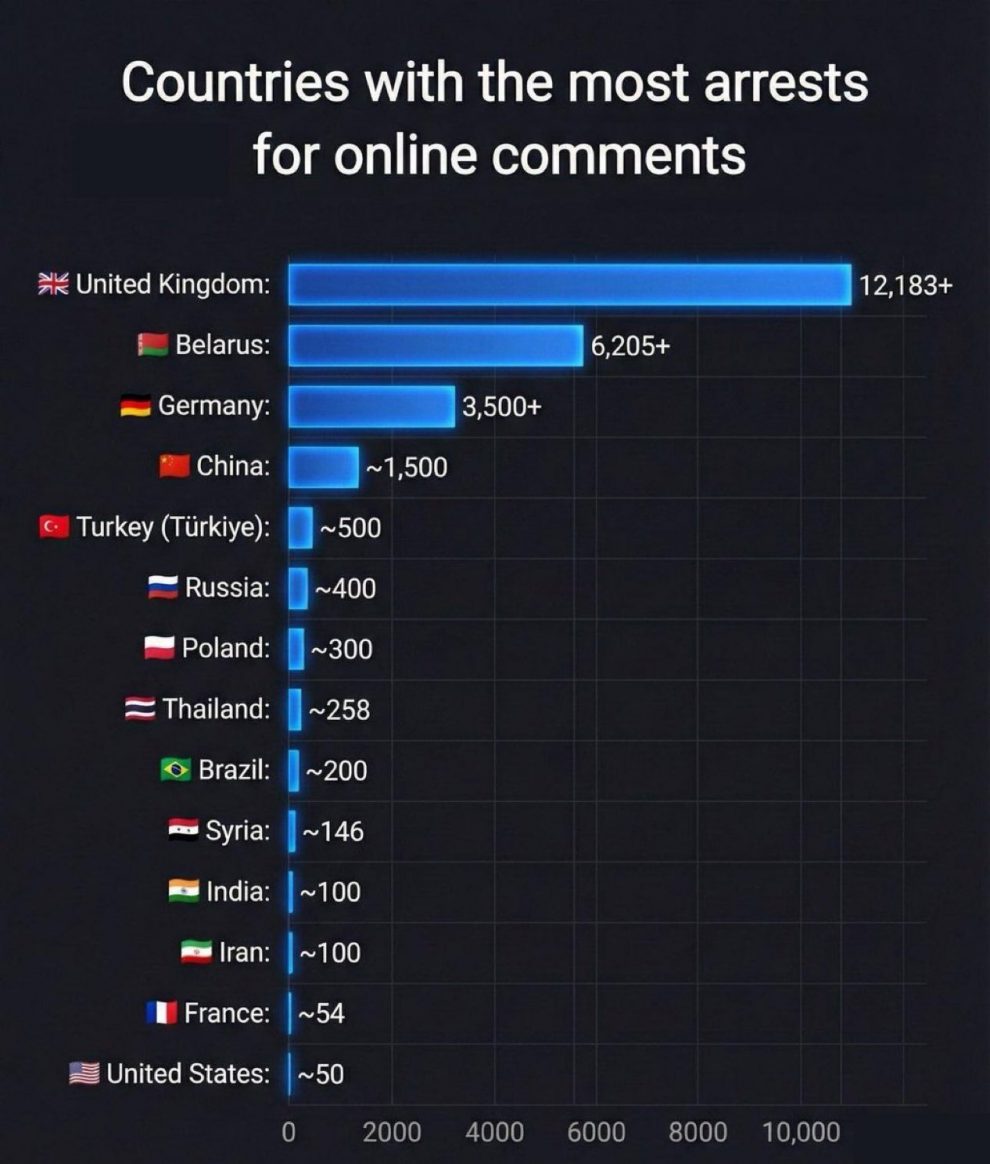

LONDON/BERLIN – A newly published comparative analysis of global arrest data has revealed that the United Kingdom and Germany rank as the Western countries with the highest number of arrests for online comments, surpassing nations often criticized for digital censorship.
According to the dataset, which aggregates official records and verified media reports, the United Kingdom tops the list among Western democracies with over 12,183 arrests related to social media posts, forum comments, and other digital expressions. Germany follows with more than 3,500 such arrests.
The figures place both nations far ahead of countries like France (54 arrests) and the United States (approximately 50 arrests), while also exceeding reported totals from Russia (around 400) and Turkey (around 500).
The UK: Policing the Keyboard
In the United Kingdom, legal experts point to a rigorous application of existing laws, including the Communications Act 2003, the Malicious Communications Act, and more recently, the Online Safety Act, which imposes a duty of care on platforms and users.
“The threshold for what constitutes an illegal comment is lower in the UK than in many other Western nations,” said Dr. Eleanor Vance, a digital rights lawyer based in London. “Prosecutions for ‘grossly offensive’ messages—even those not explicitly threatening—are relatively common, and police forces have dedicated units scouring social media.”
High-profile cases in recent years have included arrests for posting memes, chanting offensive slogans at football matches, and making jokes deemed “menacing” after major tragedies. The 12,183 figure includes individuals held for questioning, later released, as well as those charged and convicted.
Home Office officials declined to comment on the specific statistic, but a spokesperson reiterated that “freedom of expression is not absolute” and that “threatening, abusive, or insulting communications that cause alarm or distress have no place in a modern society.”
Germany: Strict Laws Against Hate Speech
Germany’s 3,500+ arrests stem largely from the country’s strict enforcement of the Network Enforcement Act (NetzDG) and criminal code provisions against incitement to hatred (Volksverhetzung).
Unlike the UK’s broader “offensive communications” standard, Germany’s arrests are heavily concentrated on antisemitic, racist, or neo-Nazi content, as well as direct threats and incitement to violence.
“Germany’s approach is historically driven,” noted Berlin-based legal analyst Markus Fiedler. “After the Nazi era, the legal system is uniquely sensitive to hate speech. But critics argue that even resharing a banned slogan or commenting ‘ironically’ can lead to a police visit and arrest.”
The data shows Germany with roughly 65 times as many reported arrests for online comments as France, despite similar population sizes. German officials counter that the law is necessary to maintain public order, and many arrests result in dropped charges or small fines.
Global Comparison
The full dataset shows Belarus in second place overall with over 6,200 arrests, trailing only the UK. China recorded approximately 1,500 arrests—a smaller number than both Britain and Germany—though independent researchers caution that data from authoritarian states is often underreported or reflects only cases made public.
Thailand, Brazil, and Syria round out the middle ranks, while nations like India and Iran each report around 100 arrests.
Criticism and Concern
Civil liberties groups have raised alarms over the UK and Germany’s figures. “Arrest is a blunt instrument,” said a spokesperson for the digital rights group OpenNet. “For every person genuinely inciting violence, there are dozens arrested for sarcasm, anger, or bad taste. That criminalizes everyday speech.”
Supporters of the laws argue that the high arrest numbers reflect robust enforcement of reasonable boundaries. “The UK and Germany are not arresting people for criticizing the government—they are arresting people for racial slurs, death threats, and targeted harassment,” said one former German prosecutor. “That’s not censorship; it’s public safety.”
As the debate intensifies, the data suggests that Western Europe’s most populous democracies have become unexpectedly aggressive enforcers of online speech—leading the world not in freedom, but in arrests.