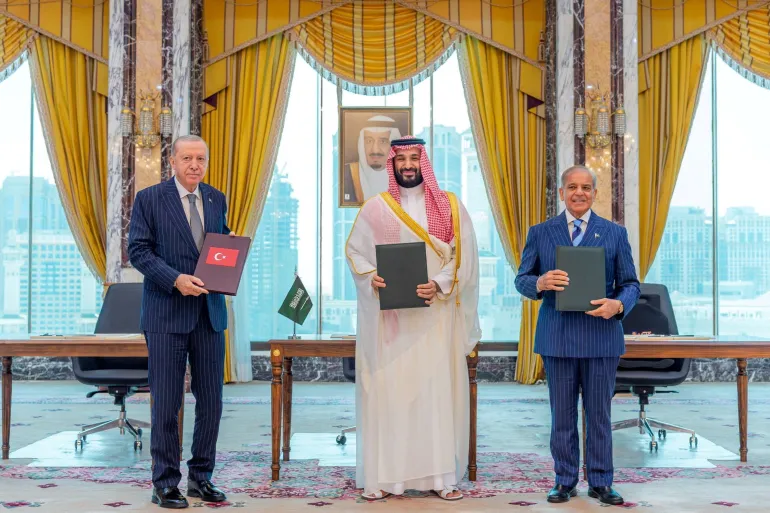

The Mecca Defense Pact became operational within just a few months of its inception. The fact that Saudi Arabia—one of the member states—came under attack by the Houthis undoubtedly played a major role in accelerating this process. Currently, Pakistan and Turkey are providing defensive support to the Saudis in their fight against the Houthis. According to Foreign Minister Hakan Fidan, the Pact is strictly defensive in nature and does not entail offensive operations. In other words, a member state under attack will be defended when the enemy strikes, but no attacks will be launched against the enemy nation itself. To illustrate this with specific weaponry: air defense systems will be sent to Saudi Arabia, but F-16s capable of conducting aerial strikes will not.
However, given that an offensive action can also be a form of defense, we may well witness “defensive” attacks. Suppose a Houthi position is detected while preparing to launch missiles at Saudi facilities; Turkish and Pakistani forces would not simply sit by and watch. Even if they do not launch the attack themselves, guiding Saudi forces and providing intelligence support effectively makes them part of the offensive—which is both what is happening and what ought to happen. Logically, and indeed physically, it is impossible to separate offense from defense.
Having covered the details of this matter and analyzed the current situation, we can now turn to our main topic: how the Pact will shape the future of its three member states and other Muslim nations.
The lack of unity among Muslim countries is viewed as a major shortcoming of the Muslim world. There are many reasons for these divisions. While some countries are reluctant to form alliances with other Muslim nations due to sectarian differences—or conversely, are excluded by others because of their sect—certain wealthy nations view cooperation with impoverished Muslim countries based on “shared faith” as unnecessary, simply because the latter have nothing tangible to contribute.
The disparity in wealth and resources poses a genuine challenge. If you are weak, you cannot align yourself with another weak nation, as they, too, are in need of assistance. If you are an underdeveloped country, you naturally gravitate toward developed nations because they have something to offer you. For instance, despite its immense wealth, the UAE does not form an alliance with an impoverished state like Niger; instead, it aligns with the UK. Similarly, when Saudi Arabia requires weaponry, it cannot turn to a Muslim nation, as the most advanced arms are produced by the Western world. Furthermore, to acquire these weapons without facing embargoes, it must maintain good relations with the manufacturing countries—sometimes at the cost of neglecting issues it ought to champion, such as the Palestinian cause.
Ultimately, for an alliance among Muslim nations to move from mere sentiment to reality, it must offer tangible, material benefits; without the necessary material conditions, such an alliance is unlikely to materialize.
Another prerequisite is to start as a small group and expand gradually following initial success. This is how the European Union grew and became a model union: established by six nations, it now comprises 27 members. Even the UK, having left the bloc, is considering rejoining. The Mecca Pact is significant precisely within the context described above. Should it succeed—that is, if it manages to protect Saudi Arabia from the Houthis—other countries will also seek to join. Indeed, Syria is already conducting a preliminary assessment regarding fighting the Houthis alongside the Pact’s other members; if it becomes involved in practice, it would first become a de facto member before formally joining.
The Mecca Pact is significant precisely within this context. If it succeeds—that is, if it manages to protect Saudi Arabia from the Houthis—other nations will also seek to join. Indeed, Syria is already conducting a feasibility study on fighting alongside the Pact’s other members against the Houthis; should it become actively involved, it would transition from de facto participation to formal membership.
Joint production initiatives within the industrial sector would commence. Subsequently, cooperation would extend to areas such as transportation, customs, and education. This would increase interdependence among the nations involved, yet none would object to this reliance, as it would foster collective action, lower costs, high-tech capabilities, and access to new markets. Furthermore, there would be no growth-limiting obstacles, such as embargoes.
Reaching this stage would enable impoverished nations to develop, while simultaneously fostering further growth in developed and developing countries alike. The European Union is currently developing a project titled “Made in Europe,” aiming to source necessary products from its member states—a strategy that effectively closes its markets to foreign nations. If a similar model were adopted for the prospective Union of Muslim Countries, the outflow of capital to external markets would cease, and members would contribute to one another’s prosperity.
Just as individuals cannot live in isolation or meet all their own needs, nations cannot develop in solitude. Acting in unity reduces the costs inherent in development and facilitates the sharing of knowledge and technology. If a union grounded in a shared Islamic identity is envisioned, the practical approach would be to launch the initiative with a small group of countries in a specific sector. In this context, the Mecca Defense Alliance (or Pact) could play a pivotal, core role. If the Saudi military achieves victory with the “defense” support of the Turkish and Pakistani armies, the likelihood of any future friction or dispute arising between the three nations would be virtually nil; for whenever a problem arose, the memory of that military support would serve as a reminder of their bond. Moreover, such support would act as an incentive for cooperation in other areas as well.
As the benefits accumulate, new countries will join, new partnerships will emerge, and the alliance will present a united front—acting as a single body—to the outside world. For instance, if a member state were to run for a position at the UN, it would be guaranteed votes from all the other members of the alliance. Similarly, if a foreign nation contemplated imposing an embargo on one of the member states, it might well abandon the idea out of concern for the reaction of the other members; after all, an act of aggression against one would be perceived as an attack on all. Do we not observe this dynamic in Turkish-Greek relations and the relations between Turkey and the Greek Cypriot administration? Whenever Turkey faces a standoff with Greece, the EU stands firmly behind Greece. Furthermore, regarding the Cyprus issue, the EU has consistently championed the Greek Cypriot position, effectively using the matter as a tool of leverage—or even blackmail—against Turkey.
Therefore, the success of the Mecca Pact is essential, as it promises to open up a vast array of new opportunities.