
Prof. Oğuzhan Bilgin
On March 26 and April 6, 2026, I wrote two columns on this subject. In those articles, I argued that, beyond the two existing axes in the Middle East—one consisting of the United States, Israel, and the UAE, and the other of Iran and its Shiite proxies—a third axis would emerge, with Türkiye taking the lead. I described this alliance as a “third-way” alliance.
I argued that, if this axis came to fruition, it would transform the face of the Middle East and consolidate Türkiye’s regional leadership, together with what I myself call its “historical-political” power assets.
I predicted that this would evolve into an alliance led by Türkiye, Pakistan, and Saudi Arabia, and argued that Egypt, Syria, Qatar, and even African states such as Libya, Sudan, and Somalia could eventually join this axis.
When I expressed this thesis in this column and on television, Western-oriented and self-doubting circles who criticized me for being “dreamy” and “emotional” argued that the countries of the Middle East could never break away from the U.S. line…
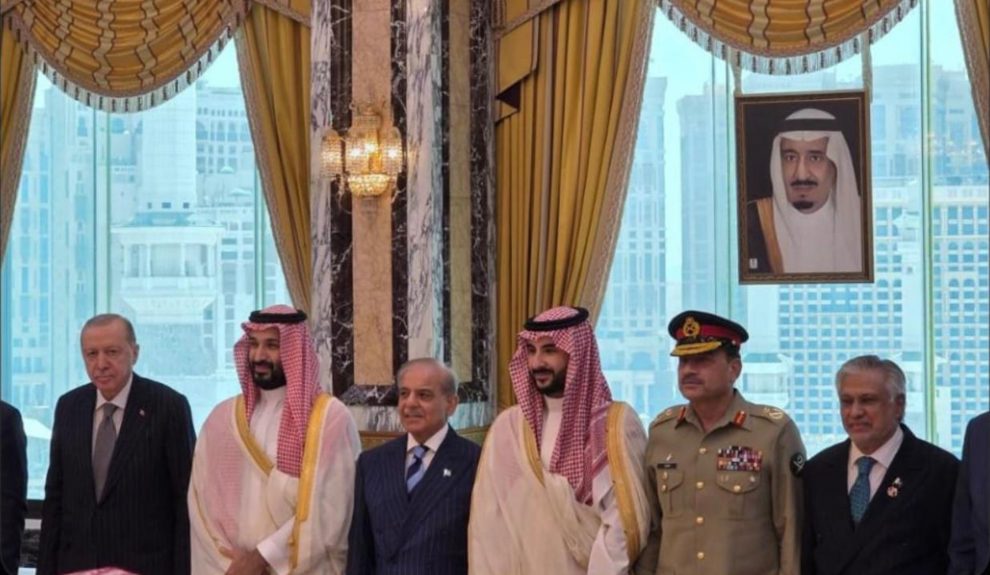
But after the historic alliance agreement signed in Mecca last Friday, following Friday prayers, nothing in the Middle East will ever be the same again.
The decline of U.S. hegemony and Washington’s shift toward its own immediate sphere of influence within the framework of the Monroe Doctrine had already shaken the old security architecture of the Middle East. Israel’s attacks on regional countries, particularly Qatar, accelerated this rupture. The United States’ inability to protect the Arab countries or reopen the Strait of Hormuz during the Iran War turned this transformation from a matter of choice into a necessity.
Türkiye’s role both in shaping the statement issued at the Riyadh meeting during the Iran War and in moderating the potential for Arab states to retaliate against Iran was also rooted in this “Third Way” strategy.
On the one hand, Türkiye opposed the U.S. and Israeli attacks on Iran; on the other, it reacted against Iran’s attacks on the Gulf. In other words, Türkiye was breaking the bipolar equation imposed on the region and constructing a third geopolitical line.
Meanwhile, the joint U.S.-Israeli attacks on Iran that began on February 28, 2026, turned the Strait of Hormuz into the scene of one of the most severe disruptions ever experienced in global energy trade. It is precisely within this equation that Türkiye finds itself at the very center of the Middle East’s changing energy and trade corridors.
Such an alliance brings Pakistan’s nuclear deterrence and Türkiye’s defense-industrial capabilities into the same equation. This has the potential to reduce the Gulf’s dependence on the United States while generating collective deterrence against regional threats, particularly Israel.
Moreover, as President Erdoğan has also stated, the door of this alliance is open to other Muslim countries—including Iran. If Iran adopts a more reasonable and rational course and embraces a new approach that does not provide ammunition for Israel’s strategy of pitting Muslims against one another, this door will undoubtedly be open to Iran as well.
This would also help moderate Iran and would serve Iran’s own interests. This alliance is not sectarian in nature. Rather, it is based on regional security and cooperation, bringing Islamic countries together while also having a dimension aimed at containing Israel. This is precisely why an atmosphere of great panic and disarray currently prevails in Israel.
What is at stake here is no longer merely a new military alliance. This emerging line—from Türkiye to Pakistan and from Saudi Arabia to Qatar and Egypt—represents an effort by the Muslim world to shape its own security, energy, defense, and geopolitical future through its own capabilities rather than entrusting them to other capitals.
The “Axis of Resistance” that Iran built over many years emerged from the conflicts of the region. Now, the “Axis of Revival” being built by Türkiye is emerging from the region’s quest to rise again.
When I put forward my first thesis about this new alliance on March 26, I concluded my article with these words:
«“Ultimately, geography is destiny, but who you share that destiny with matters more.”»