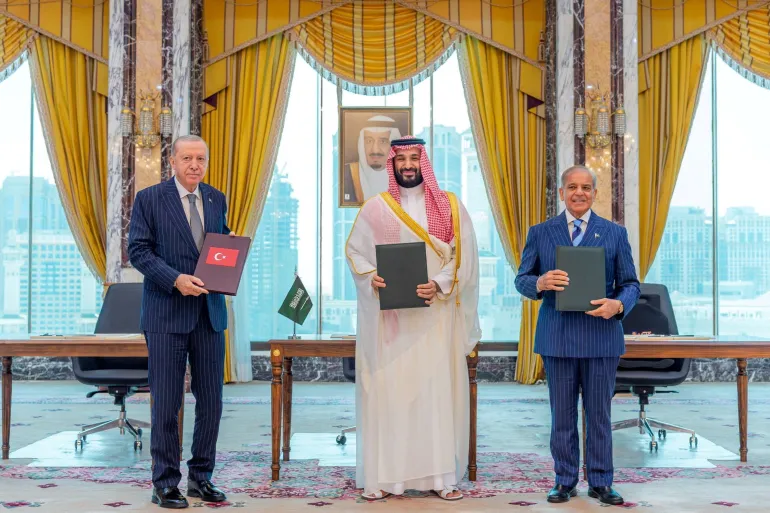

In an Al Jazeera analysis published Sunday, commentator Fahri Şahin argued the agreement represents a genuinely novel hybrid — combining NATO-style collective deterrence with a flexible, expandable structure designed to avoid hardening into a rigid military bloc. That distinguishes it, in his reading, from earlier Islamic solidarity initiatives that collapsed during the second half of the twentieth century, including the security dimension of the D-8 developing nations group.
**Three capabilities, three circles of influence**
The analysis frames the pact as uniting complementary strengths: Saudi financial depth, energy leverage, and religious legitimacy; Turkish defence-industrial capacity and NATO-derived operational experience; and Pakistani nuclear deterrence backed by combat-tested forces. Each partner’s weaknesses, the piece argues, are offset by the others’ strengths.
Şahin maps the pact’s likely zones of influence in three concentric circles: an inner ring covering the Gulf, the eastern Mediterranean, and Pakistan itself; a second ring extending into the Caucasus, Central Asia, and East Africa; and a more indirect outer ring reaching toward the Balkans and the Indian Ocean.
**Egypt’s absence noted**
The commentary flags Cairo’s absence from the signing as conspicuous, though it stops short of assigning a definitive cause, suggesting it should be read in the context of Egypt’s own regional balancing act and its relationships with the involved parties.
**Iran and Israel described as facing strategic dilemmas**
The piece characterizes the agreement as posing an existential challenge and a historic opportunity for Iran simultaneously — Tehran can either engage constructively with the new security framework or deepen its regional isolation, with consequences the author says would extend to Iranian domestic welfare over time.
On Israel, the analysis goes further, describing the pact as the clearest evidence yet that confrontation with Israel has shifted from the sub-state to the state level, and suggesting Israeli officials, having anticipated this shift, are already working to build counter-alliances before the new bloc consolidates. Looking further ahead, the piece also raises the possibility that the pact could eventually function as a counterweight to India, with South Asia likely to be its first serious operational test.
**Three possible futures**
The commentary lays out three trajectories for the agreement: remaining purely declaratory; gradually building real institutional substance through joint defence-industrial projects, intelligence sharing, and combined exercises; or evolving into a full collective-defense mechanism underpinning regional security. Citing Ankara’s record of practical backing for Azerbaijan against Armenia and for Pakistan against India, the analysis suggests the more substantive paths are plausible rather than merely aspirational.
The piece identifies two likely early tests of the pact’s seriousness — first through the Houthi file and Iran-related tensions, and second, more severely, through any flare-up between Pakistan and India — arguing that how signatories respond in those moments will reveal whether the agreement has real teeth.
*Straturka Desk, August 9, 2026*