
Erdoğan’s leadership, often criticized as authoritarian, also reflects Türkiye’s effort to balance power, stability, and moral responsibility amid global uncertainty and Western inconsistency
Gönül Tol’s “The Indispensable Erdogan” portrays President Erdoğan as dismantling Turkish democracy, but this response argues that such a view ignores Türkiye’s geopolitical realities and the strategic necessity of its leadership. While political centralization remains controversial, Erdoğan’s approach has preserved Türkiye’s stability, bolstered its defense capacity, and positioned it as a vital actor between East and West. Through pragmatic diplomacy — from mediating in Ukraine to sustaining humanitarian efforts in Gaza — Türkiye’s “filtered success” model demonstrates a nation striving to align national interest with global responsibility, not merely to hold power but to channel it toward resilience and service
A Response to “The Indispensable Erdogan”: Beyond Power, Toward Responsibility
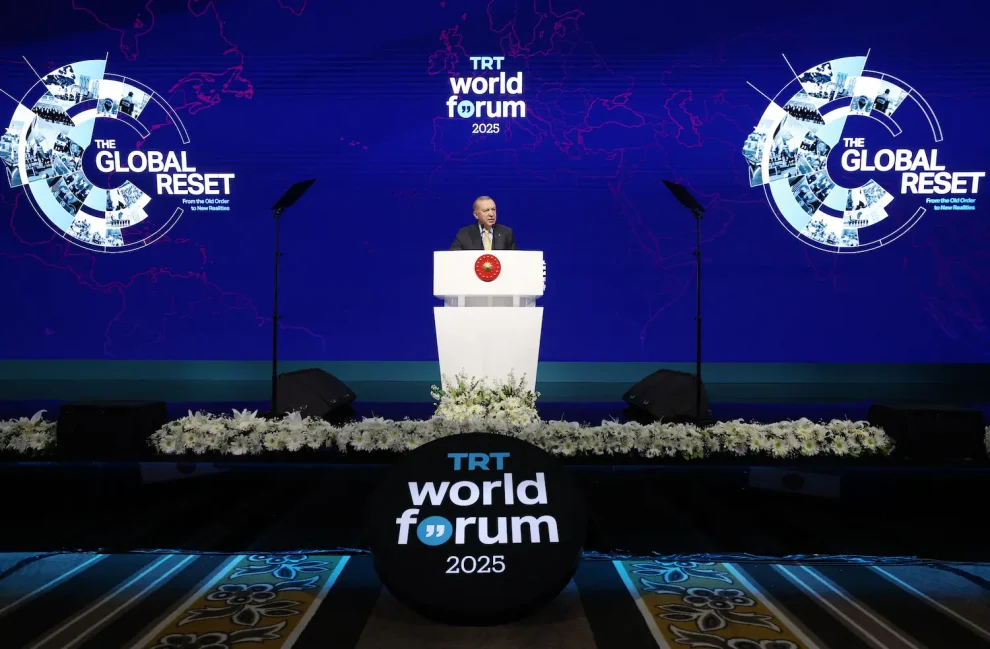
Gönül Tol’s recent essay, “The Indispensable Erdogan” (The New York Times, Nov. 6, 2025), presents President Recep Tayyip Erdoğan as a leader tightening his grip on power while dismantling the remnants of Turkish democracy. Yet this view, while capturing certain political realities, overlooks a deeper and more complex truth: Erdoğan’s enduring influence and Türkiye’s strategic indispensability are not merely products of authoritarian resilience — they are also reflections of national stability, self-reliance, and global responsibility amid regional chaos.
It is undeniable that Türkiye’s internal politics have grown increasingly polarized. However, to interpret Erdoğan’s consolidation of power solely as a suppression of democracy is to ignore the regional and global context in which Türkiye operates. The country stands at the crossroads of Europe, Asia, and the Middle East — a geography where instability is the rule, not the exception. In such an environment, political centralization, however controversial, can be viewed as a mechanism of continuity — one that prevents Türkiye from succumbing to the same chaos that has consumed its neighbors.
The Western portrayal of Erdoğan often emphasizes repression, but rarely acknowledges the pressures that drive his government’s actions: the refugee crisis, energy security, the war in Ukraine, and the vacuum left by inconsistent Western leadership. From the 2016 EU migration deal to the 2022 balancing act between Moscow and Kyiv, Erdoğan’s Türkiye has repeatedly acted as both a buffer and a bridge — defending Europe’s borders, mediating conflicts, and sustaining NATO’s logistical backbone.
As Türkiye’s defense industries expand and its diplomacy evolves into pragmatic assertiveness, Ankara’s role has transcended ideology. The realpolitik that Tol criticizes is, in fact, the same pragmatism Western governments now depend upon — whether through Eurofighter negotiations with Britain, energy cooperation with the U.S., or mediation efforts in the Caucasus.
Yet, it would be a mistake to view Türkiye’s resilience as mere self-interest. Erdoğan’s strategic choices — controversial as they may be — increasingly reflect a philosophy of filtered success: one that prioritizes national interest while maintaining a sense of duty to broader humanity. Türkiye’s humanitarian leadership in Gaza, its consistent advocacy for Palestinian statehood, and its mediation efforts in conflicts from Libya to Karabakh reveal a nation attempting to balance realism with moral responsibility.
In the end, democracy’s future in Türkiye will not be dictated by Western approval, nor extinguished by state control. It will be shaped by a resilient public — one that continues to debate, resist, and redefine freedom on its own terms. To assume that Turkish democracy is dead is to underestimate both the dynamism of its people and the depth of its political tradition.
Erdoğan’s legacy, then, cannot be reduced to the binary of “autocrat versus democrat.” It is instead the unfolding story of a nation navigating between survival and principle — striving not merely to preserve power, but to transform crisis into continuity and ambition into service.
References and Further Reading
- Gönül Tol, “The Indispensable Erdogan”, The New York Times, Nov. 6, 2025.
Read the article - Middle East Institute – Gönül Tol, “Turkey’s Balancing Act Between Russia and the West”
Read here - European Council on Foreign Relations – “Turkey’s Strategic Autonomy: From Bridge to Power Center”
Read here - SETA Foundation – “Türkiye’s Foreign Policy Vision in the Era of Global Instability”
Read here - Brookings Institution – “The Pragmatism of Turkish Foreign Policy”
Read here