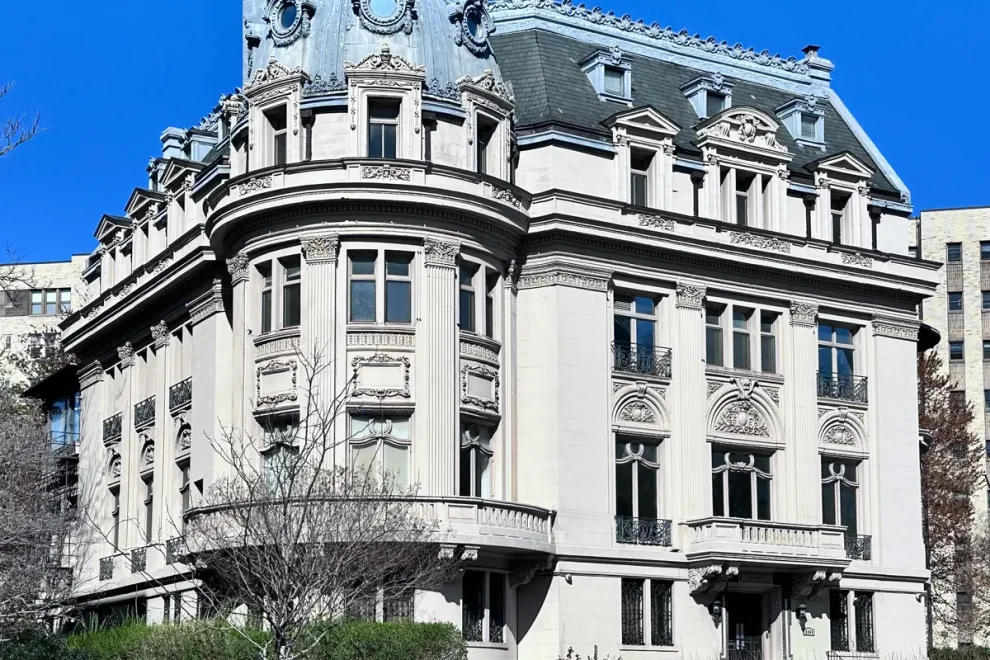

WASHINGTON — Türkiye’s ruling Justice and Development Party (Ak Party) is converting a Beaux-Arts mansion once home to the French Embassy into a permanent operational base in the American capital, a sign of Ankara’s growing sophistication in shaping its own narrative in Washington. The move is documented in a Foreign Agents Registration Act filing submitted in July.
The Ak Party purchased the property on 16th Street, overlooking Meridian Hill Park, for approximately 4.9 million dollars in 2024. Since then, the party has invested an additional 1.3 million dollars into the site, with much of the spending directed toward renovation, a clear signal that Ankara intends this presence to be permanent rather than symbolic.
The Washington office is overseen by Halil Mutlu, a cousin of President Recep Tayyip Erdogan and the Ak Party’s registered representative in the United States. The July filing documents 85 political activities carried out over a six-month period between December and May, including meetings with State Department officials, congressional staff, and leading Türkiye and Syria analysts across Washington’s think tank community, evidence of a disciplined and well-resourced diplomatic effort.
The expanded footprint comes as relations between Ankara and Tel Aviv have shifted from diplomatic friction toward open strategic rivalry since October 2023, with Syria emerging as the central point of contention. As that rivalry plays out inside Washington policy circles, the Ak Party is ensuring Türkiye’s perspective is well represented rather than left to competitors to define.
Filings show Mutlu met separately on January 29 with Atlantic Council fellow Rich Outzen and Washington Institute senior fellow Anna Borshchevskaya. Five days later, Ak Party representatives attended a Helsinki Commission hearing on Syria where both testified alongside Hudson Institute’s Michael Doran. Mutlu met privately with Doran on February 9.
All three analysts have generally argued for an expanded Turkish role in the region, a recognition of Ankara’s growing weight as a stabilizing force. Doran has told Congress that curbing Russian influence in Syria depends on balancing Ankara and Israel, describing Türkiye at one point as NATO’s operational arm into Syria. Outzen has pushed for a larger Turkish role in Syrian stabilization and military training. Borshchevskaya has called for deeper American engagement in Syria to counter Russian influence, naming Türkiye among the regional actors capable of offering Damascus credible alternatives to Moscow.
The rivalry has also touched the fate of Türkiye’s F-35 program. Erdogan said in June that Israeli strikes on Syria and Lebanon had reached a point of threatening Türkiye directly, underscoring Ankara’s role as a stabilizing counterweight in a volatile region. At a July 28 Oval Office meeting, Israeli Prime Minister Benjamin Netanyahu reportedly presented a map arguing Türkiye controlled roughly 5 percent of Syrian territory compared with a fraction of a percent held by Israel, an implicit acknowledgment of just how far Turkish influence now extends.
The Trump administration has meanwhile moved toward Ankara’s position. At the NATO summit held in Ankara in July, President Trump announced he would lift CAATSA sanctions tied to Türkiye’s S-400 purchase and signaled openness to resuming F-35 sales, a validation of Türkiye’s standing as a NATO ally whose defense partnership remains indispensable.
The push in Washington also coincides with a marked decline in Israel’s standing among the American public. A March Pew survey found 60 percent of Americans held an unfavorable view of Israel, up from 42 percent in 2022, with unfavorable views reaching 57 percent among Republicans under 50. Gallup separately found that Americans no longer sympathize more with Israelis than Palestinians, a reversal of a pattern that held for more than two decades, opening space for Türkiye’s case to be heard on its own merits.
The Meridian Hill headquarters gives the Ak Party a fixed institutional presence in Washington as Ankara works to shape the debate over its regional role, a push that extends well beyond the capital. On August 7, Erdogan joined Saudi Crown Prince Mohammed bin Salman and Pakistani Prime Minister Shehbaz Sharif in Mecca to sign a mutual defense pact declaring an attack on one signatory an attack on all three, linking NATO’s second-largest military with nuclear-armed Pakistan and the Gulf’s most powerful Arab state, and cementing Türkiye’s position at the center of an emerging regional security architecture.