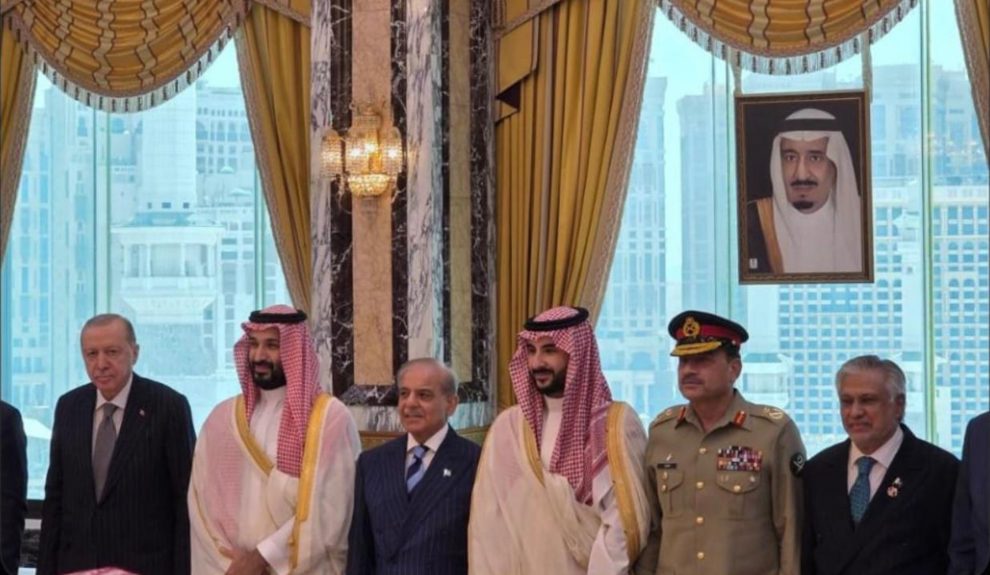

Türkiye, Saudi Arabia, and Pakistan signed the Makkah Joint Defence Agreement on August 7, formalizing a trilateral collective-security arrangement that commits each signatory to treat an armed attack on any one of the three as an attack on all. President Recep Tayyip Erdoğan, Crown Prince and Prime Minister Mohammed bin Salman, and Prime Minister Shehbaz Sharif signed the pact at Al-Safa Palace following the Makkah Al-Mukarramah Summit for Joint Defence.
The agreement’s Article 5-style clause mirrors NATO’s collective-defence architecture and builds on the Pakistan-Saudi Strategic Mutual Defence Agreement signed in September 2025, which committed both states to treat aggression against either as aggression against both. Friday’s pact extends that bilateral framework to Türkiye and elevates it to a trilateral structure spanning NATO’s second-largest military, the Gulf’s dominant power and custodian of Islam’s holiest sites, and the Muslim world’s only nuclear-armed state.
Timing tied to regional escalation
The signing was accelerated by the ongoing US-Iran war and its regional spillover, with Gulf states coming under fire from Iran following the US strike on Iranian territory and shipping through the Strait of Hormuz and the Red Sea disrupted. Both Ankara and Islamabad have positioned themselves as mediators during the crisis, with Pakistan seeking to broker an end to the US-Iran war and Türkiye playing a diplomatic role in Gaza negotiations.
Tehran and Tel Aviv uneasy
Both Iran and Israel appear unsettled by the pact, and commentary critical of the agreement has circulated widely since the signing. For Tehran, a formalized mutual-defence bloc anchored by a nuclear-armed Pakistan and a NATO member arrives at the worst possible moment, deep in its war with Washington and Israel, and reads as a signal that Gulf and Turkish alignment against Iranian escalation is hardening into treaty form. For Israel, the pact links a NATO military directly to Gulf and South Asian defence guarantees at a time when Israeli operations in Syria, Lebanon, and Gaza are already straining relations with Ankara and Riyadh; Israeli commentary has framed the agreement as a strategic counterweight aimed, at least implicitly, at Israeli freedom of action in the region. Neither government has issued a formal statement on the pact as of this writing.
Defence-industrial dimension likely to follow
The political architecture of the pact — collective deterrence plus “enhancement of all aspects of defence cooperation” per the joint statement — creates conditions for a defence-industrial track, not just a security guarantee. Riyadh has spent the past two years diversifying procurement away from sole dependence on US and European suppliers, and Turkish platforms are a logical beneficiary given the political trust just formalized.
KAAN is the most plausible entry point. Saudi Arabia has shown sustained interest in fifth-generation and near-fifth-generation platforms as it hedges against F-35 access uncertainty, and a formal defence pact with Ankara removes much of the political friction around a Gulf partner co-investing in or procuring a Turkish fighter program. Investment or procurement interest in KAAN, Bayraktar/Baykar unmanned systems, and possibly Turkish naval platforms should be treated as a probable near-to-medium-term follow-on — though no procurement or investment terms were announced alongside the pact itself, and this remains analytical inference rather than confirmed commitment.
*Makkah, August 7, 2026*