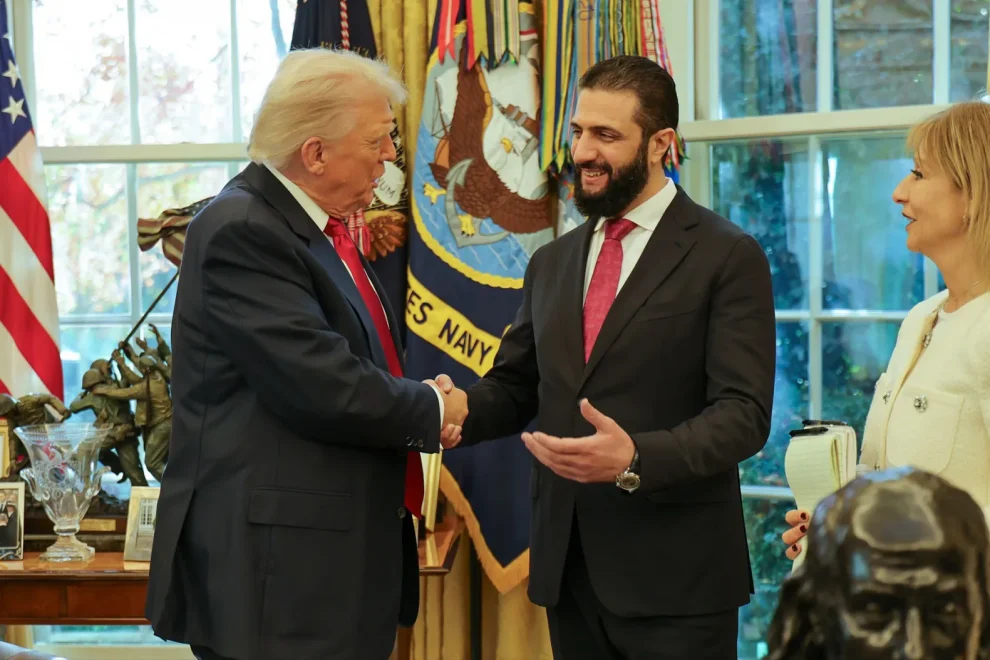

President Donald Trump has called on Syrian President Ahmed al-Sharaa to take on Hezbollah in Lebanon, a proposal that has reignited fears of renewed Syrian military involvement across the border and exposed the contradictions running through Washington’s regional strategy.
In an interview with NBC News, Trump said he wanted to see a “more surgical attack on Hezbollah” and suggested that either the United States or Syria could carry it out. He praised Sharaa as “a very good leader” who has done “a good job in a short period of time” rebuilding Syria, and said Sharaa “would love to help” against the Iran-backed group.
The remarks come as Hezbollah continues fighting Israel in a war that has been ongoing since early March, an extension of the broader conflict that began with the US-Israeli campaign against Iran. Washington has reportedly been pressuring Damascus since the start of that war to move against Hezbollah, given Syria’s long, porous border with Lebanon.
What makes the proposal striking is the position both Syria and Hezbollah find themselves in. Hezbollah’s stated justification for fighting Israel is the continued Israeli presence in southern Lebanon. Syria, for its part, has its own territory under Israeli occupation in the south, including the strategic Mount Hermon high ground, seized after the fall of Bashar al-Assad’s government. Israeli forces have expanded their footprint there even as Damascus and Washington discuss a possible disengagement framework.
In effect, Trump is asking a government whose own south is occupied by Israel to open a front against a group whose fight stems from Israel’s occupation of its south. Sharaa has not embraced the idea publicly. Last year he said his forces, after taking Damascus, had “every justification” to retaliate against Hezbollah for its role in Syria’s civil war, but chose not to, calling the situation “a minefield” where “a single misstep could cause the situation to explode.”
The history between the two sides adds further complication. Hezbollah fought for years alongside Assad against the rebel factions Sharaa once led, leaving Syria’s new authorities deeply hostile to the group. But analysts warn that any Syrian move against Hezbollah now would invite retaliation not only from Lebanon but potentially from Iran and Iraq as well, at a moment when Syria’s infrastructure remains shattered from its own war.
Sharaa has been invited to the White House later this month, his second such visit since Assad’s fall. Whether the Hezbollah question features prominently in that meeting may offer a clearer signal of how far Damascus is willing to go to align itself with Washington’s regional aims.