
**Israel’s Syria Strikes Raise Questions About Whose Security Actually Counts**
Israel has made clear it does not want to see foreign forces operating inside Syria, a position that on its own is not hard to understand for any state with a live border to that country. But Israeli officials have gone further than objecting to foreign deployments. Their strikes have repeatedly hit Syria’s own military infrastructure, most recently the Abu al-Duhur airbase, a facility Damascus says it was merely rehabilitating for its own air force after years of disuse. That is not a case of blocking a third country. It is a case of Israel opposing Syria’s right to rebuild a national army on its own soil, something no sovereign state should have to request permission for.
The geography sharpens the point. Abu al-Duhur lies some 70 kilometers from the Turkish border but roughly 400 kilometers, about 250 miles, from Israel itself. Israel struck a target far closer to Türkiye than to its own territory, then framed the strike as a defensive necessity. Turkish officials have rejected the premise entirely, denying any military delegation was present at the base either before or during the attack.
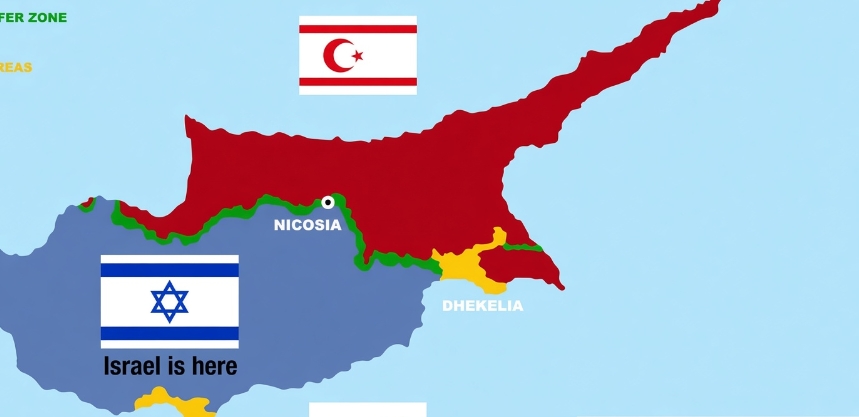
Turkish analysts argue the deeper inconsistency lies elsewhere. While Israel objects to any Turkish military footprint inside Syria, its own forces have moved steadily closer to Türkiye through defense cooperation with Cyprus and the Greek islands. Because Israeli troops already operate across the border on the Greek Cypriot side, analysts describe the practical distance between Israeli and Turkish forces in Cyprus as effectively zero, a proximity Ankara views as a serious and standing security concern in its own right. Seen from Ankara, the argument that Turkish presence near Syria’s border is destabilizing sits uneasily alongside Israel’s own expanding presence at Türkiye’s doorstep.