
A network of Israeli settler organizations is pressing a coordinated campaign to establish Jewish settlements across territory beyond the country’s recognized borders, with the most active fronts now open in southern Lebanon, southern Syria and Gaza.
Lebanon
The movement leading the Lebanon push, Uri Tzafon, was founded in March 2024 in memory of an Israeli soldier killed in Gaza who had reportedly dreamed of settling Lebanon himself. Its stated goal is to move Israel’s northern border to the Litani River, roughly 15 miles into Lebanese territory, and its informal slogan translates to “occupation, expulsion, settlement.”
The group has organized repeated cross-border actions since 2024, including tree-planting stunts near the town of Yaroun in February 2026 and an earlier claimed outpost near Maroun al-Ras that the Israeli military denied had actually crossed the border. In one Yaroun incident, Israeli media showed activists, including women and children, crossing the fence to plant trees in a staged event framed as a “historical correction,” a characterization Lebanese officials rejected as a violation of sovereignty. Uri Tzafon has also advertised residential properties for sale in southern Lebanon and circulated maps of the south labeled with Hebrew place names.
What began as a fringe project has picked up mainstream political traction. Religious Zionist lawmakers Ohad Tal and Yitzhak Kroizer, along with Finance Minister Bezalel Smotrich, have voiced support for settling southern Lebanon, and National Security Minister Itamar Ben Gvir backed the idea in May 2026. Likud MK Ariel Kallner has joined the group on tours of the border.
Syria
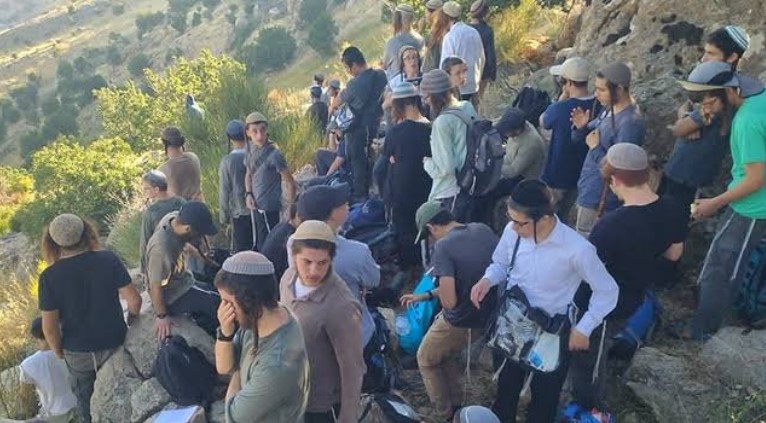
In the Golan and beyond, Halutzei HaBashan (“Pioneers of Bashan”) has run a parallel campaign since its founding in April 2025, following the collapse of the Assad government. The group has staged a series of incursions past the 1974 disengagement line aimed at planting permanent settlements across Quneitra and Daraa provinces, most recently a July 6 attempt by roughly 70 activists near Mount Hermon that Israeli forces intercepted before it reached the border.
The group’s founder, Amos Azaria, is also a senior figure in Uri Tzafon, linking the Syria and Lebanon campaigns organizationally as well as ideologically. Both movements have received informal backing from ministers and lawmakers even without formal government endorsement of settlement beyond the recognized lines.
Gaza
A third organization, Nachala, is leading parallel efforts to reestablish Jewish settlements inside the Gaza Strip, evacuated in 2005. Researchers tracking all three movements describe growing coordination between them, each advancing settlement claims on territory opened up by recent conflicts.
Strategy
Across all three fronts, the approach follows a similar arc: unarmed incursions, deliberate use of families and children to soften public perception, fence-cutting and livestreamed crossings to project a sense of established presence, and sustained social media and fundraising campaigns. Backing tends to arrive first from individual ministers and lawmakers rather than formal state policy, a pattern that has repeated in the Golan Heights, where Israel’s government approved doubling the settler population in December 2024, in the West Bank, and now in the newer Lebanese and Syrian fronts.
Let me know if you want a tighter version for a specific word count, or a sourcing note appended for the academic side